Voyager-1 to hit one light-day distance mark on Wednesday, create space record
Launched in 1977, Nasa's Voyager-1 is nearing a distance of 25.9 billion kilometres from Earth, where radio messages will take a full day to reach it.
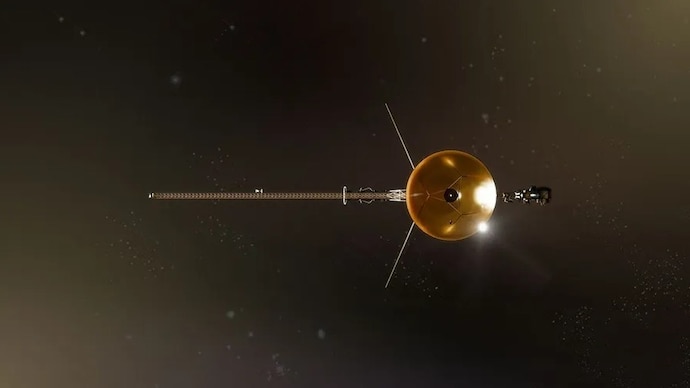
Nearly 50 years after leaving Earth, Nasa's Voyager 1 spacecraft is approaching a milestone no human-made object has ever achieved — travelling one light-day away from our planet.
Nasa expects Voyager 1 to reach the one-light-day milestone at around 3:46 pm IST on Wednesday, November 18, when it will be approximately 25.9 billion kilometres from Earth.
A light day is the distance light travels in 24 hours. At that distance, even a radio message travelling at the speed of light would take an entire day to reach Voyager 1, with another day needed for its reply to return.
The milestone will mark another remarkable achievement for humanity's most far-travelling spacecraft, which has continued exploring space long after its original mission ended.
WHAT IS VOYAGER 1?
Voyager 1 was launched by the US space agency Nasa on September 5, 1977, to study the outer planets of our solar system, particularly Jupiter and Saturn.
During its journey, it sent back detailed observations of both planets, including their moons, rings and atmospheres, and also helped scientists discover new moons and understand previously unknown features of these distant worlds.
The spacecraft completed its planetary exploration and continued travelling beyond the outer planets, eventually reaching interstellar space in August 2012.
This is the region beyond the protective bubble of particles and magnetic fields created by the Sun.
WHY DOES TRAVELLING ONE-LIGHT DAY AWAY MATTERS?
Voyager 1 is now the most distant human-made object in existence.
Reaching one light-day will be another first, highlighting just how far human exploration has travelled.
The spacecraft is moving at around 61,000 kmph, but even at that speed, it has taken nearly five decades to reach this distance.
Voyager 1 also carries a Golden Record, a gold-plated disc containing sounds, music, images and greetings in 55 languages, intended as a message from Earth to any intelligent life that might encounter it.
Despite its age, the spacecraft continues to send scientific information back to Earth.
Its journey is a reminder of how a mission designed to explore two distant planets became one of humanity's longest-running journeys into space.

