How Gen Z rebelled against Bhakts at home to reach Jantar Mantar
Before they challenged the government at New Delhi's Jantar Mantar over the NEET paper leaks and irregularities in the education system, many young protesters first challenged the politics inside their own homes. Some arrived with bandaged hands. Others hid behind masks. Many carried unanswered calls from their BJP-supporting parents.
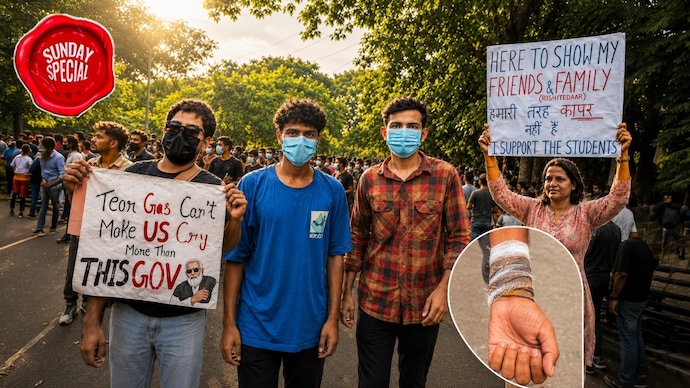
The first battle of Rishab's protest was not fought at New Delhi's Jantar Mantar. It was fought inside his own home in Bihar's Patna Sahib. By the time the 21-year-old stepped onto New Delhi's Sansad Marg with a backpack slung over one shoulder and a trolley bag trailing behind him, his right hand was already wrapped in a bandage. The wound had nothing to do with police barricades or clashes on the streets. It was the mark of a confrontation with his father.
"My father is a BJP supporter. He was completely against my coming to Delhi for the protest," Rishab told India Today Digital. "He pushed me in anger, and I injured my hand," he revealed.
But the injury caused by the fight with his father did not stop Rishab. Neither could his parents persuade him to stay back at home. "I left home despite my father's opposition. Now that I am here, I won't return until the students' demands are fulfilled," Rishab said.
With him walked three of his cousins, Shivam, Sanket and Nishant, each hauling suitcases of their own. Like Rishab, they too had left homes where the Bharatiya Janata Party (BJP) is more than just a political preference. It is part of the family's identity. "Our parents are the BJP's and Prime Minister Narendra Modi's bhakts," Shivam told India Today Digital.
Bhakt literally means "devotee". The term is often satirically used by the BJP's critics to describe the party's staunch supporters, who are blind to its failings.
"A BJP MLA's daughter had also taken part in the Cockroach Janta Party protest. She had shared an image through her Instagram story, but it was later deleted. It is possible that her MLA father would have got it deleted," Kuldeep Mishra, Executive Editor of The Lallantop, India Today Digital's sister media outlet, said on the recent Netanagri weekly show.
For many of the young people who reached New Delhi's Jantar Mantar, the battle did not begin at the protest site. It began at home. It was between the elders of the family, mostly parents, determined to stop their children from joining the protest at Jantar Mantar and the Gen Z youths refusing to stay away.
India Today Digital had earlier reported on how, for many students, the first protest began at home before they ever reached Jantar Mantar. This report focusses on a more specific aspect of young protesters from BJP-supporting families, and how they defied, negotiated with, or persuaded their parents to make the journey to the protest site in New Delhi.
These young people from families supporting the BJP, the party in power, were among the tens of thousands of protesters who had descended upon Jantar Mantar to take part in the protest led by the Cockroach Janta Party. As a result of the protests, Union Education Minister Dharmendra Pradhan was forced to tender his resignation on Saturday.
CJP PROTEST IS WITNESSING HUGE TURNOUT AFTER JULY 20
For more than a month, the CJP, a satirical outfit born out of controversial remarks by Chief Justice of India (CJI) Surya Kant, had been occupying a corner of Delhi's Jantar Mantar. The CJP, founded by Abhijeet Dipke, was demanding Pradhan's resignation over the NEET-UG 2026 question paper leak. The sit-in protest entered the national spotlight when social activist Sonam Wangchuk announced an indefinite hunger strike, demanding Pradhan's resignation.
Wangchuk ended his 26-day fast on Friday, but the movement he helped amplify gew only bigger. What was once a tightly managed protest confined to Jantar Mantar spilt onto the streets beyond Jantar Mantar, with crowds growing far larger than anyone would have anticipated.
The inflection point came after police used lathis, pellet guns and tear gas to disperse protesters during the July 20 Parliament march. What had begun as frustration over alleged failures in the education system quickly transformed into anger over the response of police. Since July 20, the protest drew fresh waves of students and young people every day, many saying they came not only because of the original demands, but because of the brutality by Delhi Police and Rapid Action Force (RAF) personnel.
PROTESTERS WITH MASK, HIDING FROM THEIR BJP-SUPPORTING PARENTS
Amid the swelling crowd was 22-year-old Anand, a BCA graduate from Bihar, studying in Delhi. Despite the scorching heat, Anand hid behind a mask at the protest site. Joined by two friends, the 19-year-old admitted that he was wearing the mask not because he was scared of being identified by Delhi Police or the RAF, but because of his parents.
"My parents support the BJP. I'm wearing a mask so they don't find out that I'm at the protest site," Anand told India Today Digital on July 24. His phone, he said, had been ringing constantly since the morning. His parents, who live in Bihar, repeatedly urged him to stay away from Jantar Mantar. "They kept calling me, telling me not to visit Jantar Mantar and join in protests. But this protest is about our future. I needed to be here," Anand said.
While most parents might be asking their children to stay away from Jantar Mantar, fearing violence, India Today Digital met several young protesters who had to revolt at home to participate in the protest because their families supported the BJP. Many others, like Anand, might not have wanted to provoke unwanted reaction because they knew the political allegiance of their family members.
At Jantar Mantar, the mask had acquired a meaning beyond anonymity. For some, it was a shield against possible police action. For many, it was protection from recognition by parents who would be watching the happenings of the protest on their mobile phones or through television coverage.
Several students said their families were also deeply worried about their safety, fearing they could get caught in violence and get injured if they joined the protest. Those concerns prompted many of them to wear face masks at the protest site, not only to protect their identities, but also to ensure that their parents wouldn't recognise them in photographs or videos.
Himanshu Sharma from Delhi, another young protester who used a mask to conceal his identity, revealed that his disguising attempt also had to do with parents' fear and their political leanings.
"My parents are kattar (staunch) BJP supporters. I haven't even told them that I've come to the protest site," Sharma told India Today Digital. Then came the sentence that perhaps best captured the widening political fault line running through many Indian households at the moment.
"I have one message for my parents. It is because of their wrong decision and supporting the wrong party that I'm protesting here today," Sharma said.
His friends had a different story to tell. Ankit Kumar and Sakiv had travelled with Sharma but without the need to hide. "We don't need masks. We're not scared of anyone," Ankit said. "Our parents know we're here, and they support us protesting at Jantar Mantar," he added.
The contrast played out repeatedly across the protest site. In one group, young demonstrators tightened their masks whenever cameras approached, anxious that an image broadcast on prime-time news or viral Instagram Reels might travel back to their parents or their relatives. In another,
BEYOND BJP, THE CONCERN OF PARENTS FOR THEIR KIDS
Not every BJP-supporting household responded with confrontation. Amid the stories of bruises, secrecy and deception were quieter conversations where politics gave way to parenthood.
Ayush Kumar, another protester from Bihar, said he informed his parents before leaving for Jantar Mantar, despite knowing they were BJP supporters. He had expected an argument. Instead, he received something closer to reluctant acceptance.
"My parents support the BJP, but they didn't stop me from coming here," Ayush told India Today Digital. What surprised him even more was their parting message.
"They told me, 'There is no need to return home. Stay there if you have to. Just take care of yourself," Ayush said.
For him, the political disagreement remained, but it did not outweigh his parents' concern for his safety.
RSS-AFFILIATED FATHER AND HIS LESSON OF DEMOCRACY
A few metres away from Ayush Kumar stood Arpana from Delhi's Bypass area, carrying a story that reflected a similar contradiction to Ayush's.
Arpana's father is associated with the Rashtriya Swayamsevak Sangh (RSS), the ideological fountainhead of the BJP. She hesitated for days before asking for permission, convinced the answer would be an outright "no".
Instead, she got a lesson in democracy. "When I asked my father if I could come to Jantar Mantar, he immediately agreed. I was genuinely surprised," Arpana told India Today Digital.
According to her, her father's response has stayed with her. "He told me, 'Protesting is your right. I cannot stop you from protesting. Go and join the others. Just stay safe," Arpana told India Today Digital.
If Rishab's home had become a battleground, Arpana's became proof that political disagreement and democratic dissent could still coexist under the same roof.
Standing beside her was 19-year-old Suhani, whose story once again had the secret script. Her family may not identify with the BJP, she said, but they admire Prime Minister Narendra Modi and would never have allowed her to join the demonstrations against his government happening at Jantar Mantar.
"I came here without telling my parents. If I had informed them, they would have never let me come," Suhani told India Today Digital.
Across Jantar Mantar, these stories unfolded with remarkable regularity. Some students arrived carrying the scars of family confrontations. Others concealed their faces behind masks, hoping relatives watching television debates or scrolling through Instagram Reels would not recognise them. A few had parents who disagreed with their politics but still defended their right to protest. The movement had united thousands under a common cause, but each had travelled a different road to reach it.
For anyone walking through the protest site, the defining images of this agitation are not just the police barricades, the chants or the swelling crowds. They are also a bandaged hand from a fight at home, faces hidden behind masks to avoid being recognised by parents, unanswered phone calls, and families hundreds of kilometres away hoping their children will return.
Because for many of these young protesters, the hardest battle was never fought at Jantar Mantar. It was fought at home, against what they call their "Bhakt parents", long before they reached the protest site.
The first battle of Rishab's protest was not fought at New Delhi's Jantar Mantar. It was fought inside his own home in Bihar's Patna Sahib. By the time the 21-year-old stepped onto New Delhi's Sansad Marg with a backpack slung over one shoulder and a trolley bag trailing behind him, his right hand was already wrapped in a bandage. The wound had nothing to do with police barricades or clashes on the streets. It was the mark of a confrontation with his father.
"My father is a BJP supporter. He was completely against my coming to Delhi for the protest," Rishab told India Today Digital. "He pushed me in anger, and I injured my hand," he revealed.
But the injury caused by the fight with his father did not stop Rishab. Neither could his parents persuade him to stay back at home. "I left home despite my father's opposition. Now that I am here, I won't return until the students' demands are fulfilled," Rishab said.
With him walked three of his cousins, Shivam, Sanket and Nishant, each hauling suitcases of their own. Like Rishab, they too had left homes where the Bharatiya Janata Party (BJP) is more than just a political preference. It is part of the family's identity. "Our parents are the BJP's and Prime Minister Narendra Modi's bhakts," Shivam told India Today Digital.
Bhakt literally means "devotee". The term is often satirically used by the BJP's critics to describe the party's staunch supporters, who are blind to its failings.
"A BJP MLA's daughter had also taken part in the Cockroach Janta Party protest. She had shared an image through her Instagram story, but it was later deleted. It is possible that her MLA father would have got it deleted," Kuldeep Mishra, Executive Editor of The Lallantop, India Today Digital's sister media outlet, said on the recent Netanagri weekly show.
For many of the young people who reached New Delhi's Jantar Mantar, the battle did not begin at the protest site. It began at home. It was between the elders of the family, mostly parents, determined to stop their children from joining the protest at Jantar Mantar and the Gen Z youths refusing to stay away.
India Today Digital had earlier reported on how, for many students, the first protest began at home before they ever reached Jantar Mantar. This report focusses on a more specific aspect of young protesters from BJP-supporting families, and how they defied, negotiated with, or persuaded their parents to make the journey to the protest site in New Delhi.
These young people from families supporting the BJP, the party in power, were among the tens of thousands of protesters who had descended upon Jantar Mantar to take part in the protest led by the Cockroach Janta Party. As a result of the protests, Union Education Minister Dharmendra Pradhan was forced to tender his resignation on Saturday.
CJP PROTEST IS WITNESSING HUGE TURNOUT AFTER JULY 20
For more than a month, the CJP, a satirical outfit born out of controversial remarks by Chief Justice of India (CJI) Surya Kant, had been occupying a corner of Delhi's Jantar Mantar. The CJP, founded by Abhijeet Dipke, was demanding Pradhan's resignation over the NEET-UG 2026 question paper leak. The sit-in protest entered the national spotlight when social activist Sonam Wangchuk announced an indefinite hunger strike, demanding Pradhan's resignation.
Wangchuk ended his 26-day fast on Friday, but the movement he helped amplify gew only bigger. What was once a tightly managed protest confined to Jantar Mantar spilt onto the streets beyond Jantar Mantar, with crowds growing far larger than anyone would have anticipated.
The inflection point came after police used lathis, pellet guns and tear gas to disperse protesters during the July 20 Parliament march. What had begun as frustration over alleged failures in the education system quickly transformed into anger over the response of police. Since July 20, the protest drew fresh waves of students and young people every day, many saying they came not only because of the original demands, but because of the brutality by Delhi Police and Rapid Action Force (RAF) personnel.
PROTESTERS WITH MASK, HIDING FROM THEIR BJP-SUPPORTING PARENTS
Amid the swelling crowd was 22-year-old Anand, a BCA graduate from Bihar, studying in Delhi. Despite the scorching heat, Anand hid behind a mask at the protest site. Joined by two friends, the 19-year-old admitted that he was wearing the mask not because he was scared of being identified by Delhi Police or the RAF, but because of his parents.
"My parents support the BJP. I'm wearing a mask so they don't find out that I'm at the protest site," Anand told India Today Digital on July 24. His phone, he said, had been ringing constantly since the morning. His parents, who live in Bihar, repeatedly urged him to stay away from Jantar Mantar. "They kept calling me, telling me not to visit Jantar Mantar and join in protests. But this protest is about our future. I needed to be here," Anand said.
While most parents might be asking their children to stay away from Jantar Mantar, fearing violence, India Today Digital met several young protesters who had to revolt at home to participate in the protest because their families supported the BJP. Many others, like Anand, might not have wanted to provoke unwanted reaction because they knew the political allegiance of their family members.
At Jantar Mantar, the mask had acquired a meaning beyond anonymity. For some, it was a shield against possible police action. For many, it was protection from recognition by parents who would be watching the happenings of the protest on their mobile phones or through television coverage.
Several students said their families were also deeply worried about their safety, fearing they could get caught in violence and get injured if they joined the protest. Those concerns prompted many of them to wear face masks at the protest site, not only to protect their identities, but also to ensure that their parents wouldn't recognise them in photographs or videos.
Himanshu Sharma from Delhi, another young protester who used a mask to conceal his identity, revealed that his disguising attempt also had to do with parents' fear and their political leanings.
"My parents are kattar (staunch) BJP supporters. I haven't even told them that I've come to the protest site," Sharma told India Today Digital. Then came the sentence that perhaps best captured the widening political fault line running through many Indian households at the moment.
"I have one message for my parents. It is because of their wrong decision and supporting the wrong party that I'm protesting here today," Sharma said.
His friends had a different story to tell. Ankit Kumar and Sakiv had travelled with Sharma but without the need to hide. "We don't need masks. We're not scared of anyone," Ankit said. "Our parents know we're here, and they support us protesting at Jantar Mantar," he added.
The contrast played out repeatedly across the protest site. In one group, young demonstrators tightened their masks whenever cameras approached, anxious that an image broadcast on prime-time news or viral Instagram Reels might travel back to their parents or their relatives. In another,
BEYOND BJP, THE CONCERN OF PARENTS FOR THEIR KIDS
Not every BJP-supporting household responded with confrontation. Amid the stories of bruises, secrecy and deception were quieter conversations where politics gave way to parenthood.
Ayush Kumar, another protester from Bihar, said he informed his parents before leaving for Jantar Mantar, despite knowing they were BJP supporters. He had expected an argument. Instead, he received something closer to reluctant acceptance.
"My parents support the BJP, but they didn't stop me from coming here," Ayush told India Today Digital. What surprised him even more was their parting message.
"They told me, 'There is no need to return home. Stay there if you have to. Just take care of yourself," Ayush said.
For him, the political disagreement remained, but it did not outweigh his parents' concern for his safety.
RSS-AFFILIATED FATHER AND HIS LESSON OF DEMOCRACY
A few metres away from Ayush Kumar stood Arpana from Delhi's Bypass area, carrying a story that reflected a similar contradiction to Ayush's.
Arpana's father is associated with the Rashtriya Swayamsevak Sangh (RSS), the ideological fountainhead of the BJP. She hesitated for days before asking for permission, convinced the answer would be an outright "no".
Instead, she got a lesson in democracy. "When I asked my father if I could come to Jantar Mantar, he immediately agreed. I was genuinely surprised," Arpana told India Today Digital.
According to her, her father's response has stayed with her. "He told me, 'Protesting is your right. I cannot stop you from protesting. Go and join the others. Just stay safe," Arpana told India Today Digital.
If Rishab's home had become a battleground, Arpana's became proof that political disagreement and democratic dissent could still coexist under the same roof.
Standing beside her was 19-year-old Suhani, whose story once again had the secret script. Her family may not identify with the BJP, she said, but they admire Prime Minister Narendra Modi and would never have allowed her to join the demonstrations against his government happening at Jantar Mantar.
"I came here without telling my parents. If I had informed them, they would have never let me come," Suhani told India Today Digital.
Across Jantar Mantar, these stories unfolded with remarkable regularity. Some students arrived carrying the scars of family confrontations. Others concealed their faces behind masks, hoping relatives watching television debates or scrolling through Instagram Reels would not recognise them. A few had parents who disagreed with their politics but still defended their right to protest. The movement had united thousands under a common cause, but each had travelled a different road to reach it.
For anyone walking through the protest site, the defining images of this agitation are not just the police barricades, the chants or the swelling crowds. They are also a bandaged hand from a fight at home, faces hidden behind masks to avoid being recognised by parents, unanswered phone calls, and families hundreds of kilometres away hoping their children will return.
Because for many of these young protesters, the hardest battle was never fought at Jantar Mantar. It was fought at home, against what they call their "Bhakt parents", long before they reached the protest site.
The first battle of Rishab's protest was not fought at New Delhi's Jantar Mantar. It was fought inside his own home in Bihar's Patna Sahib. By the time the 21-year-old stepped onto New Delhi's Sansad Marg with a backpack slung over one shoulder and a trolley bag trailing behind him, his right hand was already wrapped in a bandage. The wound had nothing to do with police barricades or clashes on the streets. It was the mark of a confrontation with his father.
"My father is a BJP supporter. He was completely against my coming to Delhi for the protest," Rishab told India Today Digital. "He pushed me in anger, and I injured my hand," he revealed.
But the injury caused by the fight with his father did not stop Rishab. Neither could his parents persuade him to stay back at home. "I left home despite my father's opposition. Now that I am here, I won't return until the students' demands are fulfilled," Rishab said.
With him walked three of his cousins, Shivam, Sanket and Nishant, each hauling suitcases of their own. Like Rishab, they too had left homes where the Bharatiya Janata Party (BJP) is more than just a political preference. It is part of the family's identity. "Our parents are the BJP's and Prime Minister Narendra Modi's bhakts," Shivam told India Today Digital.
Bhakt literally means "devotee". The term is often satirically used by the BJP's critics to describe the party's staunch supporters, who are blind to its failings.
"A BJP MLA's daughter had also taken part in the Cockroach Janta Party protest. She had shared an image through her Instagram story, but it was later deleted. It is possible that her MLA father would have got it deleted," Kuldeep Mishra, Executive Editor of The Lallantop, India Today Digital's sister media outlet, said on the recent Netanagri weekly show.
For many of the young people who reached New Delhi's Jantar Mantar, the battle did not begin at the protest site. It began at home. It was between the elders of the family, mostly parents, determined to stop their children from joining the protest at Jantar Mantar and the Gen Z youths refusing to stay away.
India Today Digital had earlier reported on how, for many students, the first protest began at home before they ever reached Jantar Mantar. This report focusses on a more specific aspect of young protesters from BJP-supporting families, and how they defied, negotiated with, or persuaded their parents to make the journey to the protest site in New Delhi.
These young people from families supporting the BJP, the party in power, were among the tens of thousands of protesters who had descended upon Jantar Mantar to take part in the protest led by the Cockroach Janta Party. As a result of the protests, Union Education Minister Dharmendra Pradhan was forced to tender his resignation on Saturday.
CJP PROTEST IS WITNESSING HUGE TURNOUT AFTER JULY 20
For more than a month, the CJP, a satirical outfit born out of controversial remarks by Chief Justice of India (CJI) Surya Kant, had been occupying a corner of Delhi's Jantar Mantar. The CJP, founded by Abhijeet Dipke, was demanding Pradhan's resignation over the NEET-UG 2026 question paper leak. The sit-in protest entered the national spotlight when social activist Sonam Wangchuk announced an indefinite hunger strike, demanding Pradhan's resignation.
Wangchuk ended his 26-day fast on Friday, but the movement he helped amplify gew only bigger. What was once a tightly managed protest confined to Jantar Mantar spilt onto the streets beyond Jantar Mantar, with crowds growing far larger than anyone would have anticipated.
The inflection point came after police used lathis, pellet guns and tear gas to disperse protesters during the July 20 Parliament march. What had begun as frustration over alleged failures in the education system quickly transformed into anger over the response of police. Since July 20, the protest drew fresh waves of students and young people every day, many saying they came not only because of the original demands, but because of the brutality by Delhi Police and Rapid Action Force (RAF) personnel.
PROTESTERS WITH MASK, HIDING FROM THEIR BJP-SUPPORTING PARENTS
Amid the swelling crowd was 22-year-old Anand, a BCA graduate from Bihar, studying in Delhi. Despite the scorching heat, Anand hid behind a mask at the protest site. Joined by two friends, the 19-year-old admitted that he was wearing the mask not because he was scared of being identified by Delhi Police or the RAF, but because of his parents.
"My parents support the BJP. I'm wearing a mask so they don't find out that I'm at the protest site," Anand told India Today Digital on July 24. His phone, he said, had been ringing constantly since the morning. His parents, who live in Bihar, repeatedly urged him to stay away from Jantar Mantar. "They kept calling me, telling me not to visit Jantar Mantar and join in protests. But this protest is about our future. I needed to be here," Anand said.
While most parents might be asking their children to stay away from Jantar Mantar, fearing violence, India Today Digital met several young protesters who had to revolt at home to participate in the protest because their families supported the BJP. Many others, like Anand, might not have wanted to provoke unwanted reaction because they knew the political allegiance of their family members.
At Jantar Mantar, the mask had acquired a meaning beyond anonymity. For some, it was a shield against possible police action. For many, it was protection from recognition by parents who would be watching the happenings of the protest on their mobile phones or through television coverage.
Several students said their families were also deeply worried about their safety, fearing they could get caught in violence and get injured if they joined the protest. Those concerns prompted many of them to wear face masks at the protest site, not only to protect their identities, but also to ensure that their parents wouldn't recognise them in photographs or videos.
Himanshu Sharma from Delhi, another young protester who used a mask to conceal his identity, revealed that his disguising attempt also had to do with parents' fear and their political leanings.
"My parents are kattar (staunch) BJP supporters. I haven't even told them that I've come to the protest site," Sharma told India Today Digital. Then came the sentence that perhaps best captured the widening political fault line running through many Indian households at the moment.
"I have one message for my parents. It is because of their wrong decision and supporting the wrong party that I'm protesting here today," Sharma said.
His friends had a different story to tell. Ankit Kumar and Sakiv had travelled with Sharma but without the need to hide. "We don't need masks. We're not scared of anyone," Ankit said. "Our parents know we're here, and they support us protesting at Jantar Mantar," he added.
The contrast played out repeatedly across the protest site. In one group, young demonstrators tightened their masks whenever cameras approached, anxious that an image broadcast on prime-time news or viral Instagram Reels might travel back to their parents or their relatives. In another,
BEYOND BJP, THE CONCERN OF PARENTS FOR THEIR KIDS
Not every BJP-supporting household responded with confrontation. Amid the stories of bruises, secrecy and deception were quieter conversations where politics gave way to parenthood.
Ayush Kumar, another protester from Bihar, said he informed his parents before leaving for Jantar Mantar, despite knowing they were BJP supporters. He had expected an argument. Instead, he received something closer to reluctant acceptance.
"My parents support the BJP, but they didn't stop me from coming here," Ayush told India Today Digital. What surprised him even more was their parting message.
"They told me, 'There is no need to return home. Stay there if you have to. Just take care of yourself," Ayush said.
For him, the political disagreement remained, but it did not outweigh his parents' concern for his safety.
RSS-AFFILIATED FATHER AND HIS LESSON OF DEMOCRACY
A few metres away from Ayush Kumar stood Arpana from Delhi's Bypass area, carrying a story that reflected a similar contradiction to Ayush's.
Arpana's father is associated with the Rashtriya Swayamsevak Sangh (RSS), the ideological fountainhead of the BJP. She hesitated for days before asking for permission, convinced the answer would be an outright "no".
Instead, she got a lesson in democracy. "When I asked my father if I could come to Jantar Mantar, he immediately agreed. I was genuinely surprised," Arpana told India Today Digital.
According to her, her father's response has stayed with her. "He told me, 'Protesting is your right. I cannot stop you from protesting. Go and join the others. Just stay safe," Arpana told India Today Digital.
If Rishab's home had become a battleground, Arpana's became proof that political disagreement and democratic dissent could still coexist under the same roof.
Standing beside her was 19-year-old Suhani, whose story once again had the secret script. Her family may not identify with the BJP, she said, but they admire Prime Minister Narendra Modi and would never have allowed her to join the demonstrations against his government happening at Jantar Mantar.
"I came here without telling my parents. If I had informed them, they would have never let me come," Suhani told India Today Digital.
Across Jantar Mantar, these stories unfolded with remarkable regularity. Some students arrived carrying the scars of family confrontations. Others concealed their faces behind masks, hoping relatives watching television debates or scrolling through Instagram Reels would not recognise them. A few had parents who disagreed with their politics but still defended their right to protest. The movement had united thousands under a common cause, but each had travelled a different road to reach it.
For anyone walking through the protest site, the defining images of this agitation are not just the police barricades, the chants or the swelling crowds. They are also a bandaged hand from a fight at home, faces hidden behind masks to avoid being recognised by parents, unanswered phone calls, and families hundreds of kilometres away hoping their children will return.
Because for many of these young protesters, the hardest battle was never fought at Jantar Mantar. It was fought at home, against what they call their "Bhakt parents", long before they reached the protest site.

