Indian man in Germany says Europe's biggest advantage isn't salary. It's this...
An Indian man living in Germany said Europe's quality of life is shaped by people-first urban design. His video put the focus on public spaces, pedestrian safety and everyday infrastructure.
It's often the big things that dominate conversations about life in Europe, higher salaries, better healthcare and modern infrastructure.
But for one Indian living in Germany, the real difference lies in something far simpler: the footpaths people walk on, the parks they relax in and cities designed with pedestrians in mind rather than just cars.
Satyam Singh, an Indian content creator based in Germany, has sparked a conversation online after sharing a video explaining why he believes Europe's quality of life cannot be measured solely by economic indicators.
Instead, he argues, it is shaped by everyday infrastructure that makes daily life safer, calmer and more enjoyable.
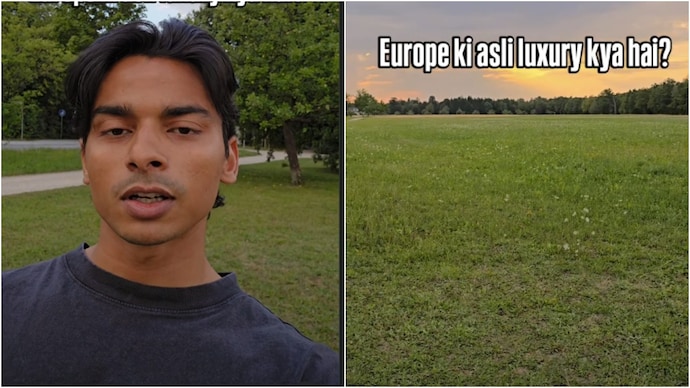
Filming from a park near his home, Singh pointed to the clean surroundings where children were playing, people were cycling and others were quietly spending time outdoors.
"The most interesting thing is that the infrastructure here is designed for people, not just for cars. The pavements are so wide that they sometimes seem wider than the roads themselves, and there are separate lanes for cyclists," he said.
He also praised the driving culture, noting that motorists patiently share the road with cyclists and stop at zebra crossings whenever pedestrians are crossing, regardless of whether traffic signals are present.
Watch the video:
The video's caption expanded on the same idea. In Hindi, Singh wrote: "Europe ki quality of life sirf salaries, buildings ya technology ki wajah se nahi hai (Europe's quality of life isn't just because of salaries, buildings or technology).”
He continued, "Kabhi-kabhi asli difference chhoti-chhoti cheezon mein hota hai; jaise public spaces, pedestrian safety, aur infrastructure jo insaan ko priority deta hai (Sometimes the real difference lies in small things, such as public spaces, pedestrian safety and infrastructure that prioritises people).”
Reflecting on his experience, Singh added,"Aaj main bas ek park mein baitha tha aur realise kiya ki yahan cities ka design logon ke liye hai: walking, cycling aur peacefully enjoy karne ke liye (Today, I was simply sitting in a park and realised that cities here are designed for people—to walk, cycle and enjoy life peacefully).”
He concluded with a line that resonated with many viewers: "Progress sirf bade projects se nahi dikhti kabhi-kabhi ek sidewalk bhi bahut kuch bata deta hai (Progress isn't visible only through big projects; sometimes even a sidewalk says a lot).”
The video has since prompted a wider discussion on social media, with many users agreeing that quality of life is often reflected in the everyday experience of using public spaces, rather than only in economic growth or large-scale development projects.
It's often the big things that dominate conversations about life in Europe, higher salaries, better healthcare and modern infrastructure.
But for one Indian living in Germany, the real difference lies in something far simpler: the footpaths people walk on, the parks they relax in and cities designed with pedestrians in mind rather than just cars.
Satyam Singh, an Indian content creator based in Germany, has sparked a conversation online after sharing a video explaining why he believes Europe's quality of life cannot be measured solely by economic indicators.
Instead, he argues, it is shaped by everyday infrastructure that makes daily life safer, calmer and more enjoyable.
Filming from a park near his home, Singh pointed to the clean surroundings where children were playing, people were cycling and others were quietly spending time outdoors.
"The most interesting thing is that the infrastructure here is designed for people, not just for cars. The pavements are so wide that they sometimes seem wider than the roads themselves, and there are separate lanes for cyclists," he said.
He also praised the driving culture, noting that motorists patiently share the road with cyclists and stop at zebra crossings whenever pedestrians are crossing, regardless of whether traffic signals are present.
Watch the video:
The video's caption expanded on the same idea. In Hindi, Singh wrote: "Europe ki quality of life sirf salaries, buildings ya technology ki wajah se nahi hai (Europe's quality of life isn't just because of salaries, buildings or technology).”
He continued, "Kabhi-kabhi asli difference chhoti-chhoti cheezon mein hota hai; jaise public spaces, pedestrian safety, aur infrastructure jo insaan ko priority deta hai (Sometimes the real difference lies in small things, such as public spaces, pedestrian safety and infrastructure that prioritises people).”
Reflecting on his experience, Singh added,"Aaj main bas ek park mein baitha tha aur realise kiya ki yahan cities ka design logon ke liye hai: walking, cycling aur peacefully enjoy karne ke liye (Today, I was simply sitting in a park and realised that cities here are designed for people—to walk, cycle and enjoy life peacefully).”
He concluded with a line that resonated with many viewers: "Progress sirf bade projects se nahi dikhti kabhi-kabhi ek sidewalk bhi bahut kuch bata deta hai (Progress isn't visible only through big projects; sometimes even a sidewalk says a lot).”
The video has since prompted a wider discussion on social media, with many users agreeing that quality of life is often reflected in the everyday experience of using public spaces, rather than only in economic growth or large-scale development projects.
It's often the big things that dominate conversations about life in Europe, higher salaries, better healthcare and modern infrastructure.
But for one Indian living in Germany, the real difference lies in something far simpler: the footpaths people walk on, the parks they relax in and cities designed with pedestrians in mind rather than just cars.
Satyam Singh, an Indian content creator based in Germany, has sparked a conversation online after sharing a video explaining why he believes Europe's quality of life cannot be measured solely by economic indicators.
Instead, he argues, it is shaped by everyday infrastructure that makes daily life safer, calmer and more enjoyable.
Filming from a park near his home, Singh pointed to the clean surroundings where children were playing, people were cycling and others were quietly spending time outdoors.
"The most interesting thing is that the infrastructure here is designed for people, not just for cars. The pavements are so wide that they sometimes seem wider than the roads themselves, and there are separate lanes for cyclists," he said.
He also praised the driving culture, noting that motorists patiently share the road with cyclists and stop at zebra crossings whenever pedestrians are crossing, regardless of whether traffic signals are present.
Watch the video:
The video's caption expanded on the same idea. In Hindi, Singh wrote: "Europe ki quality of life sirf salaries, buildings ya technology ki wajah se nahi hai (Europe's quality of life isn't just because of salaries, buildings or technology).”
He continued, "Kabhi-kabhi asli difference chhoti-chhoti cheezon mein hota hai; jaise public spaces, pedestrian safety, aur infrastructure jo insaan ko priority deta hai (Sometimes the real difference lies in small things, such as public spaces, pedestrian safety and infrastructure that prioritises people).”
Reflecting on his experience, Singh added,"Aaj main bas ek park mein baitha tha aur realise kiya ki yahan cities ka design logon ke liye hai: walking, cycling aur peacefully enjoy karne ke liye (Today, I was simply sitting in a park and realised that cities here are designed for people—to walk, cycle and enjoy life peacefully).”
He concluded with a line that resonated with many viewers: "Progress sirf bade projects se nahi dikhti kabhi-kabhi ek sidewalk bhi bahut kuch bata deta hai (Progress isn't visible only through big projects; sometimes even a sidewalk says a lot).”
The video has since prompted a wider discussion on social media, with many users agreeing that quality of life is often reflected in the everyday experience of using public spaces, rather than only in economic growth or large-scale development projects.

