UP man survives rare surgery after doctors remove 13 cm knife blade from chest
Doctors at KGMU in Lucknow removed a 13 cm knife blade lodged deep in a UP man's chest after an attack.
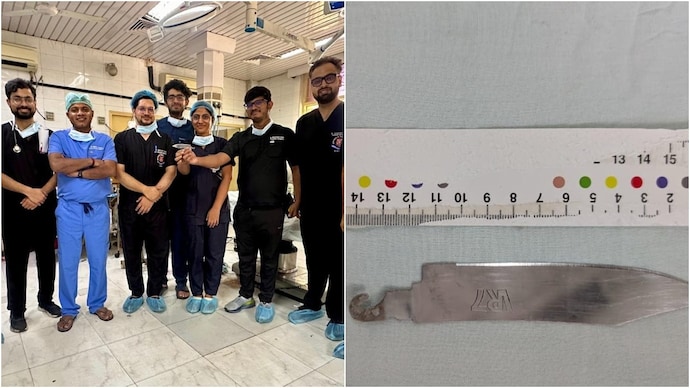
A 34-year-old man from Uttar Pradesh survived a life-threatening chest injury after doctors at Lucknow's King George's Medical University successfully removed a 13 cm knife blade lodged dangerously close to a major blood vessel near his lung.
The patient, identified as Sarvesh, was attacked with a sharp weapon in Lakhimpur Kheri on the night of July 4. The assault left a knife blade embedded deep inside the right side of his chest.
After receiving initial treatment at a local hospital, he was referred to KGMU's Trauma Centre in Lucknow and arrived there on the morning of July 5 in critical condition.
According to doctors, Sarvesh had severe internal bleeding and dangerously low blood pressure when he reached the emergency department. A CT scan revealed that the approximately 13 cm blade had penetrated up to the pulmonary hilum of the right lung — the region through which major blood vessels and airways pass.
The blade had also injured a branch of the pulmonary artery and stopped only a few millimetres away from the superior vena cava, one of the body's most important veins.
Medical experts said the situation was extremely high-risk. Any attempt to remove the blade prematurely could have triggered massive internal bleeding.
Instead of immediately extracting the weapon, the surgical team decided to leave it in place until they could safely control the surrounding blood vessels in the operating theatre. Doctors noted that in such injuries, an embedded object can sometimes act as a temporary seal, limiting blood loss.
The surgery was led by Dr Vaibhav Jaiswal, Additional Professor in the Department of Trauma Surgery, under the guidance of Professor Sameer Mishra. A multidisciplinary team, including trauma surgeons, cardiothoracic surgeons, anaesthetists, ICU specialists and nursing staff, participated in the procedure.
During the operation, doctors opened the patient's right chest and removed around 500 millilitres of accumulated blood and clots. Once bleeding was brought under control, the blade was carefully extracted. Surgeons then repaired the damaged branch of the pulmonary artery and were able to preserve the patient's lung.
Sarvesh is currently recovering in the intensive care unit and is reported to be responding well to treatment.
Doctors used the case to reiterate an important safety message: if a knife, metal rod or any sharp object becomes lodged in the body, it should not be removed outside a hospital setting, as doing so may worsen bleeding and significantly increase the risk of death.
(With inputs from Ravi Chaturvedi)
A 34-year-old man from Uttar Pradesh survived a life-threatening chest injury after doctors at Lucknow's King George's Medical University successfully removed a 13 cm knife blade lodged dangerously close to a major blood vessel near his lung.
The patient, identified as Sarvesh, was attacked with a sharp weapon in Lakhimpur Kheri on the night of July 4. The assault left a knife blade embedded deep inside the right side of his chest.
After receiving initial treatment at a local hospital, he was referred to KGMU's Trauma Centre in Lucknow and arrived there on the morning of July 5 in critical condition.
According to doctors, Sarvesh had severe internal bleeding and dangerously low blood pressure when he reached the emergency department. A CT scan revealed that the approximately 13 cm blade had penetrated up to the pulmonary hilum of the right lung — the region through which major blood vessels and airways pass.
The blade had also injured a branch of the pulmonary artery and stopped only a few millimetres away from the superior vena cava, one of the body's most important veins.
Medical experts said the situation was extremely high-risk. Any attempt to remove the blade prematurely could have triggered massive internal bleeding.
Instead of immediately extracting the weapon, the surgical team decided to leave it in place until they could safely control the surrounding blood vessels in the operating theatre. Doctors noted that in such injuries, an embedded object can sometimes act as a temporary seal, limiting blood loss.
The surgery was led by Dr Vaibhav Jaiswal, Additional Professor in the Department of Trauma Surgery, under the guidance of Professor Sameer Mishra. A multidisciplinary team, including trauma surgeons, cardiothoracic surgeons, anaesthetists, ICU specialists and nursing staff, participated in the procedure.
During the operation, doctors opened the patient's right chest and removed around 500 millilitres of accumulated blood and clots. Once bleeding was brought under control, the blade was carefully extracted. Surgeons then repaired the damaged branch of the pulmonary artery and were able to preserve the patient's lung.
Sarvesh is currently recovering in the intensive care unit and is reported to be responding well to treatment.
Doctors used the case to reiterate an important safety message: if a knife, metal rod or any sharp object becomes lodged in the body, it should not be removed outside a hospital setting, as doing so may worsen bleeding and significantly increase the risk of death.
(With inputs from Ravi Chaturvedi)

