Look ma, no magnets: How an Indian startup is using software to break China's rare earth monopoly
Meet the Bengaluru startup that wants to end China's hold on magnet-powered motors through deep-tech sovereignty and out of the box thinking.
In 2020, as the first wave of COVID-19 brought the global economy to its knees, Manish Seth, the CEO and co-founder of Vimag Labs, found himself face to face with a professional predicament. A shipment of magnets, crucial for the prototype motors his young Bengaluru-based startup was building, got stuck in a locked-down Shanghai port. It stayed there for three excruciating months. It was at this point, Seth, who had spent decades setting up manufacturing plants from scratch for the likes of Volkswagen, Ford, and General Motors, decided to take matters in his own hands.
“I had gone through that pain,” Seth tells India Today Tech. “At that point in time, I decided that we need to do something about it. And that’s how the idea of the total magnet-free, rare-earth-free motor started.”
The fuel tank and the engine are the most critical components in any internal combustion engine vehicle. In a modern electric vehicle (EV), these are replaced by a battery and a motor. The motor, paired with its control inverter, is literally where the rubber meets the road. It directly impacts efficiency, torque, acceleration, and—critically—how much range a vehicle can squeeze out of its battery. Historically, high-performance EV motors have relied heavily on permanent magnets.
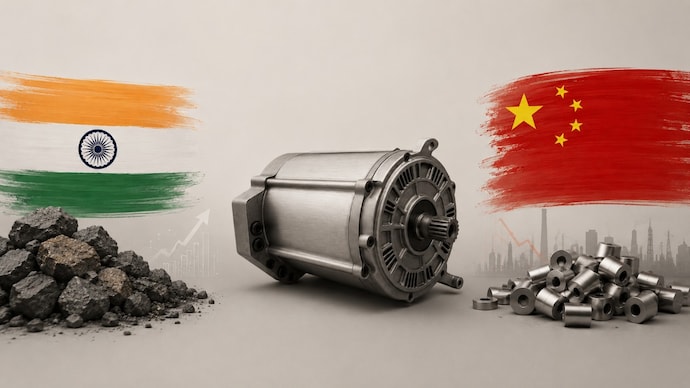
According to data from the International Energy Agency (IEA), China holds a near-monopoly on the supply chain, controlling roughly 90 percent of the world’s rare earth minerals and about 94 percent of the magnets (specifically Neodymium-Iron-Boron, or NdFeB magnets) used in high-power electric motors. Tightening export controls from Beijing have left India and the rest of the world vulnerable to supply shocks.
While other magnet-free alternatives exist—such as centuries-old AC induction motors or switched reluctance motors—they are often heavy, inefficient workarounds. Similarly, ferrite magnets (like the ones announced by Ola Electric) come with performance tradeoffs.
“You cannot substitute gold with aluminum,” Seth says bluntly. “You have to give something as worth of gold. Other magnet-free tech makes motors big. You cannot generate as much torque or power, and then you consume more batteries, so your range goes down. Global automotive and aerospace industries are not going to compromise on performance.”
Look ma, no magnets
Vimag Labs’ solution sidesteps this compromise entirely by turning to what the startup calls a software-defined magnet. Instead of embedding heavy, expensive, and geopolitically volatile rare earth magnets into the rotor of the motor, Seth’s team has stripped them out completely. In their place sits a precisely engineered arrangement of standard copper coils and steel, backed by a powerful suite of custom algorithms.
“Think of our technology as generating a software-defined magnet inside the motor,” Seth explains. “We remove permanent magnets, replace them with copper coils, and then through software, we generate magnetic fields inside the motor. The trick is how to convert the copper inside the motor into magnets, and that we do through software and electronics.”
The secret sauce lies in the motor’s firmware. When power leaves the vehicle’s battery packs, it doesn't travel into the motor through standard mechanical brushes or failure-prone slip rings. Instead, Vimag Labs’ proprietary architecture transfers the power wirelessly inside the motor itself, manipulating the electromagnetic spectrum much like a high-tech transformer. The firmware dynamically adjusts this power transfer, instantly turning the copper coils into highly tuned electromagnets that match—and sometimes beat—the performance of a conventional Permanent Magnet Synchronous Motor (PMSM).
Furthermore, because the magnetic field is altered in real time, the motor delivers a slightly higher driving range than standard PMSMs, effectively saving vehicle manufacturers money on expensive battery cells.
“If you drive a modern car, at least 20 percent of it is already software. Weapon systems, aerospace, the Apollo missions—they were all software-driven. Why? Because software is easier to control, adapt, and optimise,” Seth says reiterating that the digital backbone of their motor may well be its most potent superpower. “If you’re driving a traditional EV and the physical magnets get demagnetised due to heat or age, you are stuck. You cannot do anything. But if it’s software-defined, you can actively tune the magnetic field on the fly. You can keep improving the performance of the motor through over-the-air (OTA) software developments without ever changing the physical hardware.”
Necessity is the mother of invention
Clearly, the breakthrough couldn’t have come sooner. Nations worldwide are seeking resource sovereignty. While India has vast deposits of rare earth minerals underground, refining them into usable forms is incredibly challenging. This is the area where China historically excels.
Refining rare earth elements requires a process called leaching, where raw ore is dissolved in massive quantities of acid to isolate the heavy metals. A major byproduct of this process is thorium, a radioactive waste material that requires highly specialised, long-term containment. It is the main reason why most countries outsource their magnet manufacturing to China, preferring to offload—and confine—the environmental cost to places like the Baotou Lake in Mongolia rather than handle radioactive waste on their own soil.
“India can mine rare earth but developing the refining ecosystem is a 15-year project,” Seth points out. “It’s not easy.”
Meanwhile, rare earth prices remain wildly unstable, heavily influenced by export quotas set by Beijing. Prices have swung by 30 percent to 80 percent in a matter of months, in the past, at times skyrocketing to 1 million Chinese RMB per ton before settling back down. Also, with the meteoric rise of Artificial Intelligence demanding massive amounts of rare earths for data centre infrastructure and defense hardware, the supply available for commercial EVs, drones, and robotics is rapidly shrinking.
Because Vimag’s motor relies entirely on standard copper, steel, and conventional power electronics, it can be manufactured 100 percent within Indian borders today.
“As the electronics industry moves further, and as India invests heavily into chips through the India Semiconductor Mission, the cost of our motors is going to continuously go down,” says Seth. “We are electronics-dependent rather than rare-earth-dependent. Supply of rare earths is going to decrease globally, but the supply of semiconductors is only going to increase.”
The wheels are already in motion. The startup recently secured its fifth Indian patent for its proprietary Virtual Magnet Synchronous Motor (VMSM) platform. Currently, the technology makes the most economic sense for drivetrains rated above 3 to 5 kilowatts (kW), ruling out low-speed electric bicycles for now.
Certifications and technology integration take up extra time and effort (compared to permanent motor setups). “Instead of taking two months to integrate into a vehicle system, it takes us about four months because various components in the vehicle need to adapt,” Seth notes, though he emphasises this is far from a deal-breaker.
Currently, Vimag is focused on electric two- and three-wheeler ecosystems. Without revealing specific names, Seth confirmed that active testing is underway with a manufacturer in the top five of electric two-wheeler sales, alongside deep discussions with another player occupying the top two slots. The team has also collaborated with an “iconic, premium Indian heritage brand that recently made its foray into EVs,” Seth says.
Additionally, Vimag has partnered with a powertrain supplier that commands a massive 40 percent market share in the commercial three-wheeler space while co-developing a next-generation EV platform with one of India’s top two passenger car manufacturers. Simultaneously, the team is working with a Tier 1 automotive supplier in Europe to integrate their magnet-free motor into premium European and American electric cars.
“The products are actually in the real world right now,” Seth notes. “People can buy them, but because we are limited by supply, we are ramping up carefully. We expect to ship between 1,000 and 10,000 motors from our factory by the end of this year.”
To fuel this scaling phase, Vimag Labs is preparing to open a new investment round, coming off the back of a successful $5 million Series A funding led by venture capital firm Accel.
“Three years ago, people had no idea what we were talking about,” Seth says. “It was all about SaaS, delivery apps, or Bitcoin. But recently, the world realised that you cannot be dependent on foreign nations for critical, sovereign technologies. Because we took most of the fundamental technology risk out over the last five years, investors can see the test results and see how hungry the customers are.”
To ensure its proprietary winding and assembly techniques remain tightly controlled, Vimag has partnered with manufacturing automation specialist Jendamark to design and deploy specialised assembly lines. The startup currently employs 22 engineers spread across design centres in India, the United States, and Europe. The entire system is built around strict global automotive safety (ISO 26262) and US cybersecurity standards.
“Safety as a separate team does not work,” says Seth, who also serves as the de facto Chief Safety Officer. “It’s built directly into our design process as a Poka-yoke (mistake-proofing). If the code doesn't comply with global standards automatically, it simply cannot go through.”
Fasten your seatbelts
Currently, even a magnet-free motor relies on Microcontroller Units (MCUs) manufactured by a handful of global semiconductor giants like Texas Instruments, STMicroelectronics, and Renesas—and China has done very well by making copies of those chips. However, these off-the-shelf chips are fundamentally optimised to run permanent magnet motors.
“Using them for our new physics is like trying to force a square peg into a round hole,” Seth explains. “You have to spend valuable computing power grinding down the edges.”
Vimag’s roadmap includes designing its own Application-Specific Integrated Circuit (ASIC). This, too, like the motor would be virtual magnet based. By putting the entire intellectual property and value of the drivetrain on a single piece of proprietary silicon, the startup aims to eliminate the secondary supply chain bottleneck of global chip shortages. Internal estimates suggest that moving from general-purpose microcontrollers to a custom ASIC could slash the Bill of Materials (BOM) cost of the motor's electronics by nearly 90 percent.
The team is already building prototypes for electric trucks and heavy buses—a segment that demands massive torque without adding dead weight. It is also researching alternative conductor materials to replace copper, investigating how advanced inverters can enable seamless vehicle-to-grid (V2G) power sharing, and exploring how high-voltage Silicon Carbide (SiC) MOSFET architectures can be adapted to cool next-generation AI data centers.
In the next two to three months, the startup plans to engage with government agencies for potential military applications. “The team is in discussions with MeitY (Ministry of Electronics and Information Technology) on these magnet-free systems,” Seth shares. “Defense is a long-lead item with vastly different standards and requirements. Rather than getting distracted from scaling our current commercial product, we have parked it for a few months down the line.”
Taking inspiration from the cost-effective, high-impact innovation model of ISRO, Vimag wants to put India firmly on the map of global deep-tech innovation.
“You need double-digit million dollars to start, and after that, it's a standard CapEx topic. But money alone won’t cut it. You still need the right talent,” Seth concludes, noting that only four other large global conglomerates (ZF, Continental, Valeo, and Schaeffler) are working on similar tech. “The market is so big that Vimag Labs cannot satisfy it alone. That's something governments and investors need to look at. If done properly, it can generate immense returns.”
In 2020, as the first wave of COVID-19 brought the global economy to its knees, Manish Seth, the CEO and co-founder of Vimag Labs, found himself face to face with a professional predicament. A shipment of magnets, crucial for the prototype motors his young Bengaluru-based startup was building, got stuck in a locked-down Shanghai port. It stayed there for three excruciating months. It was at this point, Seth, who had spent decades setting up manufacturing plants from scratch for the likes of Volkswagen, Ford, and General Motors, decided to take matters in his own hands.
“I had gone through that pain,” Seth tells India Today Tech. “At that point in time, I decided that we need to do something about it. And that’s how the idea of the total magnet-free, rare-earth-free motor started.”
The fuel tank and the engine are the most critical components in any internal combustion engine vehicle. In a modern electric vehicle (EV), these are replaced by a battery and a motor. The motor, paired with its control inverter, is literally where the rubber meets the road. It directly impacts efficiency, torque, acceleration, and—critically—how much range a vehicle can squeeze out of its battery. Historically, high-performance EV motors have relied heavily on permanent magnets.
According to data from the International Energy Agency (IEA), China holds a near-monopoly on the supply chain, controlling roughly 90 percent of the world’s rare earth minerals and about 94 percent of the magnets (specifically Neodymium-Iron-Boron, or NdFeB magnets) used in high-power electric motors. Tightening export controls from Beijing have left India and the rest of the world vulnerable to supply shocks.
While other magnet-free alternatives exist—such as centuries-old AC induction motors or switched reluctance motors—they are often heavy, inefficient workarounds. Similarly, ferrite magnets (like the ones announced by Ola Electric) come with performance tradeoffs.
“You cannot substitute gold with aluminum,” Seth says bluntly. “You have to give something as worth of gold. Other magnet-free tech makes motors big. You cannot generate as much torque or power, and then you consume more batteries, so your range goes down. Global automotive and aerospace industries are not going to compromise on performance.”
Look ma, no magnets
Vimag Labs’ solution sidesteps this compromise entirely by turning to what the startup calls a software-defined magnet. Instead of embedding heavy, expensive, and geopolitically volatile rare earth magnets into the rotor of the motor, Seth’s team has stripped them out completely. In their place sits a precisely engineered arrangement of standard copper coils and steel, backed by a powerful suite of custom algorithms.
“Think of our technology as generating a software-defined magnet inside the motor,” Seth explains. “We remove permanent magnets, replace them with copper coils, and then through software, we generate magnetic fields inside the motor. The trick is how to convert the copper inside the motor into magnets, and that we do through software and electronics.”
The secret sauce lies in the motor’s firmware. When power leaves the vehicle’s battery packs, it doesn't travel into the motor through standard mechanical brushes or failure-prone slip rings. Instead, Vimag Labs’ proprietary architecture transfers the power wirelessly inside the motor itself, manipulating the electromagnetic spectrum much like a high-tech transformer. The firmware dynamically adjusts this power transfer, instantly turning the copper coils into highly tuned electromagnets that match—and sometimes beat—the performance of a conventional Permanent Magnet Synchronous Motor (PMSM).
Furthermore, because the magnetic field is altered in real time, the motor delivers a slightly higher driving range than standard PMSMs, effectively saving vehicle manufacturers money on expensive battery cells.
“If you drive a modern car, at least 20 percent of it is already software. Weapon systems, aerospace, the Apollo missions—they were all software-driven. Why? Because software is easier to control, adapt, and optimise,” Seth says reiterating that the digital backbone of their motor may well be its most potent superpower. “If you’re driving a traditional EV and the physical magnets get demagnetised due to heat or age, you are stuck. You cannot do anything. But if it’s software-defined, you can actively tune the magnetic field on the fly. You can keep improving the performance of the motor through over-the-air (OTA) software developments without ever changing the physical hardware.”
Necessity is the mother of invention
Clearly, the breakthrough couldn’t have come sooner. Nations worldwide are seeking resource sovereignty. While India has vast deposits of rare earth minerals underground, refining them into usable forms is incredibly challenging. This is the area where China historically excels.
Refining rare earth elements requires a process called leaching, where raw ore is dissolved in massive quantities of acid to isolate the heavy metals. A major byproduct of this process is thorium, a radioactive waste material that requires highly specialised, long-term containment. It is the main reason why most countries outsource their magnet manufacturing to China, preferring to offload—and confine—the environmental cost to places like the Baotou Lake in Mongolia rather than handle radioactive waste on their own soil.
“India can mine rare earth but developing the refining ecosystem is a 15-year project,” Seth points out. “It’s not easy.”
Meanwhile, rare earth prices remain wildly unstable, heavily influenced by export quotas set by Beijing. Prices have swung by 30 percent to 80 percent in a matter of months, in the past, at times skyrocketing to 1 million Chinese RMB per ton before settling back down. Also, with the meteoric rise of Artificial Intelligence demanding massive amounts of rare earths for data centre infrastructure and defense hardware, the supply available for commercial EVs, drones, and robotics is rapidly shrinking.
Because Vimag’s motor relies entirely on standard copper, steel, and conventional power electronics, it can be manufactured 100 percent within Indian borders today.
“As the electronics industry moves further, and as India invests heavily into chips through the India Semiconductor Mission, the cost of our motors is going to continuously go down,” says Seth. “We are electronics-dependent rather than rare-earth-dependent. Supply of rare earths is going to decrease globally, but the supply of semiconductors is only going to increase.”
The wheels are already in motion. The startup recently secured its fifth Indian patent for its proprietary Virtual Magnet Synchronous Motor (VMSM) platform. Currently, the technology makes the most economic sense for drivetrains rated above 3 to 5 kilowatts (kW), ruling out low-speed electric bicycles for now.
Certifications and technology integration take up extra time and effort (compared to permanent motor setups). “Instead of taking two months to integrate into a vehicle system, it takes us about four months because various components in the vehicle need to adapt,” Seth notes, though he emphasises this is far from a deal-breaker.
Currently, Vimag is focused on electric two- and three-wheeler ecosystems. Without revealing specific names, Seth confirmed that active testing is underway with a manufacturer in the top five of electric two-wheeler sales, alongside deep discussions with another player occupying the top two slots. The team has also collaborated with an “iconic, premium Indian heritage brand that recently made its foray into EVs,” Seth says.
Additionally, Vimag has partnered with a powertrain supplier that commands a massive 40 percent market share in the commercial three-wheeler space while co-developing a next-generation EV platform with one of India’s top two passenger car manufacturers. Simultaneously, the team is working with a Tier 1 automotive supplier in Europe to integrate their magnet-free motor into premium European and American electric cars.
“The products are actually in the real world right now,” Seth notes. “People can buy them, but because we are limited by supply, we are ramping up carefully. We expect to ship between 1,000 and 10,000 motors from our factory by the end of this year.”
To fuel this scaling phase, Vimag Labs is preparing to open a new investment round, coming off the back of a successful $5 million Series A funding led by venture capital firm Accel.
“Three years ago, people had no idea what we were talking about,” Seth says. “It was all about SaaS, delivery apps, or Bitcoin. But recently, the world realised that you cannot be dependent on foreign nations for critical, sovereign technologies. Because we took most of the fundamental technology risk out over the last five years, investors can see the test results and see how hungry the customers are.”
To ensure its proprietary winding and assembly techniques remain tightly controlled, Vimag has partnered with manufacturing automation specialist Jendamark to design and deploy specialised assembly lines. The startup currently employs 22 engineers spread across design centres in India, the United States, and Europe. The entire system is built around strict global automotive safety (ISO 26262) and US cybersecurity standards.
“Safety as a separate team does not work,” says Seth, who also serves as the de facto Chief Safety Officer. “It’s built directly into our design process as a Poka-yoke (mistake-proofing). If the code doesn't comply with global standards automatically, it simply cannot go through.”
Fasten your seatbelts
Currently, even a magnet-free motor relies on Microcontroller Units (MCUs) manufactured by a handful of global semiconductor giants like Texas Instruments, STMicroelectronics, and Renesas—and China has done very well by making copies of those chips. However, these off-the-shelf chips are fundamentally optimised to run permanent magnet motors.
“Using them for our new physics is like trying to force a square peg into a round hole,” Seth explains. “You have to spend valuable computing power grinding down the edges.”
Vimag’s roadmap includes designing its own Application-Specific Integrated Circuit (ASIC). This, too, like the motor would be virtual magnet based. By putting the entire intellectual property and value of the drivetrain on a single piece of proprietary silicon, the startup aims to eliminate the secondary supply chain bottleneck of global chip shortages. Internal estimates suggest that moving from general-purpose microcontrollers to a custom ASIC could slash the Bill of Materials (BOM) cost of the motor's electronics by nearly 90 percent.
The team is already building prototypes for electric trucks and heavy buses—a segment that demands massive torque without adding dead weight. It is also researching alternative conductor materials to replace copper, investigating how advanced inverters can enable seamless vehicle-to-grid (V2G) power sharing, and exploring how high-voltage Silicon Carbide (SiC) MOSFET architectures can be adapted to cool next-generation AI data centers.
In the next two to three months, the startup plans to engage with government agencies for potential military applications. “The team is in discussions with MeitY (Ministry of Electronics and Information Technology) on these magnet-free systems,” Seth shares. “Defense is a long-lead item with vastly different standards and requirements. Rather than getting distracted from scaling our current commercial product, we have parked it for a few months down the line.”
Taking inspiration from the cost-effective, high-impact innovation model of ISRO, Vimag wants to put India firmly on the map of global deep-tech innovation.
“You need double-digit million dollars to start, and after that, it's a standard CapEx topic. But money alone won’t cut it. You still need the right talent,” Seth concludes, noting that only four other large global conglomerates (ZF, Continental, Valeo, and Schaeffler) are working on similar tech. “The market is so big that Vimag Labs cannot satisfy it alone. That's something governments and investors need to look at. If done properly, it can generate immense returns.”

