
AI, influencers and the future of desire: Sukhnidh Kaur on what it means to be a woman online

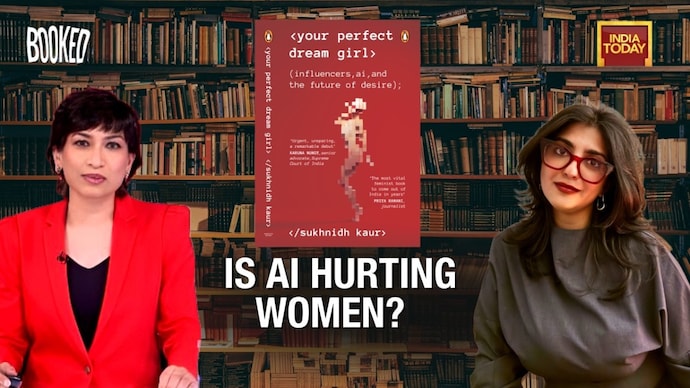
On Booked, Sukhnidh Kaur discussed how her book examines women, influencers and AI. She argued that platform power, deepfakes and AI companions are reshaping desire and control.

What does it mean to grow up as a woman in a world where visibility is currency, algorithms determine reach and artificial intelligence can recreate a person’s image without their consent?
On the latest edition of Booked, India Today’s Aneesha Mathur spoke to Sukhnidh Kaur about her book Your Perfect Dream Girl: Influencers, AI, and the Future of Desire, which examines the intersection of technology, gender, capitalism and human behaviour.
Drawing on her own experience of growing up online as well as her research into digital culture, Kaur argues that the internet has amplified problems women have faced for generations.
“There is no safe way for a woman to be visible on the internet,” she says, arguing that social-media platforms are not structurally designed to give women complete control over how their images travel or the narratives subsequently built around them.
One of the book’s central ideas is what Kaur calls “patriarchal techno-capitalism” — a system in which businesses build technologies that, in her assessment, profit from the consumption and commodification of women.
The conversation also turns to one of the most disturbing consequences of generative AI: sexually explicit deepfakes.
Kaur argues that calling such material “deepfake pornography” fails to adequately account for consent. She instead describes it as “deepfake sexual abuse material”, drawing a distinction between consensually created adult content and AI-generated imagery involving people who never agreed to participate.
But Kaur’s concern extends beyond explicit imagery.
She questions what happens to real-world relationships as AI companions increasingly allow users to construct partners who can satisfy their desires without possessing independent needs, expectations or agency.
“What happens to the women in your real life who do have needs, who do have wants?” she asks.
The book also challenges a commonly held assumption that greater visibility on platforms such as Instagram automatically translates into empowerment. While the internet has undeniably given millions of women access to audiences and economic opportunities previously unavailable to them, Kaur argues that this freedom continues to exist within boundaries established by platforms, algorithms, audiences and advertisers.
Another significant concern is whether regulation can keep pace with technological development.
Kaur says technology is advancing faster than laws and safety mechanisms, and argues that technology companies ultimately remain “profit by design”, with safety frequently added after products and business models have already been developed.
At its heart, Your Perfect Dream Girl asks a deceptively simple question: if technology is being built using the values, desires and prejudices of human society, can technology alone ever fix the problems it amplifies?