
Lotus: Once you look for it, you'll find it everywhere in Indic culture
Devdutt Pattanaik's new work explores the role of 'the flower of India' in fields as diverse as literature and mathematics.
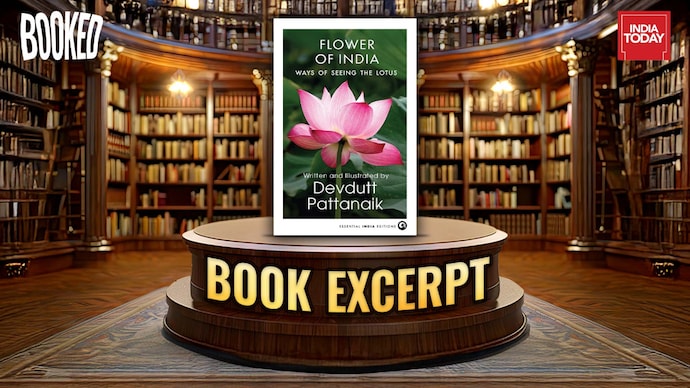

In Flower of India: Ways of Seeing the Lotus (Aleph Books), well-known mythologist Devdutt Pattanaik shows how pervasive and resonant a symbol the lotus is for Indian civilisation. He narrates how the lotus has shaped the nation’s cultural imagination in history, religion, art, and everyday life.
Here is an excerpt from the book:
Sanskrit Literature
Kalidasa, the famous Sanskrit playwright and poet who lived around Ujjain in 500 ce, uses the lotus in nearly every form—eyes, lips, breath, faces, rivers, even moods. In Kumarasambhava, Parvati’s eyes are compared to the trembling blue lotus, and her lips are imagined as honeyed lotus petals. Siva is likened to a bee tasting that sweetness. In Raghuvamsa and Vikramorvasiya, the lotus serves as the model for women’s faces and limbs. Kalidasa also connects the lotus with the cosmos: Brahma is called the ‘hundred-petalled one’ as he sits upon a lotus. The yaksha in Meghaduta is compared to a lotus closing at sunset, while the mingling of Ganga and Yamuna becomes a garland of white and blue lotuses.
Tamil Literature
‘Even if a fiery blaze singes and makes its life hell, Lotus doesn’t bloom but to the warm intimacy of the Sun; O lord of Vittuvacode, even if you do not save me from my burning ordeal, My heart will yield to no one else but to your infinite essence.’ This is a devotional hymn from 900 ce by Kulasekara Alwar.
‘As if long stemmed purple lilies and lotus knew for sure the misery of separation that awaited the lady and her husband, bees wailed mournfully shedding tears and the flowers quivered in sorrow.’ Here, the lotus and lilies are foretelling the fate that will befall Kannagi and Kovalan, right before they enter the city of Madurai. This is from the Cilappatikaram, written around 600 ce.
In Tamil literature, the lotus (malar) stands at the heart of natural and poetic imagination. Sangam poets paint tanks brimming with divine lotuses, humming with bees, glowing with pollen. Nallur Nattattanar in Cirpanatruppatai praises the lotus as the gods’ favourite flower. Kapilar compares the sweetness of noble friendship to honey drawn from lotus blossoms.
Paranar, called the Kalidasa of Tamil, crafted brilliant similes: flame-like lotus flowers, long stems, and broad leaves. In Akam poems, we see buffaloes plunging into tanks to feed on lotuses (metaphor for errant husbands), otters disturbing lotus creepers (metaphor for boisterous lovers), and maidens’ faces compared to full-blown blooms. Mamulanar and Mankuti Marutanar describe lotuses with thorny stems and fiery petals, while Marutam Patiya Ilamkatunko gives a full portrait—buds like spears, leaves like elephant ears, and roots that split the earth. The lotus was also linked with love and longing: women’s faces, eyes, and lips often carry lotus imagery in the Kalitokai. Unlike Sanskrit poets, Sangam poets rarely tied lotus to the Sun’s cycle, yet they captured every detail of its form and colour with astonishing realism.
Mathematics
While the Greeks had no terminology for denominations above the myriad (10,000), and the Romans above the mille (1,000), the ancient Hindus dealt freely with no less than eighteen denominations. And they used the lotus as a metaphor to indicate these high value numbers. The word ‘abja’ is equivalent to what is called a billion (1000,000,000) today while ‘padma’ refers to what will be called hundred trillion today (100,000,000,000,000). Both ‘abja’ and ‘padma’ are words for lotus flowers, suggesting the central thalamus of the lotus is seen as number 1, while the petals represent the number 0.
Freckles
The skin of Asian elephants is generally grey or dark grey, but the forehead, trunk, ears, and cheeks display pinkish or light-coloured patches, where pigment-producing cells (melanocytes) are less active or absent. This gives their head and trunk a spotted or mottled appearance. These marks become more visible with age and are unique to each elephant, much like freckles or fingerprints in humans. Since elephants are closely linked with lotus ponds, these pink marks are called ‘lotus marks’ or ‘padmaka’, as mentioned in the Sanskrit work, Naiadha-carita.
Beauty
In the Kusa Jataka, a prince named Kusa (whose name means grass) is born with a face like a lotus bud—ugly but radiant in virtue. His wife Pabhavati (whose name means radiance) is compared to a fully bloomed lotus, showing the tension between outer and inner beauty, a recurring Buddhist theme.
Impermanence
In the Abhinha Jataka, a young man earns his living by collecting lotuses for sale. The lotus fades away each time, which is why there is a daily demand for fresh flowers. He reflects on the impermanence of beauty and realizes that all worldly pleasures fade like the flowers he gathers. The lotus becomes a lesson in impermanence.
Character
In the Padakusalamanava Jataka, a young man is executed unjustly. When his head is severed, a lotus springs up where the blood falls, showing the triumph of innocence over violence.
In the Mahapaduma Jataka, when a virtuous man is exiled and later betrayed, his steadfastness is compared to a lotus unstained by mud, echoing the ideal of detached purity amidst corruption.