
Why a weak monsoon could deepen India's structural water crisis
India's big reservoirs are running well below last year and below normal across the east and south, after a June that delivered about a third less rain than usual. The strain lands on a country that is water-stressed by design as much as by drought.
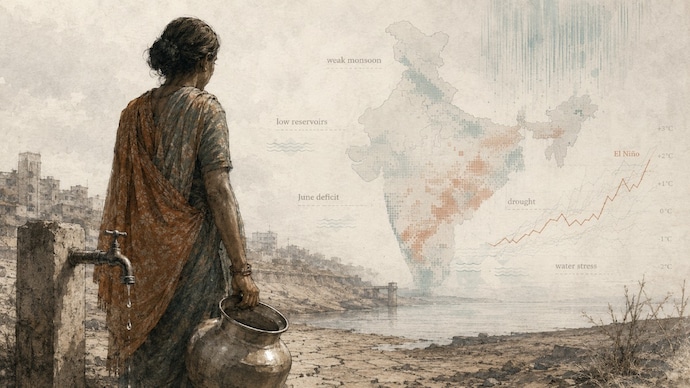

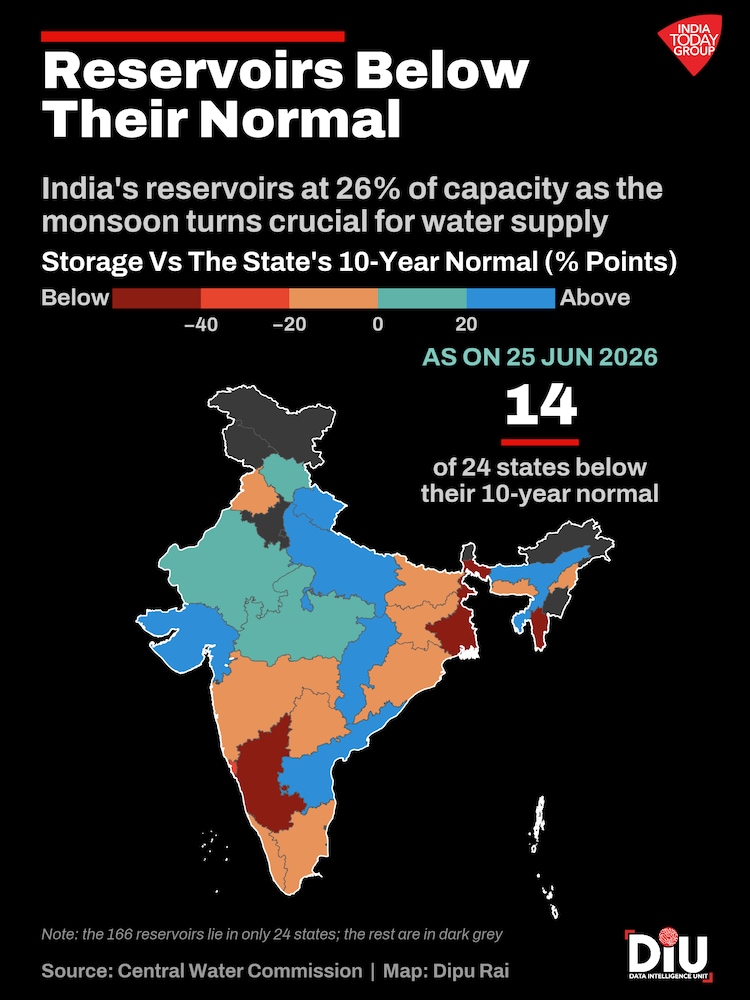
India's biggest reservoirs held 26.4 per cent of the combined live capacity on June 25, according to the Central Water Commission, which monitors 166 major reservoirs each week. That is close to the 10-year normal for late June but roughly 10 percentage points below where they stood a year ago.
In much of the country, the taps are already tightening: Mumbai has made low-pressure rationing a fixture of its summer calendar, and Pune has moved to alternate-day supply as its dams run low.
The national average is not the real alarm. A late-June low near the normal is what the calendar expects. The alarm is twofold: how far individual states have fallen below their own norm this year, and how little margin the country has to begin with.
India is home to about 18 per cent of the world's people but holds roughly four per cent of its fresh water, according to government estimates. Its average annual water availability has stayed below 1,700 cubic metres per person — the line the Falkenmark index uses to mark a water-stressed country — since 2011.
STATES RUNNING UNUSUALLY DRY
The CWC's 166 reservoirs sit in 24 states; India's four other states and its union territories have no major reservoirs in the set. Of those 24 states, 14 are below their own 10-year normal for the week.
West Bengal's reservoirs were 60 per cent below normal. Mizoram was down by 54 per cent, and Karnataka, 40 per cent. On the map, the deficit forms a band across the east and the southern peninsula, while parts of the north and west sit above normal.
THE REASON? BAD MONSOONS
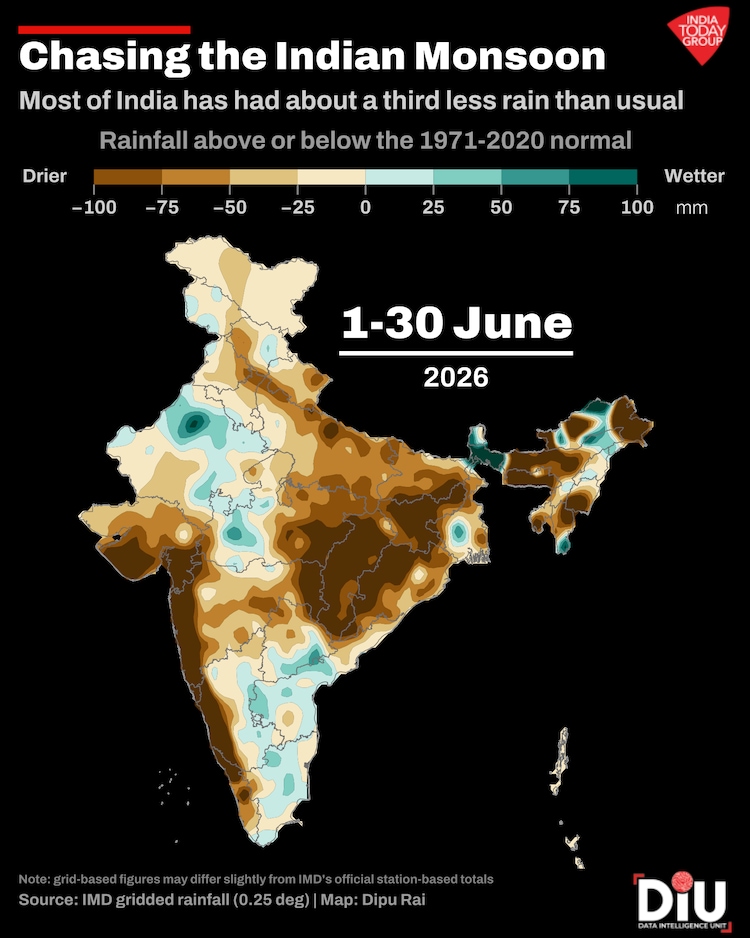
Reservoirs refill when the monsoon rains come, and this June they were thin. In June, India received about a third less rain than the 1971–2020 normal, according to IMD gridded data. This deficit is concentrated over central, eastern, and peninsular India. That is the same map as the reservoir shortfall, because it is the same weather.
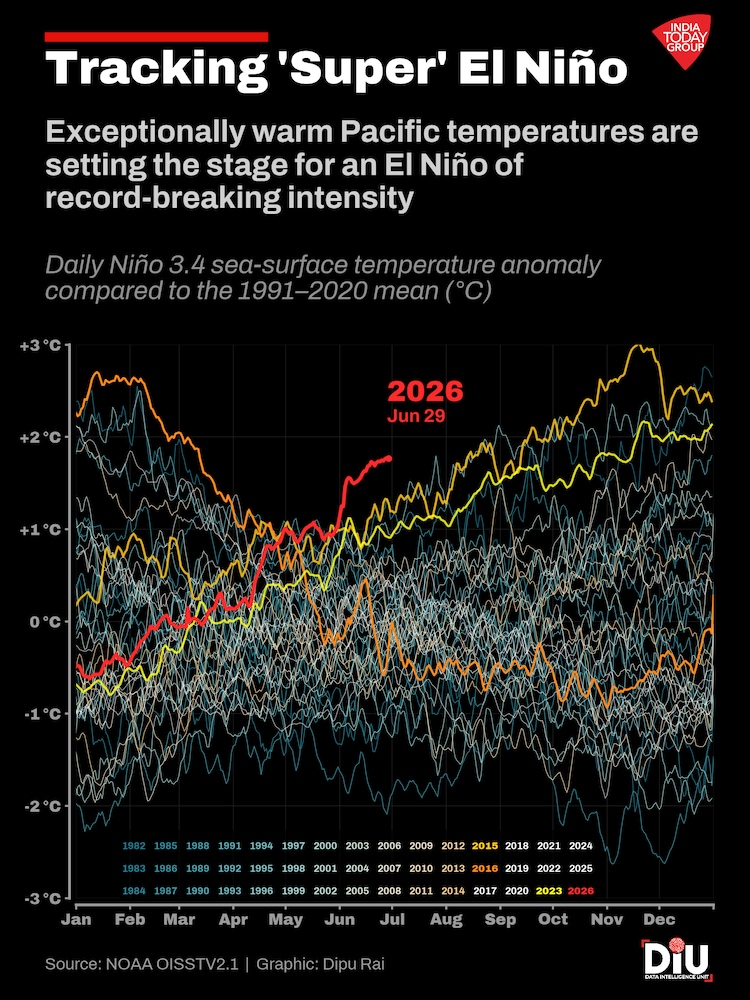
The wider setting is the Pacific Ocean, which warmed fast in 2026. The Nino 3.4 sea-surface temperature anomaly, the standard gauge of the El Nino–Southern Oscillation, reached about +1.8°C by June 29. It’s up from below zero at the start of the year, according to NOAA OISST data. A strong El Nino, edging toward the "super", ranges above +2°C.
El Nino years tend to weaken the Indian monsoon, and this June's deficit fits that pattern. It left less in the bank to carry the country to the heart of the season.
A CREEPING DROUGHT
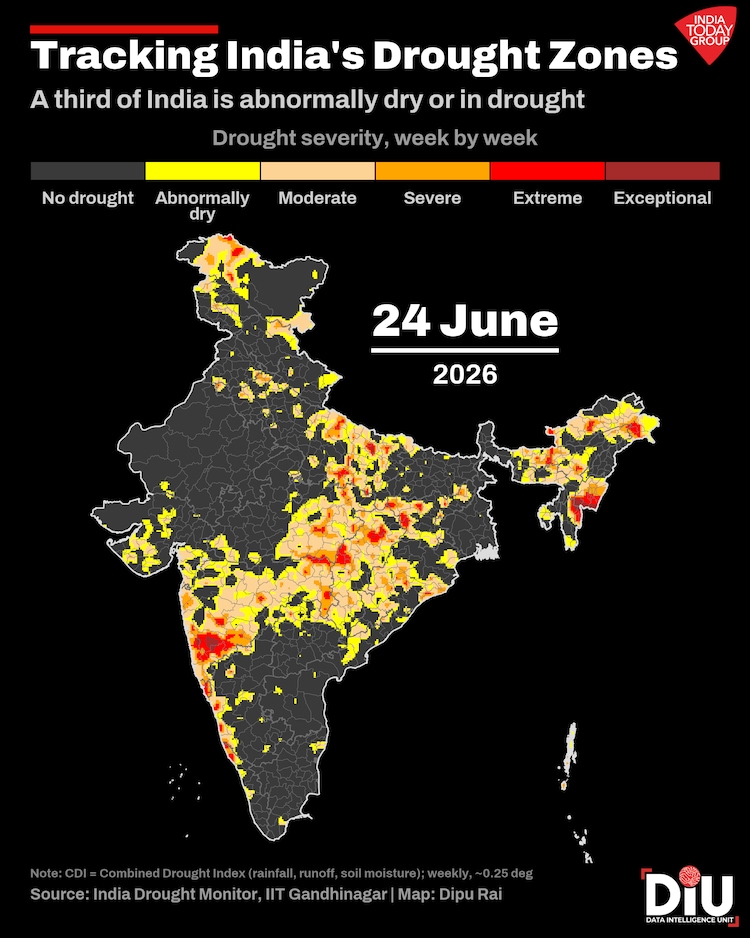
A dry June shows up quickly in the drought picture. The India Drought Monitor's Combined Drought Index, which blends rainfall, runoff, and soil moisture, has spread week by week through the season. By June 24, about 37 per cent of India was in some level of drought, with the sharpest patches in the south, east and north-east. Sensing the risk, the Union Agriculture Ministry has drawn up a contingency plan for 12 severely affected states and 326 districts.
WOULD A NORMAL MONSOON SETTLE IT?
A good July and August will refill the reservoirs and reset this year's count. But the deeper problem is not a single dry month. India uses the water it has poorly, and that is a matter of political economy, not rainfall.
Water-guzzling crops are grown in arid regions, lift irrigation runs on subsidised power, price is rarely used to ration demand, and water recycling is rarely mandated — even where it is feasible. Each is a policy choice, and together they turn a tight water balance into a recurring emergency.
The result is the "day zero" scenario that cities elsewhere have already reached: reservoirs empty, piped supply suspended, residents queuing at distribution points.
Cape Town came close in 2018, and Chennai in 2019, despite its own legally binding rainwater-harvesting rules. Day zero is rarely a single event. It is the end of a long process of rapid, unplanned urbanisation, heavy groundwater extraction and thin water management.
India's water poverty is also a problem of usability, not only quantity. Recent contamination in Indore and Ahmedabad, both ranked among the country's cleanest cities, is a warning: governance fixated on the "visible and aesthetic" neglects the invisible drainage and water systems, urban planning experts Ravi Bhushan and Purba Barua argue in the Economic and Political Weekly. Water experts such as Kaveh Madani describe the wider condition as “water bankruptcy”, a shortage built up by consuming more than the system can replenish, until water bodies lose the capacity to bounce back.
There are ways out. A more diversified economy, leaning less on water-intensive sectors, builds resilience against drought. In agriculture, the "evergreen revolution" that MS Swaminathan advocated aims to raise yield per drop of water rather than per hectare alone, lifting output and incomes while cutting input costs.
Newer pressures cut the other way. The water and energy demands of artificial-intelligence data centres are drawing scrutiny worldwide, and building them without environmental impact assessment or public cost-benefit disclosure invites exactly the mistrust that water projects can least afford.
The monsoon writes this season's ending. But the reservoirs, the rain map and the drought index all point past it, to a country living close to its water limits every year and choosing, through policy, to stay there. Fixing that is less a hydrological problem than a political one.