
 Handcrafted ByOur Editors
 My IIT, My Story: Deer, deep research and midnight chai shape life at IIT Madras
For most people, IIT Madras is known for JEE ranks and placements. But for PhD scholar Anagha Manohar, the campus is a place where interdisciplinary research, quiet mornings, wildlife and late-night conversations define everyday life.
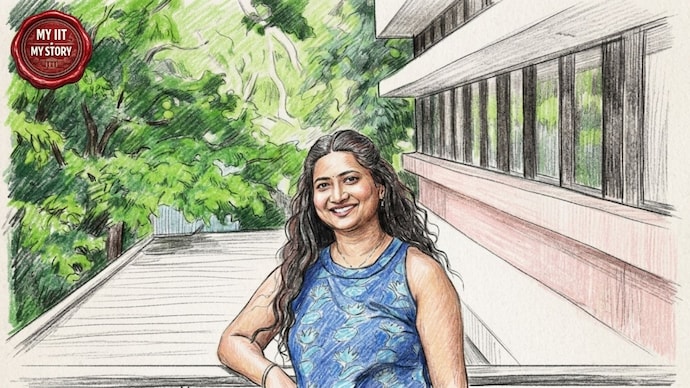
Anagha Manohar is pursuing her PhD in IIT Madras

New Delhi,UPDATED: Jul 19, 2026 10:02 IST
Ask someone outside an IIT what life inside the campus looks like and the answers are usually predictable: classrooms, coding, placements and sleepless nights before exams.
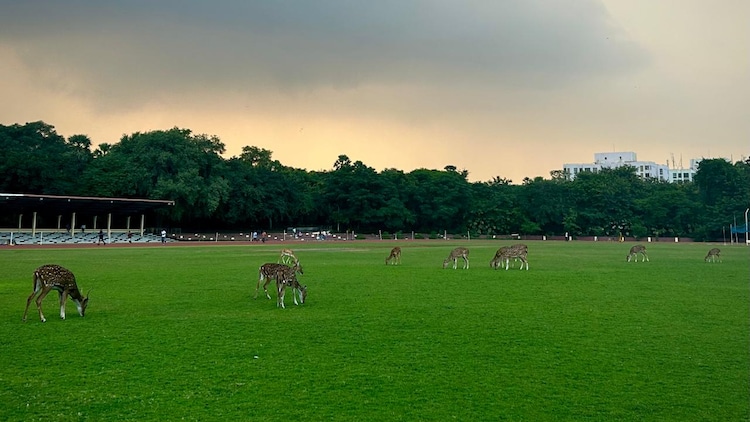
For Anagha Manohar, however, IIT Madras is remembered through different images – a quiet sunrise over the Watsa Stadium, deer wandering freely near the Student Activity Centre, fluorescent microscopes illuminating living cells, and tea breaks that become brainstorming sessions for the next experiment.
A doctoral scholar in the Department of Applied Mechanics and Biomedical Engineering (AMBE), Anagha represents a side of IITs that rarely makes headlines. Away from placement statistics and entrance exam cut-offs, thousands of research scholars spend years inside laboratories trying to answer questions that may eventually shape medicine, healthcare and technology.
FROM AN MBBS DREAM TO INTERDISCIPLINARY RESEARCH
Ironically, Anagha herself never imagined this path.
Like lakhs of students across India, she once prepared for the National Eligibility Entrance Test Undergraduate (NEET UG) with the dream of becoming a doctor. When she could not secure a medical seat, she chose to pursue a BSc in Physics instead, discovering that she enjoyed the subject as much as biology.
She later completed a master's in Theoretical Physics at the University of Madras, graduating as the university's first-rank holder and receiving her degree from President Droupadi Murmu.
The COVID-19 pandemic changed how she viewed science.
Watching scientists across disciplines work together to understand the virus convinced her that the world's biggest problems could not be solved by one field alone. Physics, biology, chemistry and engineering increasingly overlapped, and she wanted to work where those boundaries disappeared.
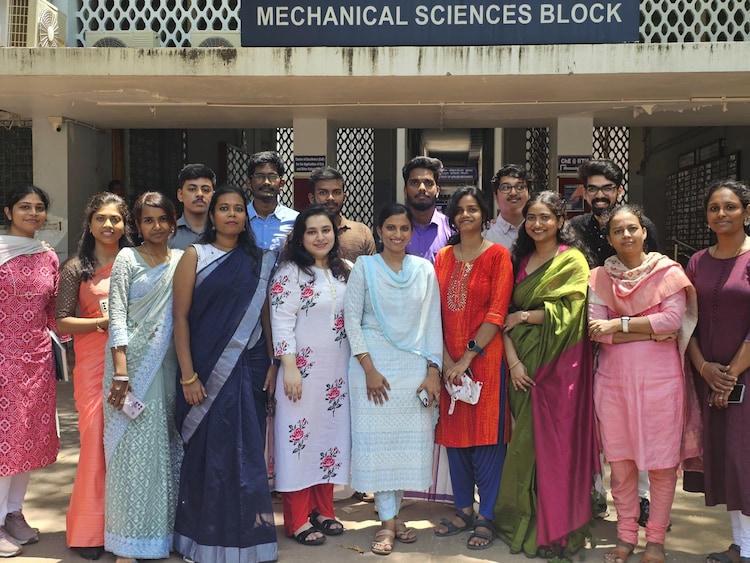
After a research internship at IIT Kharagpur studying the energy landscape of COVID proteins using molecular dynamics simulations and spectroscopy techniques, she joined IIT Madras under its interdisciplinary PhD programme.
"IIT Madras had always been a dream," she recalls. "Whenever my father's car passed the campus on Sardar Patel Road, I would look at those gates and wonder what it would be like inside."
Today, she works under Dr Swathi Sudhakar and Prof Ethayaraja Mani, integrating her background in physics and material science with experimental biology. Her research focuses on the self-assembly of proteins into functional, biocompatible nanoparticles for therapeutic applications such as drug delivery. Alongside her research, she has mentored BTech and MTech students, contributed to publications and theses, and recently received the Hindustan Unilever Women in STEM Fellowship.
THE IIT MADRAS FEW VISITORS GET TO EXPERIENCE
Today, those gates open into a routine that looks very different from what many imagine.
Most mornings begin around 9.30 am with a handwritten planner listing the day's experiments. Nearly eight hours are spent inside the laboratory, punctuated by a lunch break and a much-awaited evening cup of tea around 5 pm.
"The tea break is often my motivation to work through the day," she says.
Her days revolve around experiments, reading scientific literature, supervising student projects and discussing ideas with fellow researchers. Unlike the structured schedules associated with undergraduate life, no two days in the lab are exactly alike.
The work itself is anything but routine.
One of the questions driving her research is how proteins typically associated with disease can be repurposed for beneficial biomedical applications. As she puts it, she is trying to "turn a bad guy into a good guy."
Among her favourite places on campus is the microscopy facility. Watching biological processes unfold through a fluorescence microscope still fascinates her, while the adjoining cell culture laboratory – where living cells are grown under carefully controlled conditions – remains one of the most restricted spaces because even minor contamination can compromise months of work.
She has also worked with sophisticated imaging systems such as confocal microscopes and accessed advanced electron microscopy facilities used across high-end biological research.
Yet some of her favourite memories are not inside the lab.
If a visitor had only a few hours on campus, Anagha would first take them to the Watsa Stadium.
"It is beautiful at any time of the day," she says. "It's calming and serene."
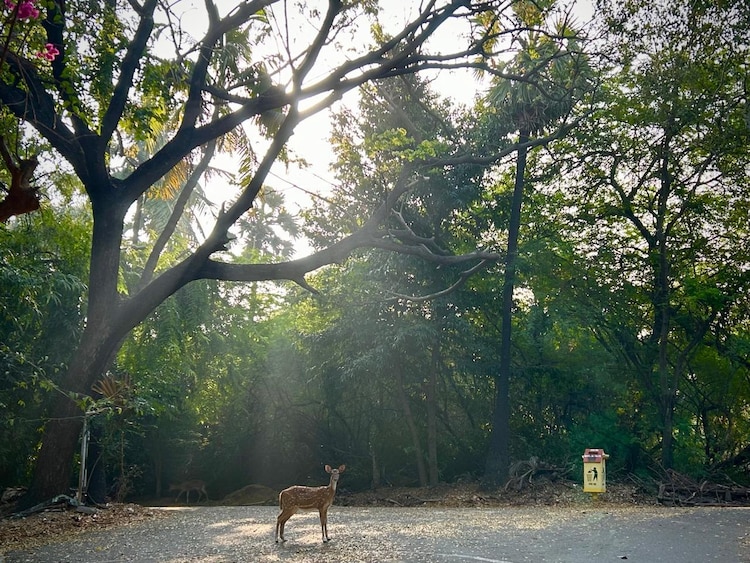
The second stop would be the stretch near the Student Activity Centre, where deer are a familiar sight rather than a rare occurrence.
Few outsiders realise that wildlife and world-class research coexist on the 620-acre campus. Early mornings reveal a quieter IIT Madras – tree-lined roads, empty cycling tracks and grazing deer replacing the bustle that visitors usually associate with the institute.
Campus life changes again after sunset.
During festivals such as Saarang and Shaastra, the hostel avenues glow with lights while students crowd concert venues, comedy shows and food stalls. Although research scholars often spend long hours in laboratories, these festivals provide a welcome pause from experiments and deadlines.
Even the food map has its own rhythm.
Late at night, students gravitate towards Zaitoon, one of the few eateries open past midnight. Recently introduced food trucks serving dosas, burgers and sandwiches have added more options, while Campus Cafe remains a popular evening stop.
For Anagha, though, some of the people who define IIT Madras are not professors or students.
"There is a coconut-water aunty on campus whose smile can cure sadness," she says with a laugh.
She is equally quick to acknowledge the laboratory managers, technicians, instrument operators, office staff and security personnel whose work quietly keeps one of India's leading research institutions functioning every day.
When asked what she would miss the most after graduation, her answer is immediate.
"All of it," she says. "The campus, the countless rides, the deer and especially Watsa. It is the most beautiful campus one can imagine."
Looking back, she believes missing out on medicine did not mean missing out on science.
Instead, it led her towards a career where physics meets biology, where curiosity crosses disciplinary boundaries, and where discoveries happen one carefully planned experiment at a time.
For the millions of students who anxiously await entrance examination results every year, her journey offers a quiet reminder: not getting the result you hoped for does not mean the end of your aspirations. Sometimes, it is the beginning of a path you never imagined – one that can lead to meaningful research, unexpected opportunities and a different way of making an impact.
- Ends