
Chennai researcher builds AI system to stop proxy attendance in classrooms

From proxy attendance through shared QR codes to borrowed RFID cards, traditional classroom systems often fail to verify who is actually present. Now, researchers have developed an AI-powered camera system that identifies students in real time, flags unknown faces and automatically records attendance.
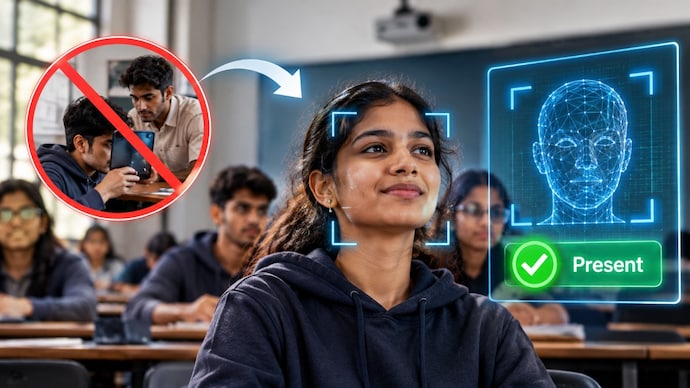
Researchers have developed an AI-powered camera system that identifies students in real time, flags unknown faces and automatically records attendance. (Photo: AI-generated)
New Delhi,Nov 19, 2026 17:04 IST Last UpdatedNov 19, 2026 17:04 IST
 Published by
Last UpdatedNov 19, 2026 17:04 IST Published byPrincy Shukla
Nov 19, 2026 16:51 ISTEvery teacher knows the drill: call out names, wait for a "present, ma'am/sir," and hope no one is answering on a friend's behalf. Roll calls get skipped, QR codes get forwarded on WhatsApp, RFID cards get borrowed. The one thing missing from most "smart" attendance systems, ironically, is proof that the actual person is in the room.
Researcher Rushikesh Borse and his team from Great Lakes Institute of Management, Chennai have built a system that tries to close that gap for good.
Published in the journal Engineered Science, their work describes a completely paperless, camera-based attendance system that watches a classroom the way a very attentive teaching assistant would: quietly and continuously, without anyone swiping, scanning, or signing a register.
HOW IT WORKS
The system starts by learning what each student looks like from short videos — students looking up, down, sideways, resting a chin on a hand — rather than one neat photo. An SSIM (Structural Similarity Index) algorithm automatically picks out frames that look meaningfully different, so the dataset captures how a face actually appears in a live class, not a studio-perfect pose.
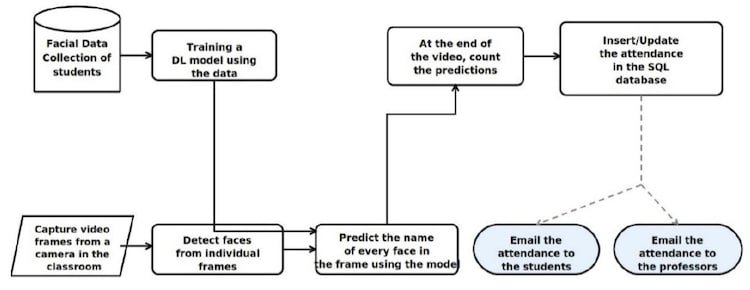
That dataset trains a deep learning model to recognise each face. The researchers tested three different models, and found Google's EfficientNet to be the most accurate. A camera mounted at a carefully chosen spot in the classroom then captures video, detects every face frame by frame, matches it against the model, and tallies how often each student was seen. That tally becomes the attendance record, written automatically into an SQL database — no spreadsheet, no manual entry.
The system was piloted on a small batch of 14 senior managers and executives from the PGXPM (Post Graduate Executive Programme in Management), an Executive MBA cohort at Great Lakes Institute of Management, Chennai — and separately tested in a more crowded classroom to confirm it wasn't tuned to just one room. The best model, EfficientNet, achieved 97.8% accuracy, comparable to or better than most face-recognition attendance systems in academic literature.
Workflow of the proposed attendance recording system
THE UNGLAMOROUS PART THAT ACTUALLY MATTERS
The most interesting piece of this research isn't the accuracy number — it's what the system does when it sees a face it has never seen before.
Most recognition models always pick the closest match, even when it's wrong — so a proxy or an uninvited guest can get marked present simply because their face is statistically closer to one known student than another. The researchers fix this by adapting Deep Open Classification, a technique originally built for text data: instead of forcing every face into a known category, the system checks whether its confidence for every student falls below a calculated threshold, and flags the face "unknown" if it does. An outsider at the back of the class is correctly identified as an intruder — not silently absorbed into someone else's attendance.
The system doesn't stop at logging data — it uses it, and this is where the 'paperless' claim earns its name. Every weekend, an automated email goes to faculty summarising subject-wise attendance, while a separate email goes to each student and their guardian, breaking down attendance by subject and day with a running percentage. No register is ever printed, filed, or manually compiled.
WHERE THIS COULD GO NEXT
The researchers are candid about the system's limits — camera placement and poor lighting can hurt accuracy — but these are engineering problems, not conceptual ones. Looking ahead, they suggest the same framework could extend beyond attendance: tracking how often a student faces the teacher (a proxy for attention), spotting seating patterns, or reading classroom-wide emotion.
Corporate training rooms and board meetings could use the same system to log participation without a QR code changing hands.
"The idea was never just to replace a register," says Rushikesh Borse. "It was to build something that could genuinely tell you who was in the room — and be honest when it didn't know."
For institutes still relying on RFID cards and shared QR codes, that honesty may be the real upgrade.
- Ends