
HC Verma didn't ask why students were failing. He asked why physics was failing them
HC Verma's journey proves that great education begins with understanding how students learn, not just what they learn. By writing Concepts of Physics, he transformed physics education in India, helping millions of JEE and NEET aspirants replace fear with confidence and curiosity.
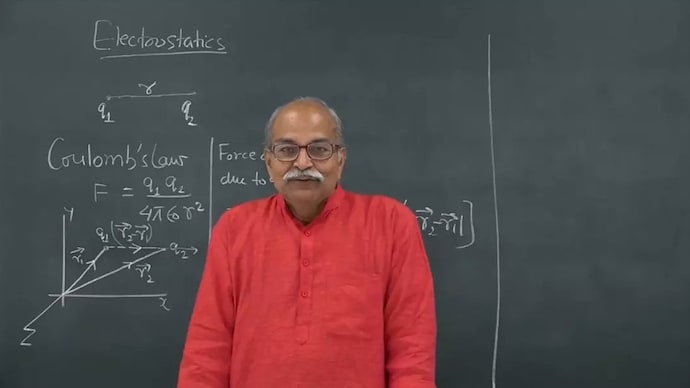

Before HC Verma wrote Concepts of Physics, one of India's most influential textbooks, he noticed something troubling in his classroom. Some of his brightest students were losing confidence in physics. Instead of asking how to write a better textbook, he asked a different question: "Why are some of my brightest students losing confidence in physics?"
The answer would change how millions of Indians understood physics.
Born in Darbhanga, Bihar, Harish Chandra Verma studied at Patna Science College before earning his MSc and PhD from IIT Kanpur. In 1980, he began teaching physics at Patna Science College, where one observation in his classroom would eventually reshape physics education in India.
Like many physics teachers, Verma relied on Resnick & Halliday, a textbook he deeply admired for its scientific rigour and clarity. But year after year, he noticed something unsettling: some of his brightest students were slowly losing confidence in physics.
The textbook was scientifically rigorous, but its language, examples, and style were developed for a very different educational environment. Many students encountering physics for the first time found it difficult to build intuition from it.
Verma realised that many students were losing confidence long before they had the chance to appreciate the beauty of Newton's laws or electromagnetism.
The barrier wasn't intelligence. It was context.
HE DIDN'T COMPLAIN. HE BUILT A BETTER SOLUTION.
Many teachers might have accepted the situation as inevitable. Others might have blamed students for not working hard enough.
Verma chose a different path.
Writing a textbook wasn't part of his job, nor was there any guarantee that publishers or students would embrace it. Even so, he decided to transform years of classroom experience into a book designed for Indian learners.
His goal wasn't to make physics easier. It was to make it more intuitive.
Instead of overwhelming students with formulas, he focused on building intuition before mathematics. Every explanation encouraged understanding before memorization, and every problem challenged students to reason rather than simply apply formulas.
What emerged wasn't a simplified version of a foreign textbook.
It was an entirely new approach to teaching physics.
That book became Concepts of Physics.
THE BOOK THAT TURNED FEAR INTO CURIOSITY
Concepts of Physics earned its place not because it offered shortcuts, but because it changed how students approached the subject.
Rather than asking students to memorise formulas, it encouraged them to ask why a principle worked before learning how to apply it.
Over time, the book found its way into classrooms, coaching institutes, libraries, and hostel rooms across India. Its pages became dog-eared, filled with handwritten notes, highlighted passages, and margins packed with solved problems.
For millions of aspiring engineers and scientists, Concepts of Physics wasn't just another entrance exam book.
It was the first book that made physics feel logical, approachable, and deeply satisfying.
EVEN AS A SCIENTIST, HE NEVER STOPPED BEING A TEACHER
In 1994, HC Verma joined IIT Kanpur, where he balanced teaching with research in nuclear physics. Over the course of his academic career, he authored 139 research papers, earning respect not only as a distinguished scientist but also as one of India's most admired physics educators.
Yet, for Verma, teaching was never secondary, it remained the heart of his life's work.
After retiring in 2017, he co-founded Shiksha Sopan, an initiative that supports nearly 250 families living around the IIT Kanpur campus by helping children from underserved communities access quality education and greater opportunities.
His lifelong contribution to science education was recognised with the Padma Shri in 2021.
His greatest legacy isn't his research or awards, but the confidence he gave generations of students to understand physics.
HIS GREATEST LESSON HAD NOTHING TO DO WITH PHYSICS
HC Verma's greatest legacy extends far beyond Concepts of Physics. While the book transformed how generations of students learned physics, its enduring impact lies in the philosophy behind it.
Instead of asking why students were struggling, Verma questioned whether the way physics was being taught was holding them back. By addressing the root cause rather than the symptoms, he reshaped how millions of Indian students experienced the subject.
His story reminds us that meaningful innovation begins with understanding people and removing the barriers that stand in their way.
HC Verma showed that great teaching isn't just about expertise, it's about empathy.