
Neena Gupta challenged a 70-year-old maths problem. Now she is on TIME100 Next India

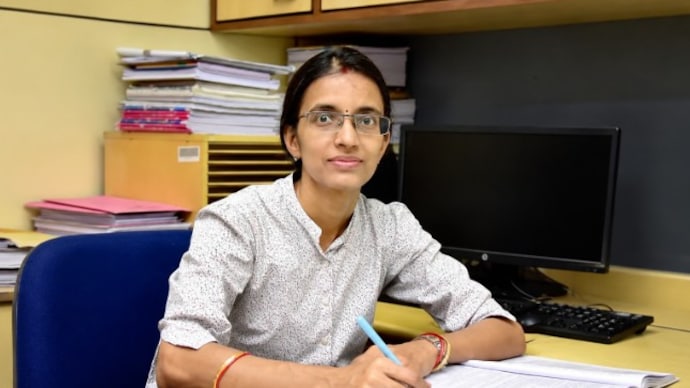
Neena Gupta, a professor at the Indian Statistical Institute, Kolkata, has earned global recognition for challenging a decades-old problem in algebraic geometry. From childhood maths puzzles to challenging the Zariski Cancellation Problem, Neena Gupta's journey has led her to TIME100 Next India 2026.
 Last UpdatedNov 19, 2026 18:10 IST
 Published by
For Neena Gupta, mathematics is as much about asking questions as it is about finding answers. It is about challenging established ideas, exploring the unknown and tackling problems that have puzzled mathematicians for generations. Today, the Kolkata-born mathematician has earned a place on TIME100 Next India 2026.
A professor at the Indian Statistical Institute (ISI), Kolkata, Gupta was named in the Health and Science Innovators category. She first gained international recognition in 2014 for finding a counterexample to a version of the Zariski Cancellation Problem, a mathematical question that had remained unresolved for nearly seven decades. The breakthrough brought her research in algebraic geometry into the international spotlight.
The TIME100 Next India list celebrates 100 emerging leaders shaping the country's future. But Gupta's journey began long before the accolades, with a childhood fascination for mathematical puzzles and a mother who encouraged her to question, explore and remain curious.
FROM KOLKATA CLASSROOMS TO THE WORLD OF MATHEMATICAL RESEARCH
Born in Kolkata in 1984, Gupta developed an early interest in mathematics, encouraged by her mother, Gyanlata Gupta, who often organised problem-solving competitions between her and her brother.
Her decision to pursue mathematics as a career took shape after a senior introduced her to the Mathematics Honours course at Bethune College. She graduated in 2006 and went on to pursue postgraduate studies at the Indian Statistical Institute (ISI), Kolkata, completing her degree in 2008 before continuing with doctoral research in algebraic geometry.
Her academic journey was not without challenges. During her postgraduate studies, she was the only woman in her mathematics class, an experience that brought the gender gap in the field into sharp focus. She has since emphasised the importance of encouraging more girls to pursue mathematics and scientific careers.
HOW A 70-YEAR-OLD MATHEMATICAL QUESTION CHANGED HER CAREER
Gupta's breakthrough came in 2014, when she found a counterexample to a version of the Zariski Cancellation Problem, first proposed by mathematician Oscar Zariski in 1949.
The problem addresses a fundamental question in algebraic geometry: if two mathematical spaces become equivalent after an additional dimension is introduced, does that necessarily mean they were equivalent before that dimension was added?
While the question may sound abstract, it has challenged mathematicians for generations.
Gupta demonstrated that a three-dimensional affine variety constructed by Asanuma provides a counterexample of a positive characteristic. Her result showed that mathematical spaces can become equivalent after an additional dimension is introduced, even when their original structures are not equivalent.
The finding challenged an established assumption in algebraic geometry and brought her work to the attention of the international mathematical community.
It was a landmark achievement that demonstrated how fundamental research can reshape the understanding of a longstanding mathematical problem. For Gupta, it also marked the beginning of a series of major recognitions.
FROM THE SHANTI SWARUP BHATNAGAR PRIZE TO TIME100 NEXT INDIA 2026
Gupta's research has earned her several prestigious national and international honours. She received the Indian National Science Academy's Young Scientist Award in 2014, followed by the Shanti Swarup Bhatnagar Prize in Mathematical Sciences in 2019, one of India's highest scientific honours.
In 2021, she won the Ramanujan Prize for Young Mathematicians from Developing Countries, becoming only the third woman to receive the honour. She was also conferred the Nari Shakti Puraskar in 2022 and invited to speak at the International Congress of Mathematicians the same year.
Her other accolades include the TWAS-CAS Young Scientist Award for Frontier Science in 2023 and the Infosys Prize in Mathematical Sciences in 2024, recognising her contributions to algebraic geometry and commutative algebra.
In 2025, she delivered the 44th Emmy Noether Lecture, organised by the Association for Women in Mathematics and the American Mathematical Society. Her lecture, titled 'The Abhyankar-Sathaye Conjecture for Linear Hyperplanes', further highlighted her contributions to mathematical research.
Her inclusion in TIME100 Next India 2026 adds another significant milestone to a career shaped by groundbreaking research, academic perseverance and international recognition.
A JOURNEY THAT CAN INSPIRE THE NEXT GENERATION
Neena Gupta's journey demonstrates what sustained curiosity, encouragement and the courage to question established ideas can achieve. From solving mathematical puzzles with her mother to challenging a decades-old problem, she has built a career around exploring questions that others have struggled to answer.
Her place on TIME100 Next India 2026 is another milestone in a career dedicated to expanding the boundaries of mathematical knowledge. For young girls considering careers in mathematics and science, her story offers an important reminder: there is room for them not just to participate in these fields, but to question, discover and shape their future.