
Being Heumann review: Ruth Madeley in a compelling story held by Hollywood cliches

Being Heumann review: Sian Heder's biopic follows Judy Heumann as she leads a landmark 26-day disability rights occupation. Actor Ruth Madeley's forceful performance gives the stirring but softened drama its conviction.
 Last UpdatedNov 15, 2026 18:05 IST
 Published by
Back in the 1970s, a fight was brewing in the US over Section 504, a law meant to protect disabled people from discrimination. But years of government delays meant those rights remained out of reach. So, in 1977, disability rights campaigner Judith Heumann and a group of activists occupied a federal building in San Francisco for 26 days, refusing to leave until they were heard. Being Heumann tells the story of that fight, and the woman who helped turn it into a landmark moment in the history of disability rights.
A wheelchair user herself, Heumann wasn't asking for special treatment. She was fighting for the simple right to live with dignity and on equal terms.
Directed and co-written by Sin Heder, the film, released on AppleTV, is based on Heumann's 2020 memoir of the same name. It has the heart of an underdog drama, the energy of a political uprising and, occasionally, the sentimentality of a conventional Hollywood biopic.
But there's more to the film than its emotional moments. With the fight for equal rights and representation still far from over, Being Heumann feels as relevant today as the story it tells. More importantly, it doesn't ask us to throw a pity party for disabled people or see them as victims. It makes us look at the world around them and question why it is society that so often makes their lives harder.
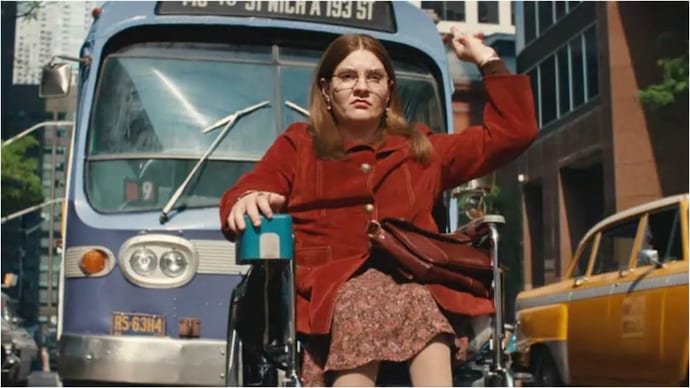
The film takes us back to 1972 New York, where Heumann is already making noise about Section 504 of the Rehabilitation Act of 1973. The provision was meant to protect disabled people from discrimination, but the government keeps dragging its feet over implementing it, citing concerns about expenses, time and basic understanding of the regulations. Heumann, played with terrific conviction by Ruth Madeley, has little patience for bureaucratic excuses. She takes her fight to the Department of Health, Education and Welfare, determined to make officials understand that disabled people cannot keep waiting for their rights.
The resistance eventually reaches a boiling point in San Francisco, where Heumann and fellow activists occupy the federal building for 26 days. It is here that the film finds its strongest rhythm. What begins as a protest becomes a remarkable show of solidarity, with disabled activists joined by gay action groups and the Black Panthers (revolutionary political and militant organisation). These scenes have a real spark to them, even if the film sometimes slips into the familiar territory of feel-good, inspirational dramas.
Heder is at her best when she lets the movement speak for itself. She understands that this isn't simply a story about one determined woman, but about a community that has had enough of being told what it can and cannot do. The film also makes room for disagreements within the movement, including differences between deaf activists and those representing other disabilities. These moments are important because they show that solidarity doesn't mean everyone thinks alike. Building a movement is messy, demanding work, and Being Heumann is better for acknowledging that.
Madeley is the film's beating heart. The BAFTA-winning British actor, who has spina bifida (a birth condition in which a baby's spine and spinal cord don't develop fully during pregnancy) and is also a disability rights campaigner, brings a wonderful mix of sharpness, impatience, humour and vulnerability to Heumann. She never plays her as a saintly figure or an inspirational poster come to life. Her Judy is stubborn, funny, occasionally difficult and entirely unwilling to be patronised. There's a particularly refreshing quality to the way Madeley approaches the character: she allows Heumann to be a person first and a campaigner second. That distinction matters.
The casting of several actors with disabilities also gives the film a welcome sense of authenticity. Madeline Delp, a wheelchair user, plays fellow activist Kitty Cone, while the ensemble brings a lived-in quality to the conversations about accessibility, independence and dignity. The screenplay is also surprisingly candid about disabled people's sexuality, relationships and everyday desires. These characters aren't reduced to their activism or their physical conditions. They have friendships, disagreements, ambitions and romantic lives, just like everyone else.
The film is less convincing when it comes to portraying those in power. Mark Ruffalo plays health secretary Joseph Califano, who eventually agrees to sign Section 504, giving the protesters a hard-won victory. Ruffalo brings his usual understated charm to the role, but Califano comes across as more irritated by the protesters than someone actively standing in their way.
The film also glosses over some of the government's harsher tactics, including attempts to starve the protesters into giving up. It's a little disappointing, especially when the rest of the film does a fairly good job of showing just how difficult the fight was.
There are a few other familiar biopic shortcuts. Dylan O'Brien plays television reporter Evan White, while Jon Beavers appears as Heumann's friend and ally Jim Pechin. Their relationship is given a romantic dimension, a dramatic choice that feels somewhat unnecessary. At times, Heder also reaches for emotional beats that are a little too neatly arranged. The film could have trusted its extraordinary real-life events more instead of occasionally dressing them up in conventional Hollywood sentiment.
Still, these shortcomings don't take away from what Being Heumann gets right. Four years after the 2021 comedy-drama CODA, Heder returns to a story about disability, but this time with considerably more political anger and urgency. Where her Oscar-winning film was a gentler family drama, this one is more confrontational, asking audiences to look beyond sympathy and consider accountability.
Ultimately, Being Heumann is an affecting, spirited account of a landmark disability rights movement, even if its Hollywood instincts occasionally soften the edges of a story that deserved a fiercer telling.

Velupula Anisha Rao is an entertainment journalist at the India Today Group, where she covers films, streaming content, and the evolving landscape of Indian entertainment. Based in Noida, she has been with India Today Digital for over three years, contributing features, interviews, and reviews that balance insight with accessibility.
Originally trained as a mechanical engineer, Anisha transitioned into journalism driven by her deep interest in cinema and storytelling. Her work often focuses on Bollywood, Hollywood, South, pop culture, emerging industry trends, and character-driven narratives, with a keen eye for cultural context and audience engagement.
At India Today, she is also part of ‘Cinematic Saturday’, a weekly segment that explores compelling ideas and conversations around cinema. She enjoys crafting stories that go beyond the surface, blending reportage with a strong narrative voice.
Anisha is fluent in English, Hindi and Telugu, and brings a fresh, contemporary perspective to entertainment journalism. She is particularly passionate about Telugu cinema, long-form storytelling, and conversations that bridge mainstream and regional film industries.
READ MORE