
Nocturne first impression: A terrifying Stephen Graham, an emotionally cold thriller

Michael Frost's return pulls former detective Jonah Lynn back towards imprisoned killer Jurek Walter. The polished psychological thriller builds menace effectively but keeps its human suffering frustratingly distant.
 Last UpdatedNov 2, 2026 14:03 IST
 Published by
A serial killer who can control people without leaving his prison cell and a former detective trapped by an unresolved case give Apple TV's Nocturne the foundations of a gripping psychological thriller. Based on Lars Kepler's crime novel The Sandman, the series opens with a disturbing mystery and quickly raises the stakes.
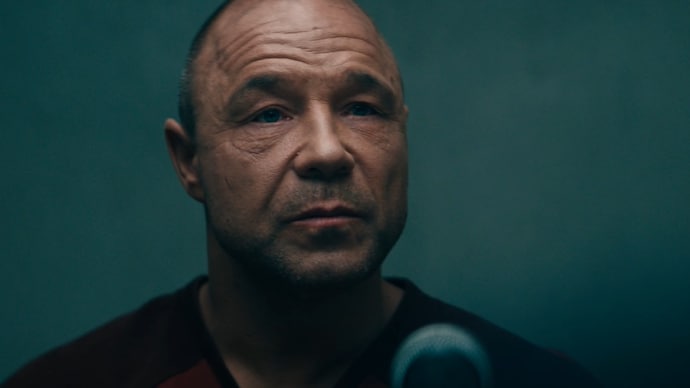
The first two episodes, directed by Tim Van Patten, are polished and often unsettling. Stephen Graham gives the drama a chilling centre as serial killer Jurek Walter, while Liev Schreiber brings restraint and urgency to the investigation. Yet the series is better at establishing danger than conveying its emotional cost.
Former detective Jonah Lynn, played by Schreiber, is drawn back into Jurek's case when Michael Frost returns alive three years after being abducted. Michael's sister Felicia, who was taken with him, remains missing. His reappearance revives the possibility that Jurek had an accomplice who is still operating outside prison.
Jonah has never moved on from the original investigation. A wall covered with photographs, newspaper clippings and clues reveals the scale of his obsession. Michael's return allows him to revisit the questions that have haunted him, particularly how far Jurek's influence extends beyond the high-security psychiatric facility where he is confined.
The opening episode establishes that influence with brutal efficiency. Jurek persuades a fellow inmate to repeatedly bang his head against a wall, eventually causing his death. Their conversation takes place through the plumbing of neighbouring cells. The sequence makes the threat clear: Jurek does not need physical access to hurt someone.
Elsewhere, Jurek's confrontation with Jonah suggests that the former detective may have concealed part of the truth, especially when Jurek accuses him of lying in court.
The second episode expands the mystery through a flashback to Jonah's earlier investigation.
Inside the facility, Jurek demonstrates how easily he can exploit routine interactions. He stages a choking incident to create confusion and slips a note into an employee's pocket, leading to an innocent colleague being suspended. Even Karl, a seemingly kind-hearted newcomer played by Rory Culkin, appears to be falling deeper under his influence.
The cast is the strongest reason to continue with Nocturne. Graham makes Jurek frightening without relying on loud outbursts or exaggerated expressions. His quiet conversations with Karl, the way he studies those around him and his apparent ability to anticipate their decisions create a steady sense of menace. The opening sequence is enough to demonstrate the reach of his psychological control.
However, the series currently tells us much more about Jurek's danger than about the person behind it. His calculated silences and sinister looks sustain the mystery, but they offer little insight into what drives him. That distance may be useful at the start of a thriller, though the character will need more depth if he is to remain compelling rather than simply threatening.
Schreiber gives Jonah a restrained intensity, playing him as a man burdened by guilt and unresolved grief. His quiet exchanges with Chief Ellison, played by Bill Camp, point to a shared history that deserves further attention. Jonah's loss of his wife and daughter and his determination to find Felicia explain his investment in the case, but the writing has not yet made that painfully felt.
Beetz makes Saga sharp, determined and willing to take risks. Poorna Jagannathan is effective as FBI agent Alexandra Quinn, particularly when Quinn initially resists Jonah's involvement. Camp lends Chief Ellison a reassuring authority, while Culkin makes Karl's increasing vulnerability around Jurek believable. Chrissy Metz, as Michael and Felicia's mother Ida Frost, conveys the distress of a parent whose ordeal remains unresolved.
Nocturne's main weakness is the distance it maintains from its characters. Jonah's bereavement, Saga's complicated family history, Sam's death and Ida's desperate wait for Felicia all have emotional potential. So far, however, these experiences operate mainly as pieces of the investigation rather than as losses the audience is allowed to absorb.
The writing also sometimes has characters explaining their suspicions instead of allowing tension to develop through action and discovery. Even so, the mystery has enough moving parts to sustain interest. Felicia's disappearance, Jurek's apparent network inside and outside Riverside, the mystery surrounding Rebecca and Saga's undercover mission all give the story room to expand.
Van Patten creates a stark visual contrast between the psychiatric facility and the quieter Pennsylvania surroundings. The atmosphere is suitably oppressive, and several sequences are genuinely disturbing. Yet mood and accomplished performances can carry a psychological thriller only so far when its emotional centre remains underdeveloped.
After two episodes, Nocturne is an intriguing crime drama with a strong cast and a mystery built for escalation. Graham's controlled performance makes Jurek a formidable villain, and Saga's arrival inside Riverside offers a promising path forward. Viewers drawn to bleak, methodical thrillers may find enough to stay invested, but the series must bring its victims and investigators closer if its ambition is to translate into lasting impact.