
Can human egg cells be created from blood sample? Scientists say yes
A California-based company says it has created the world's first early-stage human egg cells from stem cells using lab-grown ovarian tissue. The advance could widen fertility options. However, the innovation is only in experimental stages.
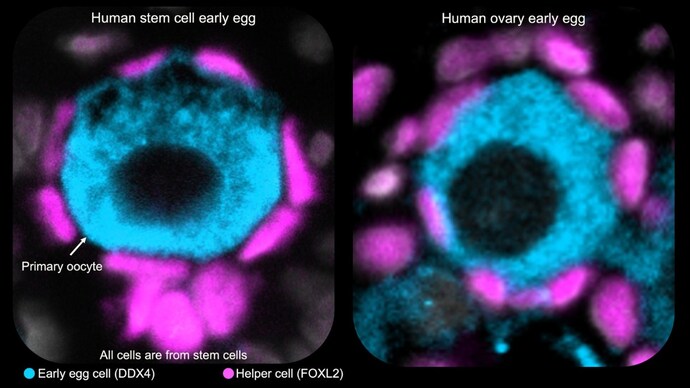

In what could be a breakthrough in reproductive medicine, a US biotechnology company says it has successfully created the world's first early-stage human egg cells from stem cells, an advance that could one day transform fertility treatment for millions of people.
The California-based startup, Conception, announced that it had generated primary oocytes, or immature human egg cells, by reprogramming blood cells into stem cells and then coaxing them to develop into miniature human ovaries containing early egg cells.
The work, however, is still at an experimental stage, and the eggs are not yet mature enough to be fertilised or used in pregnancy.
The CEO of Conception, Matt Krisiloff, shared a post on X, saying how this innovation has the potential to redefine fertility.
FROM A BLOOD SAMPLE TO AN EARLY EGG CELL
The process begins with a simple blood draw.
Scientists first convert blood cells into induced pluripotent stem cells (iPSCs)—adult cells that have been reprogrammed to behave like embryonic stem cells and can develop into many different cell types.
These stem cells are then guided to form miniature, lab-grown ovarian tissue, where early-stage egg cells develop naturally inside structures that resemble human ovarian follicles.
According to the company, recreating the ovary rather than producing egg cells in isolation is crucial because eggs rely on surrounding support cells to mature properly.
Although these cells are still far from becoming mature eggs, researchers describe the achievement as an important step toward in vitro gametogenesis (IVG)—the process of creating eggs or sperm entirely in the laboratory from stem cells.
WHY IS THIS EXCITING?
Creating functional eggs from stem cells has already been achieved in mice.
In 2016, Japanese scientist Katsuhiko Hayashi and colleagues successfully produced healthy mice from eggs derived from stem cells, with the offspring growing normally and later reproducing naturally.
Replicating the same process in humans has proved far more difficult because human egg development is significantly more complex.
If scientists eventually succeed in producing safe, fully mature human eggs, the technology could dramatically expand reproductive options.
It may help women with premature ovarian failure, those who lost fertility after cancer treatment, or women who wish to have children later in life.
It could also reduce the need for repeated hormone injections and surgical egg retrieval that are currently required for in vitro fertilisation (IVF).
Researchers have also suggested that, in the future, the technology could make it possible for same-sex couples to have genetically related children, although such applications remain highly speculative.
BUT THE BREAKTHROUGH COMES WITH IMPORTANT CAVEATS
Despite the excitement, researchers caution that the work is still in its early stages.
The egg cells produced are primary oocytes, an early developmental stage, and cannot yet be fertilised. Within or without it.
Scientists must still determine whether these cells can mature normally, produce healthy embryos and, most importantly, prove safe before any human clinical trials can begin.
Conception's chief executive, Matt Krisiloff, has also acknowledged that the technology remains years away from clinical use and that extensive safety testing will be required before it can be considered for patients.
Another important limitation is that the findings have not yet been independently validated through peer-reviewed scientific publication, meaning the wider scientific community has not had the opportunity to fully evaluate the results.
THERE ARE STILL ETHICAL QUESTIONS TO BE ASKED
Scientists say advances in in-vitro gametogenesis also raise significant ethical and regulatory questions.
Experts have pointed to concerns around the long-term safety of stem cell-derived eggs, embryo research, genetic parenthood, equitable access to the technology, and how it should be regulated before it ever reaches fertility clinics.
Reviews in reproductive medicine have noted that while stem cell-derived gametes hold enormous promise, translating the technology safely from laboratory experiments to clinical care will require careful scientific and ethical oversight.
Even so, the achievement marks an important scientific step toward understanding how human eggs develop and could eventually open new possibilities for people who are unable to produce healthy eggs naturally.