
After Bihar cop's heckle, a PM Modi hug: How Nishant Kumar is here to stay

The public reassurance from the BJP top leadership conveyed that Nitish Kumar's son is no pushover in the new power arrangement in Bihar
 Last UpdatedNov 23, 2026 19:50 IST
 Published by
 Nishant Kumar is emerging, gradually but unmistakably, as the central figure in the Janata Dal (United)’s post-Nitish Kumar era.
The elevation of Nitish’s son, who is also Bihar health minister, is not merely a matter of dynastic succession. It is also about whether the JD(U) can find someone capable of inheriting Nitish’s political authority, holding together his carefully crafted social coalition and negotiating an enduring place in a government now headed by senior ally BJP.
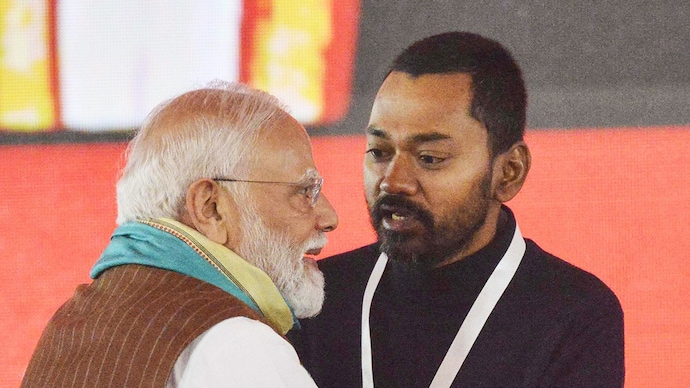
Two incidents in the space of three days have offered some glimpse of a transition: one in which Nishant was allegedly pushed aside by a policeman and another in which Prime Minister Narendra Modi embraced him on a public stage.
On November 18, during an inspection at Rajapakar in Vaishali, Nishant was allegedly stopped and pushed back by a policeman in chief minister Samrat Choudhary’s security detail as he tried to approach the CM.
The two leaders were reviewing preparations for Modi’s November 21 visit. A video of the incident went viral. The police subsequently described the episode as human error. That couldn’t prevent a political fallout as the Opposition lost no time in circulating the video.
Nishant’s response, though, was far seasoned than of a debutant politician. He did not lose composure, exchange words with the policeman or turn the incident into a public confrontation. He simply moved away. For a politician still finding his feet in a government headed by a BJP leader, such restraint was noteworthy. It also left the political argument to others.
The JD(U) was livid. Its leaders demanded an inquiry by the police headquarters. They questioned how a cabinet minister could be treated in this manner while accompanying the chief minister on an official visit.
The Opposition, meanwhile, mocked Nitish’s decision to make way for Choudhary. The insinuation was that the former chief minister’s sacrifice had bought him little respect within the new dispensation. The episode also gave fresh ammunition to those hoping to drive a wedge between allies JD(U) and the BJP.
Then came November 21. At the inauguration of Nitish Setu, a six-lane bridge over the Ganga in Vaishali, Modi embraced Nishant on stage. The gesture was brief, but its political resonance was much larger. Coming after the security controversy, it was read in political circles as public reassurance from the BJP’s top leadership—that Nishant was no pushover in the new power arrangement in Bihar and that Nitish’s stature in the National Democratic Alliance (NDA) remained high.
Modi also publicly acknowledged Nitish’s contribution to Bihar, saying Choudhary and his team were carrying forward the state’s development journey with the former chief minister’s blessings. The bridge itself has been named Nitish Setu in recognition of his contribution.
For Nishant, the significance of the embrace goes beyond a reassuring photograph. He formally joined the JD(U) on March 8, after years of distance from active politics. The entry coincided with his father’s move to the Rajya Sabha and the government’s transition to a BJP chief minister.
On May 7, Nishant was inducted into Choudhary’s expanded cabinet and given the health portfolio. On June 21, the JD(U) state council passed a resolution seeking a larger organisational role for him. Senior leaders, including working president Sanjay Kumar Jha, projected Nishant as the party’s future. Nishant’s political journey has thus been unusually rapid, taking him from a party novice to cabinet minister and prospective face of the organisation in a matter of months.
Observers say the limitations of the JD(U)’s present leadership explain why Nishant’s rise has acquired such significance. The JD(U)’s two deputy chief ministers, Vijay Kumar Choudhary (69) and Bijendra Prasad Yadav (79), are experienced politicians and administrators, and respected within the government. Yadav is a nine-time MLA from Supaul while Choudhary is a senior leader and a Nitish confidant.
But neither leader commands the kind of statewide pull Nitish built over two decades. Nor do the two deputies individually embody the breadth of the social coalition that Nitish painstakingly assembled, bringing together Kurmis, Extremely Backward Classes, women and other constituencies.
There is another crucial aspect to Nishant’s elevation. The health department has Kumar Ravi, a 2005 batch IAS officer, IIT Kanpur alumnus and one of the more accomplished bureaucrats in the Bihar cadre, as its secretary. As a trusted officer of Nitish, Ravi served in the chief minister’s secretariat before being moved to the health department in June this year. His presence brings considerable administrative experience to a portfolio that is both politically important and institutionally demanding.
For Nishant, having a seasoned bureaucrat who knows the system and understands his father’s style of governance could prove invaluable. It may help him deliver in ways that matter on the ground. Nishant has already made an impression with his unannounced inspections of hospitals and his keenness to address problems within the health department.
That is the larger challenge facing the JD(U). With 85 legislators in the Bihar assembly, it remains a substantial political force, but its long-term future increasingly appears to rest on Nishant. He must show he can eventually command his father’s statewide appeal and hold together the coalition that sustained Nitish for so long. But he offers something no other leader in the party can: an identifiable link to Nitish’s political legacy. The question is whether he can turn that inheritance into an independent political constituency.
Nishant’s place in the government has consequently acquired fresh importance. There is speculation in political circles that he could eventually be accommodated as the JD(U)’s sole deputy chief minister. That would give him greater visibility and role in the government, and also signal that the JD(U) is beginning to reorganise itself around a new generation of leadership.
For now, Nishant’s task is to establish himself within the party and the government without appearing to be in a hurry to claim his father’s mantle. The November 18 episode exposed the awkwardness of a coalition in transition: a JD(U) minister being pushed aside by the security apparatus of a BJP chief minister. Modi’s embrace three days later offered a contrasting image of recognition and inclusion. While that may not settle the questions of power-sharing or succession, it certainly has sent a message to those hoping to exploit tensions between the allies.
Nishant, meanwhile, has conveyed his maturity by showing that in Bihar’s politics, sometimes the most consequential response is not confrontation but to remain composed, let the controversy travel, and allow the next political gesture to speak.
Subscribe to India Today Magazine
