
How Samrat Choudhary powered BJP's political aatmanirbharta in Bihar
The BJP could deny Koeri OBC heavyweight Upendra Kushwaha's son Deepak Prakash in the MLC polls because it has the CM himself to access this crucial social bloc
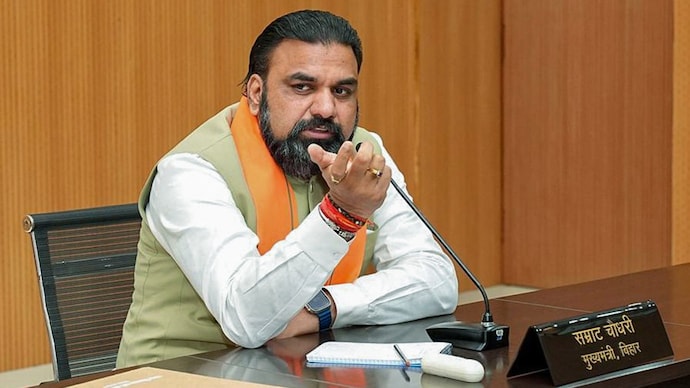

 When all 10 candidates in the Bihar Legislative Council polls last week were declared elected unopposed, the striking bit was the name missing: Deepak Prakash, former Union minister Upendra Kushwaha’s son and a minister in the Bihar government, whose political future had depended on securing a legislative berth within six months.
Unlike in the past, the ruling BJP did not have to bend over backwards to accommodate Deepak in the National Democratic Alliance (NDA) list of member of legislative council (MLC) nominees. The significance of his omission also extends beyond the fortunes of any particular political veteran.
By omitting Deepak, the BJP is neither slamming the door on Upendra, supremo of NDA constituent Rashtriya Lok Morcha (RLM), nor seeking a confrontation with one of Bihar’s most recognisable OBC (Other Backward Classes) leaders. What has changed is something fundamental. With Samrat Choudhary—a Koeri Kushwaha leader like Upendra—taking over as chief minister, the BJP no longer feels dependent on any regional satrap to access this crucial social constituency.
For much of the past two decades, the BJP in Bihar was a powerful but not self-reliant party. It possessed organisation, cadre strength and the backing of the national leadership, yet relied on regional allies for legitimacy among influential caste groups. Leaders such as Upendra derived their importance not from legislative numbers but their perceived ability to rally specific communities.
Today, the BJP believes it has found an alternative model. In Choudhary, it has a chief minister, powerful OBC face, statewide leader and independent centre of authority all rolled into one. It means the BJP’s political aatmanirbharta, riding on the chief minister.
That development matters because Koeri Kushwaha OBCs are a highly consequential bloc and a key pillar of Bihar’s influential ‘Luv-Kush’ social coalition. Numbering over 5.5 million, the community accounts for 4.21 per cent of the state’s population and is widely regarded as the second-largest OBC segment, after the Yadavs.
This is not merely about the Kushwaha community’s share in Bihar’s population. Added to it is the Kurmi vote, accounting for another 2.87 per cent. In Bihar’s social and political landscape, Kurmis and Kushwahas have traditionally moved together under the banner of the Luv-Kush alliance. Together, they constitute a little over 7 per cent of the population—a coalition that played a pivotal role in making Nitish Kumar electorally formidable for nearly two decades. More importantly, the alliance has historically provided a cohesive political identity around which broader caste coalitions could be built.
Today, however, this influential social bloc appears to be looking increasingly towards Choudhary as its natural political leader, a development that could have significant implications for Bihar’s evolving caste equations and leadership dynamics.
For decades, Upendra’s political relevance rested on his hold over the Kushwaha bloc. Governments courted him not because of the number of MLAs he controlled but because he was perceived as a gateway to a crucial voter bloc. But now, the chief minister himself is the BJP’s Kushwaha vote-catcher. The party no longer needs to outsource Kushwaha representation to an ally. For the first time, one of the state’s most important OBC blocs is represented directly from the chief minister’s office itself.
The Deepak episode in the MLC polls is thus a turning point. The NDA found room for everybody else but not Upendra’s son. For much of the past two decades, Upendra occupied a peculiar place in Bihar politics. Alliances sought his company. He joined Nitish Kumar, broke away, returned, left again and launched successive political vehicles. Critics called it inconsistency. Supporters called it survival. Either way, the strategy ensured Upendra remained politically relevant long after many contemporaries had faded from view. But now, the NDA has something it lacked in the earlier years—a chief minister from the same social cohort.
Upendra is believed to have refused the RLM’s merger with the BJP even as he reaffirmed his party presence in the NDA and left Deepak’s future in the hands of the BJP leadership. The point was not dynastic discomfort. It was leverage—or rather the visible thinning of it.
That is where Choudhary turns the tide. A BJP that once depended on allies to interpret caste blocs now has a leader himself legible to one of the most important electoral segments. In political terms, Choudhary has made the BJP less dependent and more self-contained. It can now speak not only to Bihar but increasingly for Bihar, through one of its own.
The change is visible not only in the caste arithmetic but governance too. Since assuming office in April, Choudhary has projected momentum. His administration moved quickly on a series of initiatives—AI-based scrutiny of engineering estimates, an emerging AI policy framework, plans for a Ganga Expressway under the public-private-partnership model, expansion of model state-run schools, new degree colleges, satellite townships and the Sahyog grievance redressal system.
Under him, the very language of governance has become more direct, interventionist and politically communicative. Officials increasingly speak of deadlines, outcomes and rapid execution. Choudhary’s public messaging projects an administration seen to act. This is where the BJP’s transformation becomes more interesting than the usual tale of a ruling party enjoying office.
For much of the Nitish Kumar era, the BJP was a powerful partner, but with authority mediated through coalition arrangements and constrained by the realities of shared power. Under Choudhary, it increasingly resembles a party discovering what it feels like to govern on its own terms. The rhetoric is sharper, the administrative tempo faster and the party’s social reach less dependent on intermediaries.
Caste is still an enduring political currency in Bihar. But allies are no longer the only bridge between the BJP and the voter. Choudhary’s presence in the chief minister’s office has transformed the party from an alliance manager into a more confident governing force.
That explains why the legislative council election, though unopposed and almost dull in form, carried such force in substance. It produced a message about who now matters inside the NDA. Deepak’s omission was a loud message. It suggested the NDA could afford to be selective because it no longer needed every old accommodation to keep itself standing.
Yet the larger story is not about Deepak or ultimately Upendra. It is about the BJP itself. For decades, the party’s growth in Bihar depended upon balancing powerful regional leaders, each claiming influence over a particular social constituency. Today, the BJP appears increasingly confident it can cultivate those relationships itself. At the centre of that confidence stands Choudhary. He has given the party something long sought: political aatmanirbharta.
Subscribe to India Today Magazine