
Is the digital shift in protests making campus politics redundant?

The Centre's increasing role in education and the space for students to challenge policy were central themes of the youth politics debate at the India Today Conclave South
 Last UpdatedOct 1, 2026 19:24 IST
  Published byEdited byAshish Mukherjee
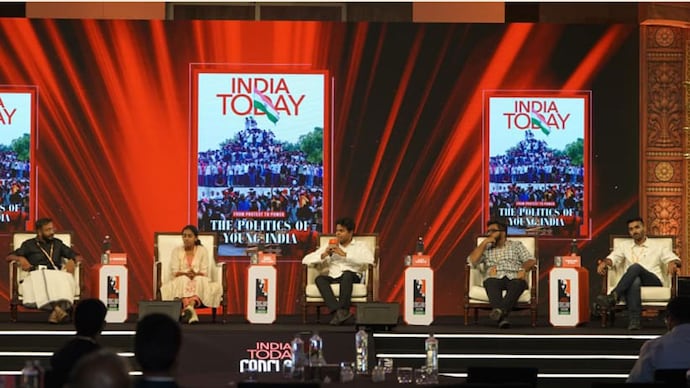
 Student politics in India remains an important arena for debating democracy, federalism and the future of education, argued young leaders from the fraternity at the India Today Conclave South in Kochi, where much of the discussion during the session ‘From Protest to Power: The Politics of Young India’ focused on the growing role of the Union government in education and the space available for students to challenge policy.
The debate had a key constitutional backdrop: education is on the Concurrent List, giving both Parliament and state legislatures a role. The National Education Policy (NEP) 2020 itself acknowledges this, calling for respect for local context and noting that education is a Concurrent subject. It also envisages a national curricular framework developed by the NCERT (National Council of Educational Research and Training) in consultation with state governments.
S. Mridhula, Tamil Nadu president of the Students’ Federation of India (SFI), argued that states were nevertheless increasingly being left out of consequential decisions. She cited Tamil Nadu’s long-running opposition to NEET (national medical entrance) as an example.
In 2021, the Tamil Nadu legislative assembly had passed a bill seeking exemption from NEET-based undergraduate medical admissions after a state-appointed committee raised concerns about its impact on poorer, rural and government school students. The governor subsequently returned the bill, citing a contrary view of its implications for disadvantaged students.
Vijay Reddy Mallangi, national media lead and South India in-charge for the Cockroach Janta Party (CJP), similarly argued that educational curricula needed greater decentralisation whereas Ajay Kamath, Karnataka state secretary of the All India Democratic Students’ Organisation (AIDSO), said institutions were implementing policies affecting students while becoming less receptive to organised dissent.
Dr Aloshious Xavier, state president, Kerala Students Union, stressed that the right to protest also came with limits, saying governments should act when protests become violent or went against democratic principles.
The relevance of student politics itself was another thread. A 2026 peer-reviewed study of Delhi University found that participation in student politics can foster political awareness, although institutional barriers and political violence can restrict meaningful democratic participation.
For Shravan B. Raj, national secretary of the Akhil Bharatiya Vidyarthi Parishad (ABVP), the digital shift had not made campus politics redundant. His argument that social media can connect people but cannot entirely replace individual contact also reflects wider research: a 2026 meta-analysis found a significant association between social-media use and youth political participation, while also noting that offline context remains an important factor shaping engagement.
SESSION HIGHLIGHTS
Dr Aloshious Xavier
- “If protests, even if there is permission, lead to violence or something that is against democracy, then the government must act.”
S. Mridhula
- “The Union should listen to the states and not decide without consultation. What they are doing is not letting states have a say. Tamil Nadu has been fighting against NEET for more than a decade, and we haven’t been heard.”
Vijay Reddy Mallangi
- “The centralisation of educational curricula needs to be fought against. It needs to be decentralised. NEP takes away the rights of states.”
Ajay Kamath
- “Institutions today don’t want students to have a voice. They implement anti-student policies but don’t want students to mobilise against them.”
Shravan B. Raj
- “Campus politics has changed a lot after the rise of social media, but student unions remain relevant because social media connects people. Meaningful individual to individual contact can only happen offline.”
Subscribe to India Today Magazine