
PARIVARTAN for polluted Delhi-NCR? Govt eyes brakes on 200,000 old trucks, buses

Annual winter pollution looming, how the Centre is scaling up the replacement of aged trucks and buses with BS-VI or stricter emission-compliant vehicles
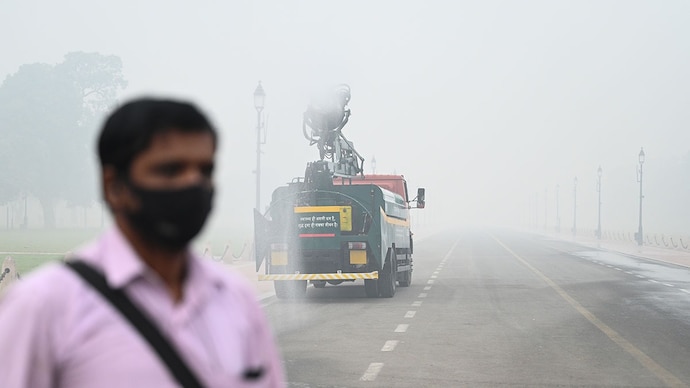

 A little-known government intervention to remove some of Delhi-NCR’s most aged trucks and buses from the roads is starting to gain momentum, with the Centre attempting to scale up the initiative before the onset of winter months when air pollution in the region spikes.
PARIVARTAN, or the Programme for Accelerated Renewal and Incentivisation of Vehicle Assets for Reducing Transport Air Pollution and Network Emissions, focuses on over 200,000 BS-IV (Bharat Stage-IV) or older trucks and buses registered in Delhi and the NCR districts of Haryana, Uttar Pradesh and Rajasthan.
As per officials of the ministry of road transport and highways, over 1,450 vehicle owners have signed up on the PARIVARTAN portal till date. Thirty-five old vehicles have been scrapped and over 50 sold outside NCR (National Capital Region), with four new replacement vehicles registered under the scheme. On August 19, Mahendra Singh from Alwar in Rajasthan became the first beneficiary to purchase a new vehicle under PARIVARTAN.
The quantities are still limited compared to the ultimate goal. However, officials believe the more important hurdle to be cleared at this juncture is the financial and administrative infrastructure being established to enable the programme to work on scale.
Government data reveals that Delhi-NCR has some 511,000 trucks, of which 191,000 are BS-IV or older. In addition, there are 36,649 diesel buses in the region, of which 16,329 are BS-IV or older. All these put together form the approximately 200,000 commercial vehicles that the government plans to replace with BS-VI or stricter emission-compliant vehicles, including electric vehicles.
The government’s argument for focusing on trucks and buses is based on other numbers. The share of trucks and buses combined is about 3 per cent of the vehicle fleet in Delhi-NCR, but it is responsible for 36 per cent of transport-related PM2.5 (very fine particulate matter that poses grave health risks) emissions, as per government data based on a study by the not-for-profit TERI (The Energy and Resources Institute). Transport accounts for an estimated 28 per cent of PM2.5, 64 per cent of carbon monoxide and 8 per cent of nitrogen oxide emissions in Delhi-NCR.
The structure of PARIVARTAN is due to that concentration. The Rs 9,585 crore scheme is not a universal programme for all vehicles; rather it is a scheme for a small number of older commercial vehicles. The total scheme outlay includes Rs 5,041 crore of budgetary support from the Centre.
The government wants the replacement to be financially attractive enough for truck/bus owners to want to make the switch. Consequent to the purchase of an eligible new replacement vehicle, an owner may be entitled to a motor vehicle tax concession of 100 per cent for 10 years and registration fees waiver. The Centre gives 5 per cent interest subsidy on loans for vehicles for five years under the scheme and participating vehicle makers must offer at least 8 per cent discount on ex-showroom price.
There’s also a regular fuel bonus. Owners replacing their old vehicles with an eligible BS-VI diesel or CNG vehicle can get monthly fuel vouchers of Rs 1,200 for Light Goods or Passenger Vehicles, Rs 2,500 in case of Medium Vehicles and Rs 4,800 in case of Heavy Vehicles for five years. In the case of a heavy vehicle receiving Rs 4,800 per month for 60 months, the maximum benefit works out to Rs 2.88 lakh, provided the monthly vouchers are used. Unused vouchers cannot be rolled over.
The advantage of the electric vehicle is a lump sum amount equal to the discounted value of the fuel vouchers. This is government data and varies as per the type of vehicle, between Rs 64,000 and Rs 2.56 lakh. The package of incentives under PARIVARTAN can overall reach about 25-30 per cent of the ex-showroom price of trucks and buses, officials estimate.
The other rationale for officials to believe that the scheme’s momentum is gathering pace is that much of the apparatus needed to provide these benefits is in place. Some 42 banks and non-banking financial companies (NBFCs) have been onboarded, which translates to 3,806 branches in NCR. Canara Bank has been designated as the nodal bank and disbursal of loans has started. Fifteen vehicle manufacturers and 184 dealers have signed up on the centralised PARIVARTAN portal. Indian Oil, Hindustan Petroleum, Bharat Petroleum and Indraprastha Gas have signed up for the fuel-voucher system.
Delhi, Haryana, Uttar Pradesh and Rajasthan have also issued notifications for motor vehicle tax concessions for 10 years and registration-fee waiver for new vehicles as well as waiver of liabilities outstanding for over one year on eligible motor vehicles scrapped at registered facilities. Thirty-seven district collectors and district magistrates are involved in implementation.
But one important thing must happen: the older vehicle must be removed from the NCR ecosystem. BS-III and older trucks and buses will have to be scrapped at Registered Vehicle Scrapping Facilities. The eligible BS-IV vehicles are either scrapped or sold outside NCR to eligible non-NCAP (National Clean Air Programme) cities/towns. The concept, according to the scheme documents, is that replacing is not just to add cleaner vehicles to older ones but to ensure the replacement actually removes older, higher-emitting vehicles out of Delhi-NCR.
Now, officials are checking up on the coming months as the first actual trial of the incentives’ replacement takes effect at scale. Outreach is being done through district administrations, state governments, manufacturers, dealers, banks and NBFCs, and scrapping facilities, with the government wanting to onboard 200,000 eligible vehicle owners onto the portal.
The four replacement vehicles are a small start. The scale of the effort is elsewhere—around 200,000 targeted trucks and buses, incentives estimated at 25-30 per cent of the ex-showroom price; 3,806 bank branches and 184 dealers already plugged into the programme, and a financial commitment of Rs 9,585 crore for a class of vehicles that, according to government data, is responsible for far more transport pollution than one might have assumed.
Subscribe to India Today Magazine