
Why the Northeast now anchors Japan's India strategy
Japanese PM Sanae Takaichi's India visit spotlights Tokyo's strategic bet on the Northeast, but delivery faces the Bangladesh uncertainty, conflict and logistical hurdles
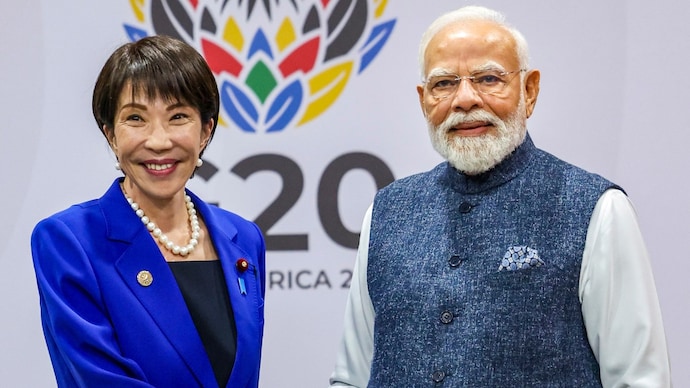

 Japanese prime minister Sanae Takaichi lands in New Delhi on July 1 for the 16th India-Japan Annual Summit, her first official visit to India, with an agenda officials describe as spanning trade, defence technology, semiconductors, critical minerals and supply-chain resilience. The summit is in the capital. The strategy it advances begins 2,000 km east, in the hills and riverine plains of India’s Northeast.
In fact, New Delhi and Tokyo had floated Assam as the venue before Takaichi’s parliamentary schedule in the Diet forced the shift. The consideration alone signalled how far the region has travelled in Japanese strategic thinking: from a peripheral, aid-absorbing frontier to what Tokyo now treats as the physical hinge of its India policy.
The logic is geographic before it is economic. The Northeast connects to mainland India only through the Siliguri Corridor, the 20-22 km ‘Chicken’s Neck’ wedged between Nepal, Bhutan, Bangladesh and China’s Chumbi Valley. It is the sole terrestrial lifeline for over 40 million people. Since the 2017 Doklam standoff with China, India has treated the area as its most acute chokepoint. Against that backdrop, every road, bridge and waterway that gives the Northeast an alternative to Chicken’s Neck becomes strategic insurance.
For Japan, whose own security depends on stable sea lanes and diversified supply chains, a better-connected eastern India is an alternative corridor that reduces exposure to chokepoints and to Chinese pressure across the region. Japan grasped this earlier than most external powers, and it has spent accordingly. Through the Japan International Cooperation Agency (JICA), Tokyo is the only foreign partner running large-scale projects across the region.
As Japan’s ambassador to India Ono Keiichi told the Advantage Assam 2.0 summit in Guwahati in February 2025, Tokyo has provided over Rs 22,000 crore for roads, water, power, healthcare and biodiversity. The institutional vehicle is the India-Japan Act East Forum, set up during former Japanese prime minister Shinzo Abe’s September 2017 visit, which fuses India’s Act East Policy with Japan’s Free and Open Indo-Pacific vision. External affairs minister S. Jaishankar has credited the forum with securing priority treatment for Northeast projects in Tokyo.
The evidence that this is now delivery rather than intention sits on the ground in Assam. The flagship Dhubri-Phulbari bridge, a 19.3-km cable-stayed span on NH-127B backed by a Rs 4,997-crore JICA loan, was 67.5 per cent complete in December 2025. It is monitored directly by the Prime Minister’s Office, with L&T executing against a September 2028 deadline. When it opens, it will collapse a 205-km-long, six-to-seven-hour detour into a 20-minute crossing between Assam and Meghalaya.
In central Assam, Tata’s Rs 27,000 crore semiconductor assembly-and-test facility at Jagiroad, billed as India’s largest, is nearing first production, with the Union government saying this May that output should begin within the current financial year. Japanese firms are already inside that ecosystem: Tokyo Electron has an equipment and training partnership with Tata Electronics, and Japanese vendors joined the supplier roster at Advantage Assam 2.0.
Around these sit Guwahati’s water and sewerage systems, the Umiam-Umtru Stage-III hydro renovation in Meghalaya, forest management in Tripura and Nagaland, a medical college in Kohima, and a bamboo value chain launched in 2022.
Takaichi is the most explicit inheritor of the Abe legacy in Japanese politics, styling herself as Japan’s ‘Iron Lady’ and carrying forward his strategic enthusiasm for India. As a former economic security minister, she sees diversification away from China not merely an economic choice but a national-security imperative. Her hawkish outlook, pro-Taiwan posture and emphasis on “industrial deterrence” make India’s Northeast especially important to Tokyo, as the physical hinge of any strategy designed to counter Chinese encirclement.
Takaichi arrives in India with what analysts have begun calling the “Takaichi Doctrine”, a framework that treats economic security as an extension of national defence. In this view, supply-chain resilience, semiconductors and technological sovereignty are not commercial priorities alone but pillars of Japan’s strategy against a China it cannot match on scale. National security begins not only on the battlefield but also in factories, supply chains and industrial policy. “Industrial deterrence” is the conversion of manufacturing capacity and technological independence into instruments of national power.
Assam and the Northeast fit into this logic. A semiconductor plant that shifts packaging capacity away from East Asia, a bamboo-to-biofuel chain that localises feedstock, and skilling pipelines that move labour on trusted terms all fit the doctrine’s demand for “friend-shoring”. Where Abe saw the Northeast primarily through the lens of connectivity, his most explicit political heir sees it as economic-security infrastructure.
Takaichi’s April 2026 overhaul of Japan’s defence-export rules, permitting lethal transfers to 17 partners including India, follows the same strategic logic. The co-developed UNICORN mast for Indian warships, produced with Bharat Electronics, strengthens the Indian Navy in the Bay of Bengal, the very waters into which the Northeast’s corridors are meant to open. Abe was the architect of the Free and Open Indo-Pacific and the great champion of Japan-India ties. Takaichi arrives with that enthusiasm intact, but with a sharper economic-security toolkit.
The demographic fit gives the partnership a second engine. An ageing, capital-rich Japan is pairing with a young, underemployed frontier of India. Meghalaya signed a memorandum in April 2026 to train and place 5,000 youth in Japan over five years. A larger Assam arrangement targets 20,000, with language and skill centres already running in Guwahati and frameworks under discussion with Nagaland and Manipur. Assam’s CM-FLIGHT scheme trains for Japanese-language proficiency and placement under Tokyo’s skilled-worker pathways. This is a lifeline for Japan’s caregiving, agriculture and manufacturing sectors, and a channel for capital and skills to flow back into the Northeast.
The relationship also carries an unusual emotional charge. In 1944, the twin battles of Imphal and Kohima marked Japan’s furthest advance into India and one of its most catastrophic defeats of the war. That history has since been repurposed for reconciliation. The Nippon Foundation-supported Imphal Peace Museum opened in 2019, and Japan and Nagaland inaugurated a Kohima peace memorial on the battle’s 80th anniversary. What was once a battlefield is now invoked as the foundation of a new friendship. Few bilateral relationships in the region rest on so deliberate a conversion of memory into trust.
Yet there are some unpredictable challenges. The sharpest sits across the border. Japan’s larger design—the ‘Bay of Bengal-Northeast India Industrial Value Chain’ that then prime minister Fumio Kishida unveiled in 2023— treats Bangladesh and the Northeast as a single economic zone, anchored on the JICA-built Matarbari deep-sea port that would give the landlocked region a direct outlet to the sea.
But Matarbari’s full commercial operation, at one point billed for 2026, has slipped to 2029-30 while Bangladesh’s politics has turned volatile. Sheikh Hasina, under whom the plan took shape, was toppled in August 2024. The interim government in Bangladesh tilted towards Beijing, and the February 2026 election returned a Bangladesh Nationalist Party government under Tarique Rahman that has promised to review inherited deals against “the country's interests”.
The trajectory since is repair rather than rupture. The connectivity projects have resumed, but a corridor that once assumed a stable, India-aligned Dhaka now runs through a ‘Bangladesh First’ government. The land route through Myanmar, meanwhile, remains frozen by civil war. For now, Japan’s Northeast strategy leans on the India-facing leg it can build directly, while the cross-border outlet it needs stays contingent on neighbours it cannot control.
Domestic frictions also pose challenges. JICA classifies key Northeast road projects as Category A for their environmental impact, and National Highways & Infrastructure Development Corporation Limited (NHIDCL) records show the familiar bottlenecks: land acquisition, utility shifting, forest clearances, the occasional terminated contract. The Dhubri-Phulbari bridge has itself drawn local eviction protests. These are the reasons strategic corridors miss strategic timelines. Private Japanese capital, wary of contested land and Manipur’s ethnic violence, has trailed public money at every turn. The proposed Japanese industrial township at Nagarbera, for which Assam acquired 2,000 bighas years ago, still sits idle for want of Japanese takers, a reminder that public loans move faster than private boardrooms.
Which is why the venue matters. A Guwahati summit would have forced both governments to showcase what has been delivered and confront what has not. A Delhi summit lets the conversation stay at the altitude of grand strategy, where communiqus are easy and follow-through is optional. The test of Takaichi’s visit is whether it names the Northeast and the Bay of Bengal value chain explicitly in the Joint Statement, whether the Act East Forum finally meets for an eighth time after a gap since February 2024, and whether the pipeline acquires faster timelines.
The region that hosted the twin catastrophes of Imphal and Kohima now sits at the intersection of India’s continental and maritime futures. Japan saw that intersection before New Delhi did, and it has bet more heavily on the Northeast than any other foreign partner. The question Takaichi and Prime Minister Narendra Modi leave unanswered is not whether Tokyo understands the region’s value. It is whether the two governments that mastered the summit can now master the follow-through.
Subscribe to India Today Magazine