From loom to global living rooms: How Bhadohi's carpet industry is getting an ODOP push
Bhadohi entrepreneurs said the Uttar Pradesh government's One District One Product scheme is strengthening the carpet industry by providing access to loans, subsidies, training, toolkits and trade fairs, helping businesses secure both capital and wider markets.
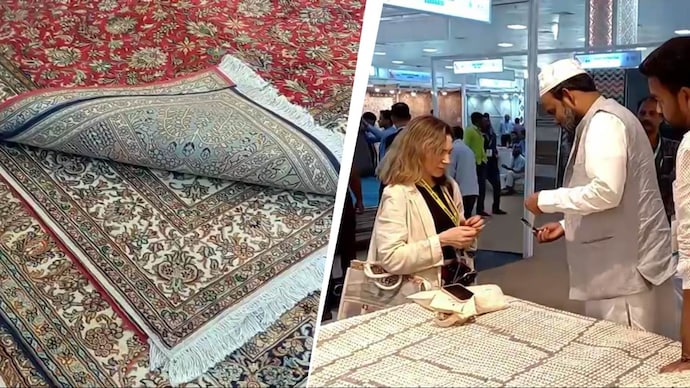

A Bhadohi carpet can take anywhere from four months to a year to make.
It passes through as many as 21 stages, from yarn to the finished piece. For the weavers, contractors and exporters behind one of India’s biggest handmade carpet clusters, that long production cycle creates a problem that has little to do with craftsmanship: money.
Raw materials have to be bought, workers have to be paid and production has to continue long before the final carpet is ready to be shipped and the exporter gets paid.
That is where entrepreneurs in Bhadohi say the Uttar Pradesh government's One District One Product, or ODOP, scheme is helping. Through loans, subsidies, training, toolkits and support for participating in trade fairs, the programme is giving different parts of the carpet industry access to capital and markets.
For Akshay Upadhyay, who runs a carpet weaving centre in Ramkapura village in Bhadohi's Gyanpur block, the support helped turn a small operation into a much bigger one.
"I got a loan of Rs 50 lakh under this scheme. With it, I am producing 2,000 carpets every month and more than 100 people have got employment," Upadhyay said.
He said the funding allowed him to expand his work, benefiting both his business and the people employed by it.

THE LONG WAIT FOR A CARPET TO PAY
The need for financing is particularly acute in the carpet business because of how long it takes to turn an order into revenue.
"In our industry, the production cycle is very long," said carpet exporter Piyush Barnwal. "A carpet goes through 21 processes, and making a single carpet can take four months to 12 months."
That is very different from industries where a product can be made, sold and paid for within days or weeks.
"We need capital, and the government is making it available on easier terms, through an easier process and with subsidy," Barnwal said.
He said he had used Rs 25 lakh in margin-money support under the scheme to expand his enterprise.
The financing matters in an industry where exporters may have orders in hand but still need money to keep production moving through months of weaving, processing and finishing.

Amit Maurya, a carpet exporter with Creative Rugs, said he took a Rs 2 crore loan under the ODOP scheme and received the subsidy attached to it.
"The work we do requires a lot of funds. If funds are available, the work can be done more easily," Maurya said.
His business exports heavily to the US, Europe and Australia, he said, while serving customers across other markets as well.
"All exporters should take advantage of it so that we can work properly and do not face a shortage of funds," he added.
FROM SMALL UNITS TO BIGGER ORDERS
The effect of easier access to financing is also visible among smaller businesses, according to Imtiaz Ahmed, a carpet exporter and administrative member of the Carpet Export Promotion Council.
"Small weavers and contractors are taking ODOP loans and setting up their own factories," Ahmed said.
Those units can employ 10 to 20 workers, he said, helping create jobs while increasing production.
"Our production is going up, and we are also able to complete our orders on time," Ahmed said.
According to him, around 200 to 250 people involved in setting up factories in Bhadohi district have benefited from the scheme. Several exporters have also used ODOP loans to establish or expand their businesses.

That is important for a carpet cluster like Bhadohi, where the industry is built around a large network of weavers, contractors, workshops and exporters. A loan to one entrepreneur can mean a new production unit, more looms and work for more artisans.
MORE THAN JUST LOANS
ODOP's support extends beyond financing.
Daya Shankar Saroj, Deputy Commissioner of Industries, said the programme, launched in Uttar Pradesh in 2018, operates through several schemes.
One provides training and free toolkits. Another helps entrepreneurs obtain bank financing to set up or expand their units, with subsidies of up to 25%, he said.
There is also marketing assistance for entrepreneurs participating in fairs and exhibitions, undertaking exposure visits or preparing promotional material such as catalogues.
"If someone works as a cluster and needs government support because they do not have sufficient funds, the government can also provide assistance under the Common Facility Centre scheme," Saroj said, adding that grants can cover up to 90% of eligible support in such projects.
According to the figures provided by the Industries Department, 2,350 people have received training and toolkits under the programme. A total of 347 beneficiaries have received financing support, while 546 people, ranging from weavers to exporters, have received assistance to participate in fairs and exhibitions.
FROM BHADOHI TO THE WORLD
Bhadohi's handmade carpets already have a global market. The district's carpet industry exports to more than 88 countries, including the US, Germany, France, Britain, Australia, Japan and countries in the Middle East.
The larger Bhadohi carpet belt accounts for more than 60% of India's roughly Rs 13,000-crore carpet exports, according to figures in the report.
But global demand alone does not solve the industry's problems. A traditional business can have skilled artisans and overseas buyers yet still struggle if entrepreneurs cannot finance production or access new markets.

That is the gap the ODOP programme is trying to fill.
For Upadhyay, it meant expanding production to 2,000 carpets a month. For Maurya, it meant access to capital in a business where large sums can remain tied up for months. For Ahmed, it has helped smaller weavers and contractors set up factories of their own. And for Barnwal, it addresses a fundamental reality of the industry: a carpet may take up to a year to make, but the costs start accumulating from day one.
The loom remains at the centre of Bhadohi's carpet industry. But increasingly, so do the loan, the subsidy, the toolkit and the trade fair that takes a locally made carpet to buyers thousands of kilometres away.