
Defeat to dominance? How non-NDA parties are boosting BJP's confidence on delimitation bill

The BJP-led NDA fell 54 votes short of the two-thirds majority needed to pass its delimitation and women's reservation legislation in April 2026. Eight months on, the BJP is confident of getting it passed. This is how changing political equations have altered parliamentary maths in a few months.
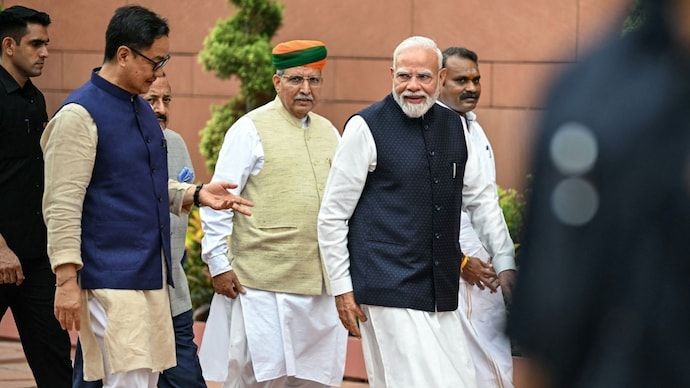
Prime Minister Narendra Modi along with fellow lawmakers arriving the address media on the first day of the monsoon session of the parliament in July. (Image: AFP)
New Delhi,Nov 27, 2026 13:58 IST Last UpdatedNov 27, 2026 13:58 IST
 Published by
Last UpdatedNov 27, 2026 13:58 IST Published byAvinash Kateel
Nov 27, 2026 13:07 ISTJust eight months ago, the BJP-led NDA government fell short of the numbers needed to push through its delimitation and women's reservation legislation. It was the first time in 12 years of Prime Minister Narendra Modi's tenure that a major government bill had been defeated on the floor of Parliament. Now, the political arithmetic appears to have changed. With reports of back-channel conversations with opposition MPs, possible support from regional parties and fresh proposals to address concerns raised by southern states, the BJP-led government is preparing for another test of strength in Parliament on the delimitation bill.
The government, which suffered a legislative defeat in April 2026 when its Constitution (131st Amendment) Bill failed to secure the required two-thirds majority, is now counting on regional parties, including the DMK and the Sharad Pawar-led NCP (SP), to bridge the gap. Then there are the rebel Trinamool Congress MPs who have flocked to the obscure NCPI.
The question is whether these additional political equations can deliver the numbers that the NDA could not muster in April. The BJP seems to be confident. The government kept the monsoon session alive well into the winter months.
After more than 100 days since Parliament was prorogued following the Monsoon Session, the government has now announced fresh sittings of both Houses.
Union Parliamentary Affairs Minister Kiren Rijiju on Thursday (November 26) said the Centre had requested the Lok Sabha Speaker and the Rajya Sabha Chairman to reconvene the Lok Sabha on Monday, November 30, and the Rajya Sabha on Wednesday, December 2, to transact "essential government business". Subject to the exigencies of business, the sittings of both Houses may conclude on December 2, 2026, he said.
According to news reports, the government is expected to use the session to introduce a fresh delimitation bill, with the revised proposals likely to address some of the objections that led to the earlier legislation's defeat.
FROM 293 IN 2024 TO 298 VOTES IN APRIL: THE BJP'S 2/3RD CALCULATION
The 2024 Lok Sabha election results left the BJP with 240 seats, 32 short of the 272 majority mark. Its allies contributed another 53 seats, taking the NDA's tally to 293.
The Telugu Desam Party, with 16 MPs, and the JD(U), with 12, were the two biggest pillars of the alliance. The Shiv Sena led by Eknath Shinde contributed seven MPs, while the Lok Janshakti Party (Ram Vilas) won five seats. Other allies included the Janata Dal (Secular) of Karnataka, Andhra Pradesh's Jana Sena Party and the UP-based Rashtriya Lok Dal.
The BJP thus formed the government with a cushion of 21 seats above the majority mark, but its dependence on regional NDA allies was evident.
That arithmetic was put to a different test in April 2026.
On April 17, the Constitution (131st Amendment) Bill, which sought to facilitate delimitation, expand the Lok Sabha and advance 33% women's reservation, was defeated in the Lower House.
Of the 528 MPs present and voting, 298 supported the Bill while 230 opposed it. Eleven MPs were absent. The government needed 352 votes, or two-thirds of the members present and voting, but fell short by 54.
The 298 votes in favour were five more than the NDA's original 2024 election tally of 293.
The bill's defeat exposed the difficulty of passing a constitutional amendment without support from the ruling alliance.
WHAT HAS CHANGED IN BJP'S NUMBERS IN PARLIAMENT NOW?
This time, the BJP is attempting to widen its support base by reaching out to regional parties and breakaway factions of Opposition parties.
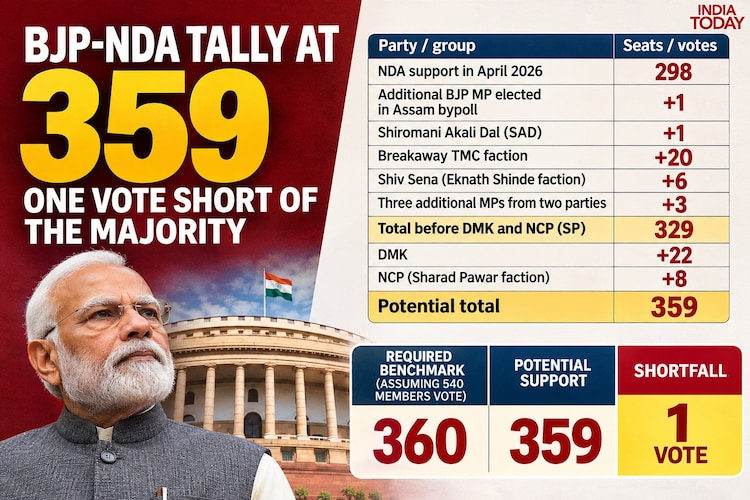
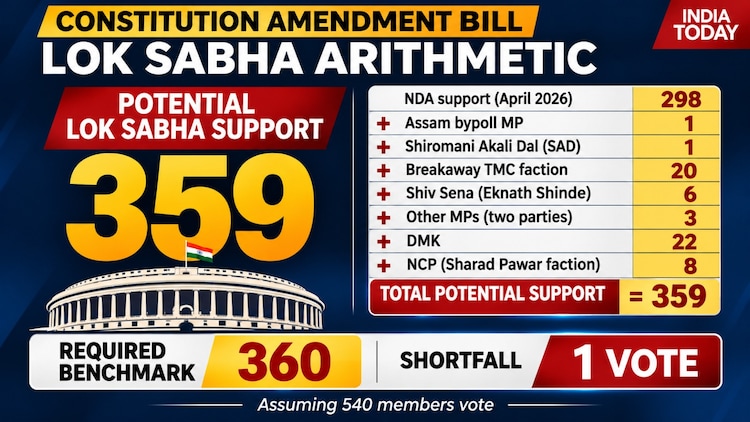
The NDA's current estimate of support is around 320 MPs. This figure includes 20 rebel Trinamool Congress MPs and one Shiromani Akali Dal MP. The possible backing of four YSR Congress Party (YSRCP) MPs could take the tally to 324.
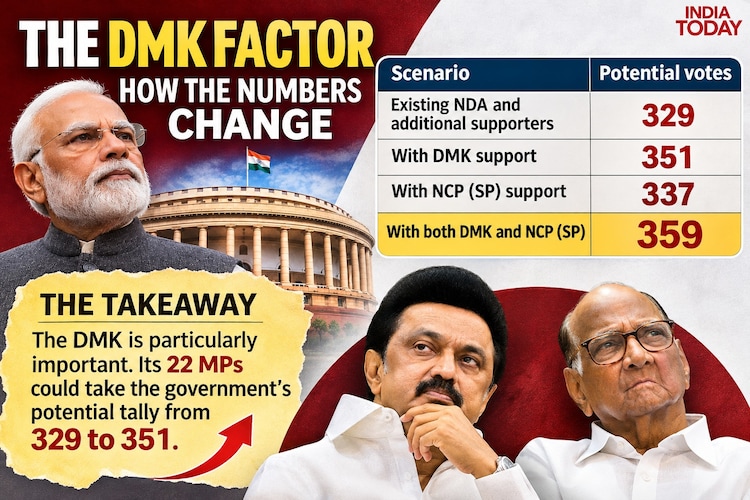
The government is also looking to secure the support of the DMK's 22 Lok Sabha MPs and the NCP (SP)'s eight MPs. If both parties back the legislation, the number could rise to 354.
However, even this expanded tally would leave the government short of the numbers required. With three Lok Sabha seats vacant, the effective strength of the House is 540. If all members vote, a constitutional amendment would require at least 360 votes, leaving the government six short even after accounting for the possible support of the YSRCP, DMK and NCP (SP).
The BJP, however, is not banking solely on these regional parties. According to a report in The Indian Express, the ruling party's leaders have indicated that six MPs from smaller parties have assured support. Another account suggests that three MPs belonging to two parties have individually agreed to back the legislation.
According to India Today TV's sources, the BJP leadership is reportedly aiming for around 380 votes, well above the 360-mark requirement.
WHY THE DMK'S 22 AND NCP-SP'S 8 MPs MATTER TO THE BJP
One of the biggest changes in the BJP's parliamentary arithmetic is the possibility of support from the DMK, which had opposed delimitation under its former CM MK Stalin but is now indicating that it might not oppose every proposal brought by the BJP-led government.
Two senior DMK leaders have told The Indian Express newspaper that the party could support delimitation if Tamil Nadu's existing share of roughly 7.2% of Lok Sabha seats is protected. The party's concern is that southern states, which have successfully controlled population growth, should not lose political representation when constituencies are redrawn.
The Centre's reported proposal to increase Lok Sabha seats by 50% uniformly across all states could address some of these concerns. The government is also considering delinking delimitation from the Census, according to India Today TV's Aishwarya Paliwal.
The DMK's strained relationship with the Congress, which ended its alliance with the Dravidian giant after the 2026 Assembly elections and joined the Vijay-led TVK government, could also influence its decision. For the BJP, the DMK's 22 MPs offer an opportunity to secure support beyond the NDA.
The other important regional player is the Maharashtra-based NCP (SP), which has eight Lok Sabha MPs. Its parliamentary leader, Supriya Sule, has said the party will examine the bill before deciding its stand, leaving open the possibility of support if it considers the legislation to be in the national interest. This is significant because the NCP (SP) is part of the INDIA bloc.
Together, the DMK and NCP (SP) account for 30 Lok Sabha MPs. If both parties back the legislation, they could substantially alter the arithmetic that defeated the government in April. The reported government support base of 324 MPs, which includes possible backing from rebel TMC MPs, the YSRCP and the Eknath Shinde-led Shiv Sena faction, could rise to 354 with the addition of the DMK and NCP (SP). That would still leave the government six votes short of the 360 required if all 540 sitting members vote.
WHAT IS THE MODI GOVERNMENT OFFERING TO PARTIES?
The BJP's renewed outreach is taking place alongside a possible change in the proposed delimitation framework.
According to India Today TV, the Union Cabinet is considering two proposals: a uniform 50% increase in Lok Sabha seats across all states and delinking the delimitation exercise from the Census.
The earlier proposal sought to expand the Lok Sabha from 543 to a maximum of 850 seats. However, the April draft did not explicitly incorporate the assurance of a proportional 50% increase in seats for every state. This became a major point of disagreement with regional parties, particularly the DMK and the NCP (SP).
The government is now attempting to address that concern before the special sitting of Parliament, scheduled from November 30 to December 3.
The Cabinet meetings — which are underway at the time of the publication — consideration of a revised proposal could therefore be crucial in determining whether the regional parties translate their conditional support into votes.
The numbers show why the BJP is looking beyond the NDA and seems confident. In 2024, the alliance's 293 seats were sufficient to form the government. In April 2026, 298 votes were not sufficient to pass a constitutional amendment. This time, the government has the numbers that it is attempting to assemble a broader parliamentary support beyond the NDA.
- Ends

Avinash Kateel is a multimedia journalist with the India Today Group (Digital), and a cub reporter. His heart belongs to coastal Karnataka, but his mind closely tracks the politics of the entire country and the policies that shape India and the world. From geopolitics to the economy, Kateel covers anything that makes news. He believes in breaking down complex stories into simple versions because news matters when readers understand it.
READ MORE