
Can Congress field OBC PM face? Karnataka Minister responds to BJP leader's dare

Karnataka BJP leader Arvind Bellad challenged the Congress to say whether it would back an OBC prime ministerial face over Rahul Gandhi. State minister Santosh Lad replied that wider OBC representation in legislatures and institutions is the real issue.
 Last UpdatedSep 29, 2026 14:47 IST
  Published byWritten ByPrateek Chakraborty
Karnataka BJP MLA and Deputy Leader of Opposition Arvind Bellad challenged Congress leader Rahul Gandhi to clarify whether he would drop himself and back an OBC candidate for the prime ministerial post. Congress leader and Karnataka Labour and Employment Minister Santosh Lad responded, asserting that greater political representation for OBC communities was the larger issue.
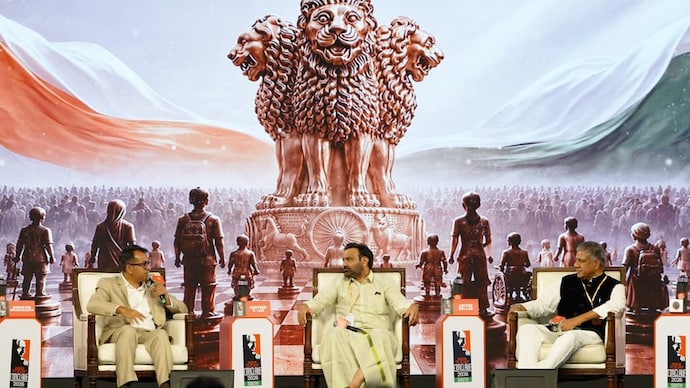
Speaking at the India Today Conclave South 2026, Bellad said it was “very surprising” that Rahul Gandhi had “suddenly woken up” to champion the right of ensuring reservations for the OBCs. He also targeted the Congress's position on implementing the Mandal Commission.
“It is very surprising that Rahul Gandhi has suddenly woken up. The Rajiv Gandhi government had opposed implementation of the Mandal Commission recommendations, while the subsequent Janata Dal government implemented them,” he said.
Challenging Rahul Gandhi, Bellad said, “Our current Prime Minister is an OBC PM. Can Congress say the next Prime Minister will not be Rahul Gandhi and be an OBC? If he says that, we'll appreciate and accept that whatever Congress is taking a stand is right.”
However, Lad rejected the suggestion that having an OBC Prime Minister or Chief Minister by itself addresses the issue of representation. “If somebody becomes the Chief Minister or Prime Minister from OBC, it doesn't mean he's representing the entire society. We are talking about larger interests,” Lad said.
“(PM) Modi doesn't represent 3,743 communities. How many people are representing in the Assembly, Parliament and system? This is the question which we are raising,” he said.
DIFFERING VIEWS ON RESERVATION
Lad said OBC representation should be considered across political institutions and argued that the issue was larger than the identity of an individual occupying the top political post. He said OBC communities should get greater opportunities and representation in Assemblies and Parliament.
The minister said the caste census could provide data needed to assess the representation of OBC communities. He pointed to the 27 per cent reservation for OBCs in education and employment and said Karnataka provides around 32-33 per cent reservation for OBCs in local bodies.
“So why not the same people to be given a chance in Assembly and Parliament?” Lad
Bellad cited Karnataka's large OBC population and said various commissions had recommended reservations for the community. He alleged that an OBC commission report submitted during the Congress government's tenure had not been accepted.
Asked about the delay in the release of Karnataka's caste census, Lad said the survey would be out in the next few months. “As far as the census is concerned, we are in the last leg now. Maybe in due course of time, in a month or a few months, this census will definitely be coming out,” Lad said.asked.
He argued that the reservation issue was not merely about having an OBC individual occupy a top political post but about representation across institutions. “Reservation is not a placement, is not an appeasement. Reservation is a right. Reservation is a representation, it's not a charity,” he said.
EMPERICAL DATA FOR CASTE CENSUS
Lad said empirical data was necessary to determine the social and economic status of different communities before deciding on representation. “Let the central government or state, let the Parliament decide... there has to be empirical data. A proper census to be made on who is OBC and who is not,” the Congress leader added.
Bellad agreed that data was necessary but emphasised that reservation should ultimately be used to empower communities. “Any reservation is a tool. It is not the end result. Reservation as a tool we should use and empower the people,” he said.
On the nationwide caste census, Bellad said the exercise could provide detailed information on the progress of different communities.
“We are going to get very detailed empirical data of all the castes, all the people of the country. What is the progress we have seen in the last 75 years? Which community has progressed how much? What is the educational status? What is the entrepreneur status? What is the economic status of all the communities?” he said.
Bellad said decisions on reservation and representation should be based on such data and should be consistent with the Constitution and subject to judicial scrutiny.