
Farooq Abdullah says J&K govt is 'walking on razor's edge' amid financial constraint

Farooq Abdullah said the Jammu and Kashmir government was working within severe constraints at a Srinagar conclave. He linked its limited room for action to the larger erosion of autonomy after Article 370 was revoked.
 Last UpdatedOct 4, 2026 23:31 IST
  Published by
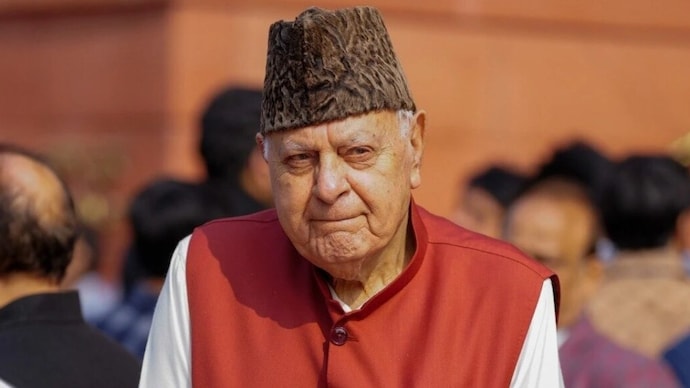
National Conference president Farooq Abdullah on Sunday said the Jammu and Kashmir government was working under severe constraints and was "walking on the razor's edge", but added that it was still trying its best for the people.
He said the administration was doing what it could within limited resources and difficult circumstances.
Speaking at the fifth 'Halla Bolle' conclave in Srinagar, the ruling party chief also spoke about the country's political climate, the 2019 abrogation of Article 370, and Jammu and Kashmir's autonomy.
He criticised those he said had weakened the region's self-rule over the years and urged people to stand on their own feet.
"The government is doing its work to the extent it can. But if you demand that we fetch the moon and stars, that is not possible. Look at the circumstances under which we are working. We are walking on the edge of a sword, and on that razor's edge, we are trying to do as much as possible," Abdullah said.
The three-time chief minister said the government was working for the betterment of the people despite the constraints.
"Our ministers are not sitting idle; they are constantly on the move. Even today, they are out reaching the people. We are trying to reach everywhere within the resources we have. If we had vast oil and gas reserves, god knows where we would have reached. But we don't. And the financial reality is that we have had a setback; for a year, we have had to carry that burden. There was nothing left. Even then, by god's grace, we are keeping our heads high," he said.
Abdullah said people often wanted more without recognising what they already had.
"I have seen the past, and I am seeing the present as well. Given the reality before us, this government is trying to do as much as it can," he said.
Turning to national politics, the NC president said people were being divided in the name of religion.
"You know the condition our country is in; it is filled with hatred. Human is being pitted against human, be it over a temple, a mosque, a gurdwara or a church," he said.
Referring to the abrogation of Article 370, Abdullah said the BJP had long wanted it removed because Jammu and Kashmir was the only Muslim-majority state.
"This is not new; since Jawaharlal Nehru's time, this has pricked their eyes. They think we should be their slaves. We bid farewell to slavery when India gained freedom, and we tried to stand on our own feet," he said.
He added that people from within Jammu and Kashmir were also responsible for eroding its autonomy.
"But because of conspiracies, our own people tried to sell out this homeland for the sake of power and position. I do not consider Delhi as the sole culprit; I consider our own people responsible. Those who surrendered our autonomy, who dismantled our self-reliance," he said.
Without naming the PDP, Abdullah criticised the party for "helping" the BJP abrogate Article 370 by forming a government in Jammu and Kashmir in 2014-15.
He said successive governments had struck down every law that had kept the region's autonomy alive. "Conspiracies were taking place then; they are taking place today, and our people are still selling out. For a few positions and perks, they are ready to trade not just autonomy, but even their self-respect," he said.
"Until we develop that inner strength, we are distant even from god. We meaninglessly show off that we offer Friday prayers, but there is no fear of god."
On Jammu and Kashmir's accession to India, Abdullah said the relationship was "temporary" and was supposed to be decided through a referendum under United Nations supervision.
"The tragedy is that the relationship of this state with the nation was temporary. It was supposed to be decided through a referendum under the supervision of the United Nations. And under that framework, whoever was to conduct it would come from outside, and Pakistan was required to withdraw its troops from the territories it occupied. That was the precondition," he said.
He said the process was never implemented because of objections from both India and Pakistan.
"When it came to implementation between the two countries, what happened? Whenever an observer arrived, India would say, 'he is pro-Pakistan; we will not accept him'. When another came, Pakistan would say, 'he is pro-India; we do not accept him'. And amid this deadlock, that referendum never took place. Even today, it remains in the United Nations statutes, which our neighbour raises every day," he said.
Abdullah said Jammu and Kashmir's special status should have been made permanent.
"Autonomy was temporary only because a final decision had not taken place – whether we were part of India or part of Pakistan. Therefore, when this issue of autonomy came, and when India stated that 'now we do not accept a referendum to take place; Kashmir is an integral part of India', Article 370 should also have been made permanent. But they kept saying it was temporary," he said.
"This is where the tragedy lies. They tried to erode that autonomy at every stage, at every time, and started extending their own central laws here, which steadily diminished our autonomy. That is the reality."
He also urged people to become self-reliant. "We have to go begging for everything. I know how many times I had to talk to (then J-K governor Girish Chander) Saxena. He genuinely helped us. We don't do anything ourselves. Today, even when it is time to harvest paddy, we look for Bihari labourers. We won't even do that ourselves. That is our reality," Abdullah said.