54 cancer deaths in Gujarat villages, locals blame factories for water pollution

Villagers from five Dholka villages have continued a sit-in over alleged chemical contamination of drinking water. They say years of illness, cancer cases and unanswered complaints have pushed them to demand action.
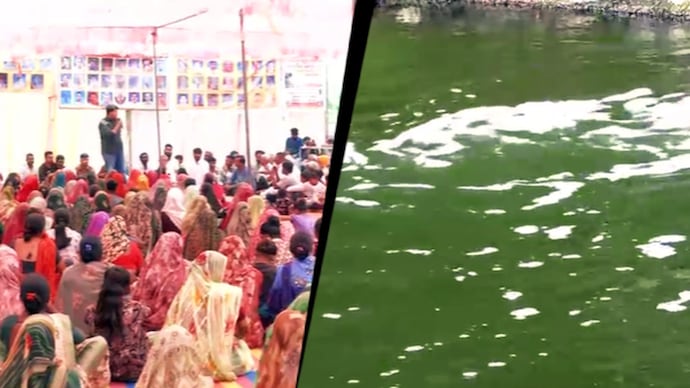

A protest over alleged chemical contamination of drinking water has entered its 12th day in five villages of Dholka in Gujarat's Ahmedabad district, with residents claiming that 54 people have died of cancer over the past seven years.
Villagers from Bhetavada, Trasad, Nesda, Paldi and Ambareli have accused factories operating near their homes of releasing chemical-laden water into drains, which they say eventually contaminates groundwater and village borewells.
The protesters say they have been dealing with contaminated water for nearly 15 years and that repeated appeals to the panchayat, municipality, Gujarat Pollution Control Board (GPCB), local MLA, district administration and the state government have failed to resolve the issue. They are now staging a sit-in at Bhetavada, demanding action to protect their families.
VILLAGERS CLAIM 54 DIED OF CANCER
According to local residents, 54 people from the five villages, including 21 from Bhetavada, have died of cancer in the last seven years. They claim that around 20 people are currently battling cancer, while skin diseases have become common among residents.
Chirag Prajapati, a villager participating in the protest, alleged that chemical-laden water discharged by private companies enters a drain passing through the village. According to him, the contaminated water mixes with groundwater and eventually affects the water available through borewells.
Villagers further claimed that the cancer cases include different forms of the disease, including oesophageal cancer, and said those who died had no history of substance abuse.
They also alleged that five factories continue to operate in the area. According to the protesters, municipal wastewater and factory effluents are discharged into the same drain.
The villagers said the discharge of chemical-laden water has stopped since the protest began, but claimed that such water was being released into the drains until around 15 days ago. They also alleged that factories sometimes release the water under the cover of darkness.
The protesters said a GPCB team has collected water samples, but the reports have repeatedly shown "NIL" contamination. They also said the district collector visited the area after learning about the protest, but claimed that no concrete response followed.
For the first time during the protest, a health team visited the area to provide medicines to residents suffering from skin ailments.
DRAIN NEAR SCHOOL ADDS TO FEARS
A drain carrying what villagers describe as chemical-laden and contaminated water passes near a government school in Bhetavada.
Residents claim that contaminated water frequently appears in the school's borewell, adding to parents' fears about sending their children to school.
The protesters say people of all age groups are being affected, with even young children suffering from skin problems.
The issue has also heightened fears around groundwater, with many residents now reluctant to drink water from their village borewells.
14-YEAR-OLD BOY'S FAMILY HIT BY CANCER
Among those at the protest site is 14-year-old Akshay Navganbhai, a Class 9 student from Bhetavada.
Holding his medical records, Akshay broke down while speaking about the impact cancer has had on his family. His grandmother, father and uncle have all developed cancer.
His grandmother and father had died of the disease. Akshay lost his father just a month ago, while his uncle has undergone surgery for cancer.
Akshay lives with his mother and two sisters. His mother is a homemaker.
FAMILIES LEFT BURDENED BY CANCER TREATMENT
The protest has brought forward several families who say they have lost loved ones to cancer or are still struggling with the disease.
Thirty-two-year-old Harshad Makwana, a resident of Bhetavada, is battling oesophageal cancer. He underwent treatment at a private hospital in Ahmedabad three months ago, at a cost of around Rs 10 lakh, and continues to undergo routine check-ups.
Harshad had already lost his elder brother and mother to cancer. He said around Rs 15 lakh was spent on his brother's treatment shortly before his death.
Another family is caring for both parents after they were diagnosed with cancer.
Nareshbhai told India Today that his 51-year-old father, Bhagwan Makwana, developed oral cancer six months ago. He said his father had no history of substance abuse and underwent surgery in Ahmedabad costing Rs 5 lakh. Since the operation, he has been unable to speak properly.
Two months later, Nareshbhai's mother, Vilas Makwana, was diagnosed with a cancerous tumour in her stomach. She underwent surgery that cost Rs 4 lakh.
The family said it arranged the money for both treatments by selling jewellery and mortgaging farmland.
Nareshbhai's grandfather had also suffered from laryngeal cancer and died of the disease eight years ago.
'WE HAD TO SELL LAND FOR TREATMENT'
Ravindrabhai, whose father Laljibhai developed throat cancer four years ago, said his father's treatment cost around Rs 4 lakh. He is now unable to speak properly.
Ravindrabhai attributed his father's illness to the contaminated water and said the family now depends on an RO plant for drinking water.
The family pays Rs 5 to Rs 10 a day to collect water from a private company's RO machine installed near the village borewell.
Kajal Makwana said her father, Manubhai, died of throat cancer in 2022.
His illness began during the Covid-19 pandemic. Kajal said the family had to keep oxygen cylinders at home as his condition deteriorated and that he was eventually unable to eat.
His treatment cost around Rs 8 lakh. The family depends on farming for its livelihood, but Kajal said she had to discontinue her studies because of the expenses incurred during her father's treatment.
Thirty-five-year-old Gautam Makwana of Bhetavada died of cancer in June 2022, leaving behind his wife and two children.
His wife, Sangeetaben, said Gautam had oral cancer and underwent surgery twice at a private hospital. The treatment cost more than Rs 10 lakh.
The family sold jewellery to pay for the first surgery and farmland for the second, but Gautam could not be saved.
SKIN DISEASES ADD TO VILLAGERS' WOES
Cancer is not the only health concern being raised by residents. Villagers say skin diseases have become widespread in Bhetavada and the surrounding villages.
Dr Dhyey Parmar, who works at the Ambuja Foundation health centre in Bhetavada, said he has been at the centre for the past eight months. According to him, most patients visiting the centre seek treatment for skin ailments.
Dr Parmar said such skin problems are generally caused by pesticides or chemicals and that treatment can take a long time. He also said there is a risk of these conditions spreading through contact with affected people.
Labhuben, a resident suffering from a skin condition, said treatment can continue for one and a half to two years. She said some people have spent up to Rs 25,000 on medical treatment.
Taraben, another resident suffering from a skin ailment, said hair loss had also become a routine problem in the village. She and her father-in-law have both been suffering from skin problems and have required medicines for several months, costing thousands of rupees.
She said villagers had been protesting for justice and felt that their concerns were not being heard.
RO PLANT BECOMES ANOTHER POINT OF CONTENTION
With villagers increasingly afraid to use borewell water, an RO plant has been installed at the village borewell, allowing residents to collect drinking water.
However, locals Chirag Pandav and Ajay Makwana told India Today that the RO plant belongs to the private company against which they are protesting.
They alleged that residents have to pay Rs 5 for hot water and Rs 10 for cold water. The system operates through a rechargeable card, and water is not dispensed if the card does not have sufficient funds.
The protesters have therefore questioned why villagers have to pay for drinking water while simultaneously holding the company responsible for the alleged contamination.
VILLAGERS THREATEN GANDHINAGAR MARCH
The villagers said the protest would continue until September 8.
One of the protesters said that if their concerns are not addressed, they plan to travel to Gandhinagar and lay siege to the Gujarat Legislative Assembly during its session.
The protest has brought together a large number of residents, including women from all five villages, who say their demand is for action over the alleged contamination of their water sources and the health problems they believe are linked to it.
Ahmedabad Chief District Health Officer (CDHO) Dr Rajnikant Kapadia told India Today that the cause of cancer in the five Dholka villages is a matter that requires investigation.