
India to have 2nd-largest global Muslim population by 2070, Hindu share to dip: Study

A new study by Pew Research Centre has revealed that India's religious composition is likely to shift gradually. While India will remain a Hindu-majority country, it will have the world's second-largest Muslim population after Pakistan by 2070.
 Last UpdatedNov 19, 2026 15:09 IST
 Published byWritten ByAbhishek De
India will remain a Hindu-majority country for the next several decades, but it will be home to the world's second-largest Muslim population after Pakistan by 2070, according to a new study by Pew Research Centre. The study, which has predicted that Muslims would overtake Christians as the world's largest religious group by 2035, reveals a gradual change in India's religious makeup.
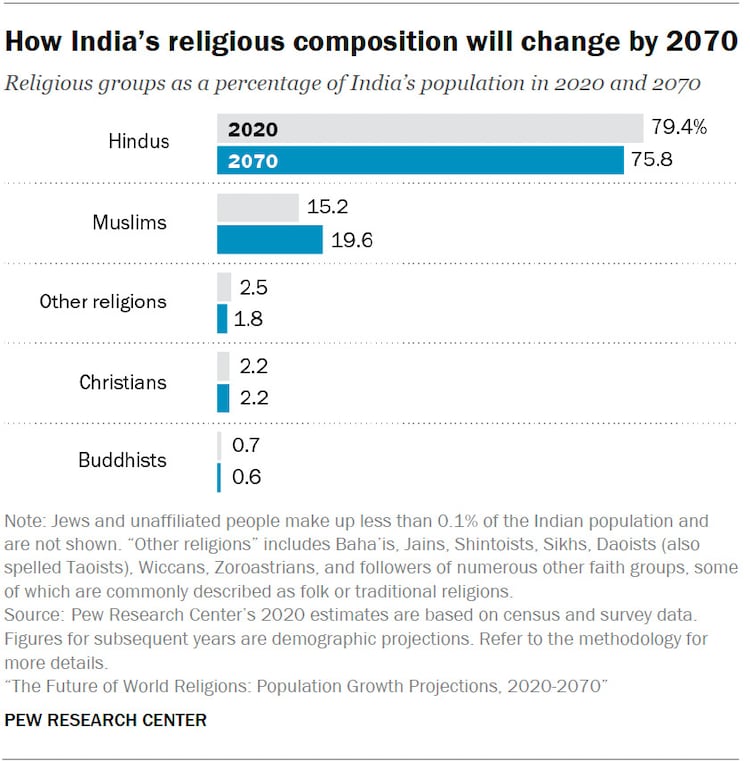
As per the study, Hindus will account for 76% of India's population in 2070, down from 79% in 2020. The share of Muslims, meanwhile, is projected to increase from 15% to 20%. Age and fertility have been cited by Pew as reasons for the change. As per the report, Indian Muslims, on average, are younger than Hindus and have more children. Thus, their numbers are projected to grow faster, even though the overall fertility has fallen.
The study, released on Wednesday, basically projects how the world's religious composition will change over the next five decades. For it, Pew examined changes in seven religious groups across 201 countries. Together, they account for 99.98% of the world's population.
We have already covered Pew's global religious population projection here. In this article, we will focus on what the study says about India. Its projections point to a gradual but significant shift in India's religious composition over the next 50 years.
WHAT PEW RESEARCH SAID ON INDIA'S HINDU POPULATION?
As per the study, India's Hindu population will increase from 1.11 billion (111 crore) in 2020 to 1.29 billion (129 crore) by 2070, a rise of around 176 million (17.6 crore). However, Hindus are expected to account for a slightly smaller share of the country's population.
Basically, while India's Hindu population will see a rise in absolute numbers, its share of the total population is expected to decline. This distinction is important.
Two years ago, a study by the Economic Advisory Council to the Prime Minister (EAC-PM) also revealed a shrink in the share of Hindus in India.
The report revealed that the share of Hindus declined sharply by 7.8% between 1950 and 2015. In contrast, the share of minorities, including Muslims, Christians, Buddhists and Sikhs, went up
THE REASON BEHIND THE NUMBERS
As mentioned above, the Pew study attributes this likely shift to fertility rates and the younger age profile of Muslims. In 2020, Indian Muslims had a median age of 24, compared with 29 for Hindus.
Moreover, the average number of children per Hindu woman is estimated to have fallen to 1.9 from 3.3 three decades ago, as per the study.
Between 2025 and 2030, Pew has forecast that Muslim women in India will have an average of 2.3 children, against 1.8 among Hindu women.
Nevertheless, Hindus will remain India's largest religious community, accounting for more than three-fourths of the population by 2070.
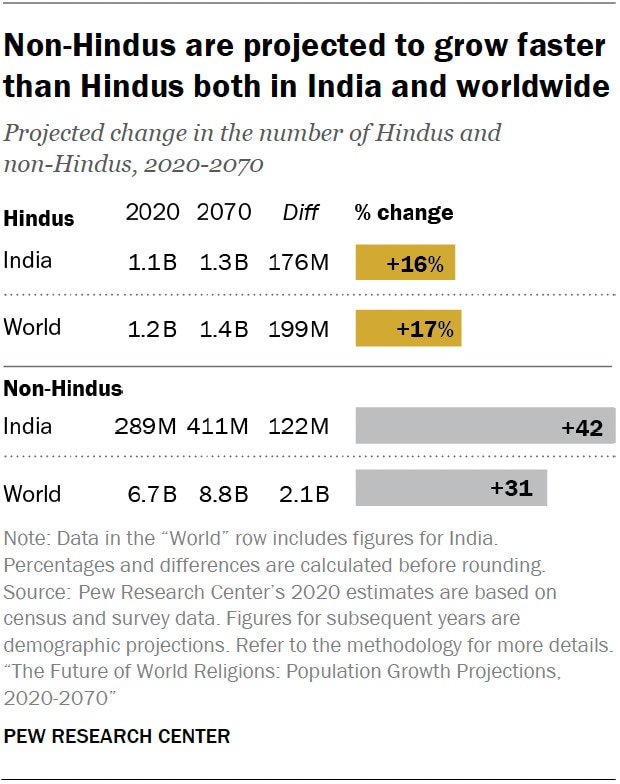
In 2020, India had an estimated 1.11 billion Hindus, accounting for 94.5% of the global Hindu population. By 2070, while this number will rise to 1.29 billion, India's share of the world's Hindu population will fall slightly (93.6%).
If we see the global picture, the Hindu population is projected to increase by 199 million over the same period. However, its share of the world's population is expected to marginally dip from 15% in 2020 to 14% in 2070.
Outside India, Pakistan and the US are expected to see a growth in the Hindu population, as per the Pew study. Pakistan's Hindu population is projected to nearly double, rising from 5 million to 10.3 million. This is likely to be driven by natural population increase, with births exceeding deaths.
The US is projected to have the world's fifth-largest Hindu population, rising to 7.4 million by 2070. Immigration has been cited in the report as the main contributor.
WHAT STUDY SAID ON INDIA'S MUSLIM POPULATION?
The study has pegged India's Muslim population to rise from 213 million (21.3 crore) in 2020 to 334 million (33.4 crore) by 2070. This will push India from third to second place among nations with the largest Muslim population.
As per the Pew study, India is expected to account for 9.2% of the global Muslim population by 2070.
In 2020, Indonesia had the world's largest Muslim population, followed by Pakistan and India. By 2070, Indonesia is expected to be overtaken by Pakistan, which is projected to have 461 million Muslims. Nigeria is projected to rank third, followed by India.
Experts said the projection of the rise in India's Muslim population is not surprising.
"Muslims are younger and have higher fertility rates," Stephanie Kramer of the Pew Research Centre told the BBC.
"Hindu fertility is already below the replacement level. Muslim fertility is projected to remain above it for another two decades," Kramer explained.
A replacement level is the rate at which new births are sufficient to maintain a stable population from one generation to the next.
WILL THESE PROJECTIONS COME TRUE?
It must be kept in mind that these demographic predictions are based on factors like fertility rates, mortality, and migration. For the report, Pew used the year 2020 as the baseline.
Five decades is a long time. Demographic trends can change. Economic conditions, health-related issues, migration, conflicts, government policies and social behaviour can all influence population growth.
At best, the study presents a possible picture of the world's religious map only if the 2020 demographic patterns continue.

Senior Assistant Editor at India Today, covering foreign affairs, geopolitics, defence and politics. Enjoy breaking down complex global developments, from strategic conflicts and military doctrine to diplomatic shifts, into sharp, accessible reporting. Also track South Asia's evolving security landscape.
READ MORE