Their husbands were India's bravehearts. These women carried their legacy forward

Speaking at India Today's Women's Summit, Lieutenant Colonel Romy Randhawa, India's first Veer Nari and widow of Major Sukhwinder J Randhawa, and Alka Ahuja, widow of Kargil braveheart and Vir Chakra awardee Squadron Leader Ajay Ahuja, revealed how they rebuilt their lives and carried forward their husbands' legacies forward.
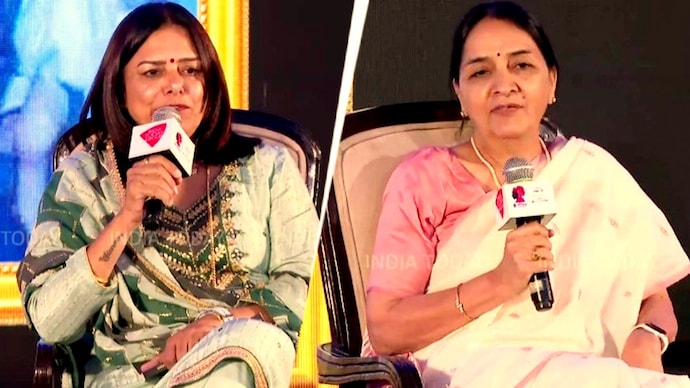

Being married to a soldier means living with the knowledge that the person you love may one day be called upon to make the ultimate sacrifice for the country.Alka Ahuja, widow of Kargil braveheart and Vir Chakra awardee Squadron Leader Ajay Ahuja, and Lieutenant Colonel Romy Randhawa, whose husband Major Sukhwinder J Randhawa was killed in an anti-terror operation in Jammu and Kashmir, faced grief in very different circumstances but found strength in remarkably similar ways.
Speaking at India Today's Women's Summit, Ahuja and Lt Col Randhawa explained how they raised their children, rebuilt their lives, and in their own ways, carried forward the legacies of their husbands. One turned her husband's courage into the strength to build an independent life; the other joined the Army herself—eventually becoming India's first Veer Nari to be commissioned as an Army officer and helping open a path for other women like her.
BRAVEHEART'S WIDOW TO FIRST VEER NARI
When Major Sukhwinder J Randhawa, a 1997 Kirti Chakra awardee, was killed in an anti-terror operation in Jammu and Kashmir, his wife Romy Randhawa was left with a one-and-a-half-year-old daughter and a life she had never imagined for herself. What followed would not only change the course of her own life, but also open a new path for other war widows—or Veer Naris—seeking to join the Indian Army.
Recalling her simple life from a small village near Tarn Taran in Punjab, she said that for her family, moving to a city itself was a significant step. She married Major Randhawa in October 1994 after a year of courtship, and in 1997 – after their daughter's first birthday - he was posted with the 2nd Battalion of the Rashtriya Rifles in the Anantnag-Shopian area of Kashmir, then deeply affected by militancy.
Then came the news in June 1997. In an operation called 'Rakshak', Major Randhawa was grievously injured after being shot. "I received the news that he had been shot and was being moved to Chandigarh. I was at my sister's home, surrounded by women from the family. By the time we reached there, we knew," she said at the summit.
"But the thing is, until you see it, you don't believe it."
Lt Colonel Romy Randhawa had little time to grieve. She had a young child to raise and, she realised, a future to build. Speaking about her decision to join the Army, she said it was also shaped by something her husband had repeatedly told her. A soldier himself, he had often spoken about the Army as the best organisation and said he wanted to raise their daughter within that environment.
"Maybe he was preparing me," she said.
But joining the Army was not an option available to her under the rules then in place. She was 27, while the upper age limit was 25. The recruitment criterion for women officers also required them to be unmarried. Nevertheless, she approached Ranjana Malik, the then president of the Army Wives Welfare Association and wife of then Chief of Army Staff General Ved Malik.
"She (Ranjana Malik) was shocked because I did not fulfil the criteria for joining the Army," Lt Col Randhawa recalled.
But Malik promised to help. She subsequently took up the matter with her husband, and together they brought about a fundamental change in the rules, allowing Veer Naris to seek commissioning in the Army.
However, it was made very clear to her that, barring the minor waivers, no other concession would be up for grabs. "We are only getting you the waiver," Lt Col Randhawa recalled being told. "But in training or anywhere else, don't think that you will get anything because you are a single mother. There would be no special treatment given to you as a single mother. Hence, postings, training and responsibilities would be the same as for everyone else."
She accepted the challenge, going on to serve in various regions, including Leh and Srinagar.
Her decision, she said, was not simply about choosing a career. It was about rebuilding her life with dignity, honour and responsibility—and giving her daughter the upbringing her father had envisioned.
FROM MEMORY TO SCREENS
Alka Ahuja remembers her late husband for his ever-smiling face and caring nature. To her, Squadron Leader Ajay Ahuja is not a sepia photograph from the Kargil War or merely a name in the history of the Indian Air Force. He is the man she continues to turn to in her mind whenever life puts her in a difficult situation.
Twenty-six years after Squadron Leader Ajay Ahuja, a Kargil braveheart and Vir Chakra awardee, lost his life in the line of duty, she still remembers him not for the circumstances of his death, but for the person he was—and for the strength he unknowingly left behind in her.
Also speaking at India Today's Women's Summit, Alka recalled how she recently gave her late husband's flying wings to actor Siddharth, who portrayed him in the series 'Operation Safed Sagar'. She had never had videos of her husband, she said, and seeing him brought to life on screen gave her a glimpse of the man she had lost.
"I don't have any videos of Ajay. Through you, I can see Ajay live now," she recalled telling Siddharth, explaining why she gave him the wings.
For her, the portrayal mattered because she felt the series had captured the reality of military life in a way that many films fail to do. "Army, Air Force movies ke liye nahi hai, reality dikhane ke liye hai (Movies based on Army and Air Force are not for the sake of it, but to show the reality of the situation)" she said, stressing the importance of accuracy and family involvement when stories of war heroes are brought to the screen.
But the most difficult legacy she had to build was not on the screen but at home, with a young son who was suddenly growing up without his father. Her son, Ankur, was especially close to his father. When Squadron Leader Ajay Ahuja died, Alka said she found herself unable to immediately explain the loss to him. Instead, the child watched the surrounding adults, travelled with his mother and slowly began to understand what had happened.
At one point, after seeing a photograph of his father, he asked her: "Mumma, Dadda kabhi nahi aayenge (Mom, will dad never come back)?"
"He understood it," Alka recalled.
She told him that his father would not return, but that his mother was there for him. After that, however, they stopped talking about him for a long time. "It took me a lot of time and a lot of courage. I thought I had to be strong. Otherwise, my son will suffer in this," she said at the summit.
When she was allotted a petrol pump, the responsibility initially seemed daunting. She had lost her father around the same period and was facing what felt like an entirely unfamiliar world. Someone even questioned whether a woman could run a petrol pump. "Somehow, I felt that if a man can do it, why can't I?" she recalled.
For Alka, the support of the military fraternity also became an important part of surviving the years that followed. Even after 26 years, she remains in touch with people from the squadron. And she believes that such connections—and reminders of the lives of fallen soldiers—matter.