13 Indians killed, 3 missing since February 28 as US-Iran war batters Gulf region
Seven Indian-flagged vessels with 148 Indian seafarers have remained inside the Persian Gulf amid renewed US-Iran fighting. The escalation has followed deadly tanker strikes and deepened risks to commercial shipping.
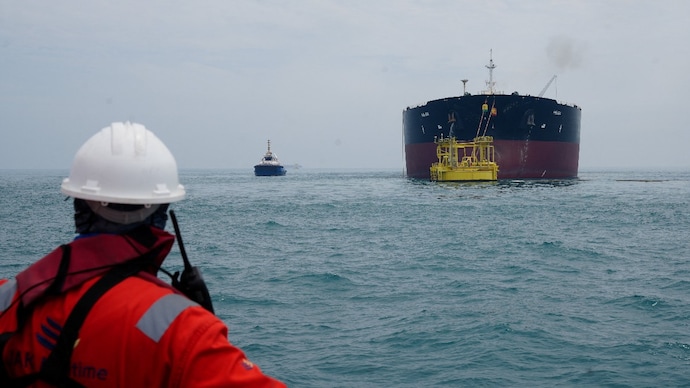

Amid escalating conflict in the Middle East, thirteen Indian nationals have been killed and three remain missing in the Gulf region since the US-Iran war erupted on February 28, according to PTI. The latest casualty came after missiles struck two Emirati oil tankers transiting the Strait of Hormuz, killing an Indian crew member aboard MT Al Bahyah.
The attack came just two days after an Indian seafarer went missing when the Cyprus-flagged container ship GFS Galaxy was hit in an Iranian strike.
Even as the conflict intensifies, seven Indian-flagged vessels carrying 148 Indian seafarers remain inside the Persian Gulf, where they are waiting for the security situation to improve before attempting to leave the region.
"About 148 seafarers are onboard the seven Indian-flagged vessels in the Persian Gulf. And given the current situation, they are not planning to come out of the region as of now," a government official told PTI.
Five of the seven Indian-flagged vessels are engaged in commercial operations in the region.
DEATH TOLL MOUNTS
The most recent fatality occurred after missiles struck MT Al Bahyah and MT Mombasa B while they were sailing through the southern shipping lane within Omani territorial waters.
An Indian crew member aboard MT Al Bahyah was killed in the attack, according to government officials. The strike also left several other crew members injured.
MT Al Bahyah had a crew of 23, including 12 Indians, six Filipinos, three Russians, one Egyptian and one Sri Lankan.
MT Mombasa B also had 23 crew members on board, including 17 Indians, three Ukrainians and three Georgians.
The attack came two days after the Cyprus-flagged container vessel GFS Galaxy was hit in an Iranian strike, leaving one Indian seafarer missing. Other crew members on board were rescued.
Iran's Islamic Revolutionary Guard Corps (IRGC) claimed responsibility for targeting the tankers.
The IRGC said the vessels had "ignored repeated warnings" before being "targeted and disabled". It also accused Washington of "inciting vessels to use an illegal route".
Last month, three Indian sailors were also killed when the US struck the Palau-flagged tanker MT Settebello.
Officials said the government is closely monitoring incidents involving Indian-flagged vessels as well as foreign ships carrying Indian crew members. It is coordinating with the Indian Navy and maintaining regular contact with shipping companies and the families of affected seafarers.
INDIAN VESSELS REMAIN IN HIGH-RISK WATERS
Government officials said seven Indian-flagged vessels remain inside the Persian Gulf as renewed fighting between the United States and Iran continues to threaten commercial shipping.
The vessels were already positioned on the western side of the Strait of Hormuz before the latest military escalation began. Like the initial phase of the conflict earlier this year, they are expected to remain in the Gulf until the security situation improves.
Officials also identified a wider group of 11 vessels of Indian interest. These include Indian-flagged ships and foreign-flagged vessels carrying cargo destined for India. Four of the vessels are transporting fertilisers.
The Strait of Hormuz remains one of the world's most strategically important waterways, with a significant share of global oil and gas exports passing through it every day.
Despite repeated security threats, dozens of vessels carrying India-bound cargo have continued to transit the strait since the conflict began.
US-IRAN PEACE DEAL UNDER FRESH STRAIN
The latest escalation has raised fresh doubts over the future of the US-Iran memorandum of understanding signed in June. The agreement had temporarily eased tensions and allowed commercial shipping to resume with fewer disruptions after months of conflict.
That fragile calm has now collapsed.
Iran announced over the weekend that it was once again closing the Strait of Hormuz following renewed hostilities.
US President Donald Trump responded by declaring that the waterway would remain open and announced the return of the blockade targeting Iranian shipping. He also said American forces would serve as "the guardian of the Hormuz Strait" and proposed a 20 per cent fee on all cargo passing through the strategic waterway.
"We're going to get paid for guarding it," Trump said. "A lot of money, but we just want to be reimbursed for doing all of this, for putting our people in danger."
However, Trump has now taken a U-turn, dropping the proposed 20 per cent Hormuz toll fee and saying it will be replaced by investment deals with Gulf states.
Iran rejected the proposal.
Foreign Minister Abbas Araghchi said Tehran had always protected the Strait of Hormuz and would continue to do so. Responding to Trump's proposal, he wrote, "20 per cent is of course too much. We will be fair."
The conflict intensified further on Tuesday as Iran launched ballistic missiles at a US air base in Jordan, while American forces carried out nearly five hours of strikes on Iranian targets in what has become a battle over control of the Strait of Hormuz.
The fighting also rattled global energy markets. Brent crude futures climbed another 5 per cent on Tuesday to $87.49 a barrel, their highest level since June 12, though prices remained below the peaks seen during the early days of the conflict.