
A barber is training AI to do his job. Could your job be next?

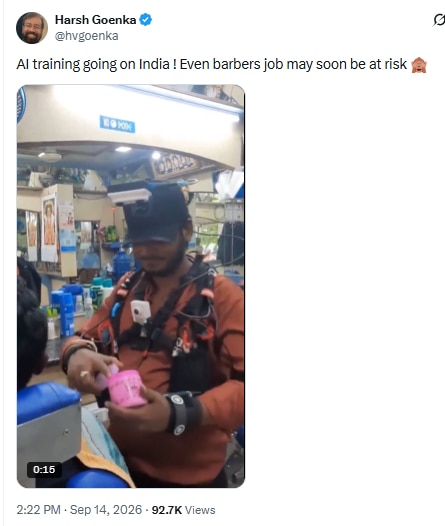
A barber wearing a head-mounted camera was shown shaving a customer as his movements were recorded for possible AI learning. The clip has widened the debate over workers being paid to generate data that could help machines learn physical tasks.
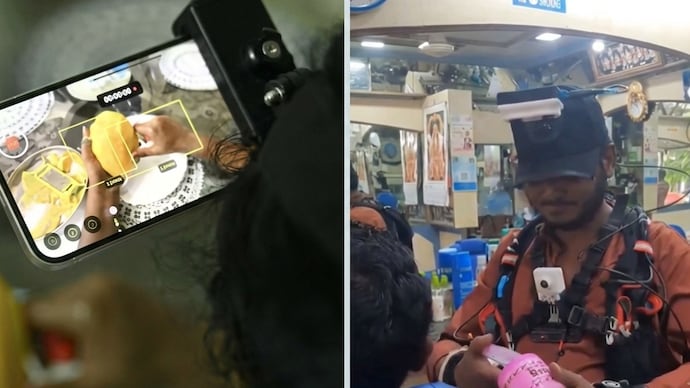
AI is learning human jobs: From barbers to factory workers, no job may be too small(Photos: (l) AFP | (r) X/@hvgoenka)

A barber shaves a customer's face while wearing a head-mounted camera and tracking equipment. The setup looks unusual, but the bigger story is what the machine may be learning from those movements.
Industrialist Harsh Goenka recently shared a video of such a setup, raising the possibility that even a hands-on profession like barbering could eventually be affected as AI and robotics learn complex physical tasks. The data captured from human movements could potentially help train machines to perform tasks such as haircuts.
The barber's chair may seem far removed from the world of AI engineers and software developers. But that is precisely what makes the example interesting. The AI jobs conversation is beginning to move beyond computers and offices and into the physical, everyday tasks that people perform for a living.
WHEN WORKERS BECOME AI TEACHERS
In India, some workers are already being paid to record themselves doing their jobs so that AI systems can learn from human movements.
An India Today report highlighted Indian workers who use cameras to record their work and earn additional money in the process. One such worker, Sunita Rathore, reportedly uses an iPhone strapped to her head while doing recycling work and earns an extra Rs 150 per hour. Her tasks include removing labels, sorting waste and stacking sacks.
The idea is simple: instead of simply telling an AI system what a job involves, give it footage of a real person actually doing it.
The recordings can provide machines with examples of how humans move, handle objects and complete physical tasks.
FROM FACTORIES TO FARMS AND WAREHOUSES
The phenomenon is not limited to one occupation. Workers across factories, warehouses, farms and other workplaces are recording their movements for AI training. For these workers, the immediate benefit is an additional source of income.
But the arrangement also raises an uncomfortable question: what happens when the work a person is being paid to demonstrate becomes something a machine can eventually learn to perform?
That does not mean that the workers recording their jobs are necessarily training machines that will replace them. But it shows how human labour itself can become valuable data in the development of physical AI and robotics.
EVEN EVERYDAY CHORES ARE BEING RECORDED
Another report showed that AI training is reaching even more ordinary activities.
Workers and homemakers have been using head-mounted cameras to record themselves performing everyday chores, including cutting fruits and making flower garlands. Some reportedly earn around Rs 250 per hour for recording such tasks.
This kind of first-person footage can show an AI system exactly what a person sees while carrying out a task and how their hands and body move during it.
It is a very different kind of AI training from feeding a chatbot text or asking software to analyse information. Here, the human body becomes part of the training data.
VIRAL FACTORY VIDEOS SPARKED ANOTHER DEBATE
The conversation became even more visible after viral videos showed Indian factory workers wearing head-mounted cameras while carrying out their work.
The videos sparked fears that workers could be recording their jobs to help train AI systems and that the technology could eventually contribute to job losses in factories. However, the specific purpose behind those videos was not confirmed, making it important to distinguish between what was shown and what was assumed about it.
Still, the reaction revealed a growing anxiety among workers: if companies can teach machines how humans perform physical jobs, where does that leave the people currently doing them?
WHY THE BARBER EXAMPLE MATTERS
The barber story brings the issue closer to home. Factory work can easily be associated with automation because machines have long been used in industrial settings. But barbering depends heavily on human movement, touch and technique.
The idea that such movements could also be captured and used as training data makes the possibilities of physical AI feel much more immediate. Goenka's post specifically raised the possibility that even barbers' jobs could face risks as AI learns physical tasks.
It is not evidence that barbers are about to be replaced. But it is a glimpse of how far the technology could eventually reach.
THE NEW WORKPLACE QUESTION
Workers can earn extra money by contributing their skills and movements to AI training. But as more human examples are collected, AI and robotics could become better at reproducing physical tasks. Whether this leads to job displacement will depend on how the technology develops and how businesses use it.
These stories show that an "AI job" is no longer limited to people building algorithms. It can also involve workers sorting waste, making flower garlands, performing factory tasks or even cutting hair.
There is an irony here: people are being paid today to show machines how human work is done. For workers, it is an additional source of income; for AI companies, it provides real-world examples of human skills and movements.
The bigger question is simple: When your skills become training data for a machine, data for a machine, are you earning from AI while also helping shape the future of your own job?
- Ends