
Bengaluru employees are working late nights and Sundays, and money isn't the reason
A Bengaluru startup founder's unusual workplace story has sparked a debate over employee motivation. ReferRush CEO Vikram Pai says a former customer-turned-competitor pushed his team to work nights and Sundays, something bonuses, incentives and equity had failed to achieve.

Bengaluru employees are working late nights and Sundays, and money isn’t the reason (Image: LinkedIn/@Vikram Pai)

New Delhi,UPDATED: Sep 1, 2026 16:07 IST
Forget the bonus. What if a workplace grudge is enough to get employees working late into the night and through Sundays? That’s the unusual claim from ReferRush CEO Vikram Pai, after a former customer allegedly mistreated his team and later launched a competing product. The founder says none of his previous attempts to accelerate the team had produced quite the same reaction.
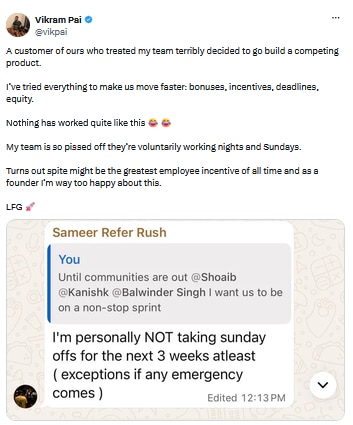
Sharing the story on X, Pai wrote that a customer who had treated his team “terribly” later decided to build a competing product. “I’ve tried everything to make us move faster: bonuses, incentives, deadlines, equity. Nothing has worked quite like this,” Pai wrote.
He said his team was now so angry about the rival that employees were voluntarily working nights and Sundays. Pai also shared a screenshot of an employee saying he would work through Sundays for the next three weeks, except in case of an emergency.
‘SPITE’ WORKED BETTER THAN BONUSES
Pai appeared both amused and pleased by the reaction. “Turns out spite might be the greatest employee incentive of all time,” he wrote, adding that as a founder he was “way too happy” about it.
The post quickly drew attention online, with users debating whether anger and rivalry can really be more powerful motivators than conventional workplace incentives.
Some found the story relatable, while others questioned the logic behind the former customer becoming a competitor.
One user even joked that employees motivated by rivalry might go too far, while another questioned why Pai had not named the competing company. Pai declined to identify the rival, saying he would “rather not.”
BUT THE STORY DIDN’T CONVINCE EVERYONE
The story also drew scepticism online. Some users questioned how a former customer who allegedly treated the team badly could go on to launch a competing product.
Others wondered whether the rival had actually introduced enough new features to push ReferRush employees into working nights and Sundays.
The reactions also sparked a broader debate over whether such rivalry can genuinely motivate employees in the long run, or whether the team’s current enthusiasm is simply a temporary response to competition.
THE BIGGER WORKPLACE QUESTION
Pai’s post is clearly framed as an amusing founder anecdote, not a blueprint for employee management. Working nights and Sundays may produce a temporary surge in effort, but it is difficult to sustain that pace indefinitely.
The episode does, however, highlight something conventional incentives can miss: employees can be motivated by emotions such as pride, ownership, competition and a desire to prove someone wrong.
For Pai, at least, the unexpected rival appears to have achieved what bonuses, deadlines and equity could not, getting his team to move faster. The irony? The competitor may have accidentally become ReferRush’s most effective motivator.
- Ends