
A 6 am call can end a career. Why work-life balance and Plan B matter

Sourabh's layoff after 12 years at Oracle highlights how constant availability and years of dedication cannot guarantee job security, while rising workplace trends show why employees are rethinking ambition, boundaries and the importance of work-life balance.

A 12-year Oracle career, constant availability, and a sudden layoff: Why work-life balance (AI-generated image)

There are people who take a work call at the dinner table, answer emails from an airport lounge and join meetings while on holiday without thinking twice. Then there are those for whom being available becomes so routine that even a family emergency does not quite mean switching off.
Sourabh appears to have been one of them.
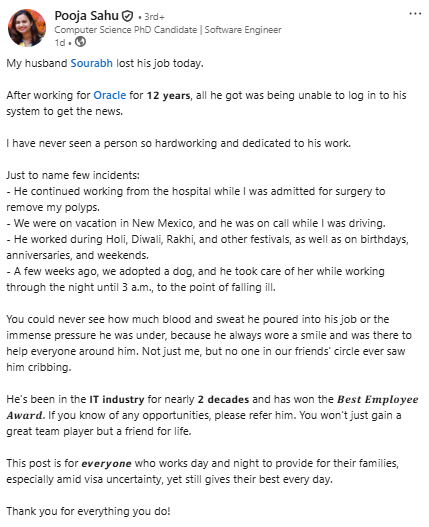
For nearly two decades in the IT industry, including 12 years at Oracle, work followed him everywhere. When his wife was in hospital for surgery, he continued working from there. During a family vacation in New Mexico, he remained on call while she drove.
He worked through Holi, Diwali, birthdays, anniversaries and weekends. Even after the couple adopted a dog, he reportedly worked until 3 am while caring for her, eventually falling ill. Then, one day, he could not log in to his system.
His wife shared the news in a LinkedIn post after he lost his job, describing him as one of the most hardworking and dedicated people she knew. He had spent nearly 20 years in the IT industry and had even received a Best Employee Award.
Her post was a request for referrals, but it quickly became part of a much bigger workplace conversation: what happens when an employee gives years of their life to a job, only to discover that dedication cannot guarantee permanence?
WHEN DEDICATION BECOMES CONSTANT AVAILABILITY
For years, staying late, replying to messages after office hours and taking calls during holidays have been treated as signs of commitment. But the idea of what it means to be a “good employee” is changing.
The Great Place To Work India study, found that 63 percent of surveyed Indian organisations reported a decline in discretionary effort, with an average drop of 5 percent. The report described this as an “effort recession”, while experts cited in it said employees were becoming more selective about where they invested their energy.
The shift is subtle but significant. Going the extra mile is increasingly being seen as something employees choose to do, rather than something they are expected to do indefinitely.
GEN Z IS CHANGING THE MEANING OF AMBITION
This change is particularly visible among younger workers. A Deloitte survey of more than 22,500 Gen Z and millennial respondents across 44 countries found that 76 percent of Gen Z and 67 percent of millennials aspire to senior or executive leadership roles. Yet only 6 percent said climbing the corporate ladder was their sole objective.
The survey also found that around half of Gen Z and millennial respondents associated leadership with continuous stress and burnout, while poor work-life balance was another major concern.
It suggests that ambition itself is not disappearing. What is changing is what employees want that ambition to look like.
WHY GOOD EMPLOYEES OFTEN GET MORE WORK
Being dependable can have another unintended consequence: becoming the person everyone turns to when something needs to be done.
A recent report examined how good employees can end up carrying more work because managers repeatedly rely on those who consistently deliver. Without clear boundaries, extra responsibilities can gradually become part of the job rather than occasional support.
Setting boundaries, therefore, is not necessarily about caring less. It can be about making sure reliability does not become unlimited availability.
Sourabh’s story puts that tension into sharp focus. His years of dedication clearly mattered to the work he did, his colleagues and his professional record. But they could not ultimately determine how long his role would exist.
WHY WORK-LIFE BALANCE MATTERS
Work-life balance is not about being less ambitious or avoiding responsibility. It is about having enough separation between work and personal life to rest, maintain relationships, and pursue interests outside the job.
Deloitte’s 2026 survey found that 41–46 percent of Gen Z and millennial respondents cited poor work-life balance as a concern, while around half associated leadership roles with continuous stress and burnout.
The need for boundaries becomes even more important when reliable employees are repeatedly given additional responsibilities.
WHY HAVING A PLAN B IS ESSENTIAL
A long tenure at one company can create a sense of stability, but the modern workplace can change quickly. Restructuring, layoffs, shifting business priorities, or technological changes can affect even experienced employees. That makes having a Plan B an important part of career planning.
A Plan B does not necessarily mean preparing to leave a job. It can mean keeping your skills relevant, staying aware of opportunities in your industry, maintaining professional connections, and knowing what roles you could move into if circumstances change. For employees who have spent many years in one organisation, this can provide a layer of career security beyond their current role.
HOW TO BUILD THESE SKILLS WHILE STILL WORKING
Preparing for a career beyond your current role does not have to mean taking a break from work or making a sudden career switch. Employees can gradually build new skills alongside their existing responsibilities.
This could include taking online courses, learning new tools, working on small personal projects, attending industry events or webinars, and staying updated on changes in their field. Updating your resume and LinkedIn profile periodically, documenting achievements, and maintaining professional connections can also make a future transition easier.
The key is consistency. Spending even a few hours each week developing skills outside your immediate job responsibilities can help ensure your career identity doesn't depend entirely on one employer or role.
A CAREER IS NOT THE WHOLE OF A LIFE
Technology has made it possible to work from almost anywhere, but it has also blurred the line between work and personal life. A laptop can enter a holiday, a phone can enter a family dinner, and one message can turn a Sunday into another workday.
Work-life balance is not about caring less about your career. It is about recognising that a job is only one part of your life. A company can restructure, a role can disappear, and years of hard work cannot always guarantee job security.
Perhaps that is the uncomfortable lesson in Sourabh’s story: while building a career, make sure you are also building a life outside it.
- Ends