
From the Editor-in-Chief

Public trust in the Election Commission is being eroded faster than anyone should be comfortable with, and needs to be restored
ISSUE DATE: Oct 12, 2026 | Oct 2, 2026 17:08 IST Last UpdatedOct 2, 2026 17:08 IST
  Published by
Last UpdatedOct 2, 2026 17:08 IST Published byShyam Balasubramanian
Oct 2, 2026 17:08 ISTThe Election Commission of India (ECI) was once a global exemplar for how it planned, conducted and protected the vote of the people of India. A genuinely admired one, held up in international forums as proof that the world’s largest and often messiest democracy could conduct free and fair elections with a neutrality and rigour that put many older democracies to shame. In a political landscape where the class of elected representatives was often seen as venal or self-serving, the ECI brought the comforting presence of a neutral referee. Its credibility was not incidental to Indian democracy. It was fundamental. That credibility is now under strain in ways that cannot be dismissed as Opposition noise.
The Special Intensive Revision (SIR) of electoral rolls has become the fault line. The Supreme Court has endorsed it and enabled its conduct in the face of persistent legal challenges. But legal endorsement and public confidence are different things. Justice Dipankar Datta made that distinction explicit on September 23, speaking on the appointment of the Chief Election Commissioner (CEC). The ECI does not merely have to be independent, he said. It must also be seen to be independent. That is not a rhetorical nicety. It is an operational precondition.
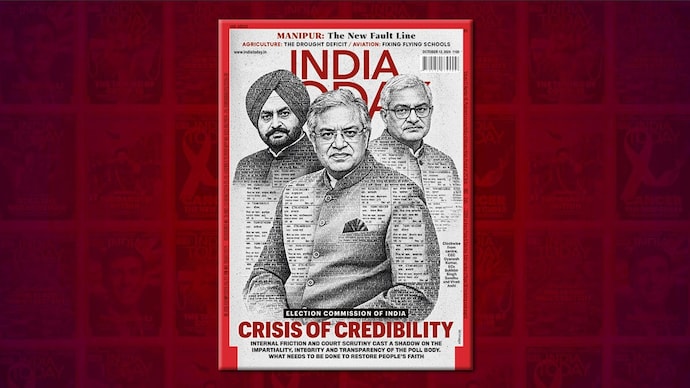
The numbers accompanying the SIR have not helped. The provisional draft rolls for 31 states and UTs excluded 133.9 million names. That is 13 per cent of India’s billion-strong electorate, roughly the entire voting population of Uttar Pradesh. The final rolls for 20 states/UTs trimmed their electorates by 60.8 million, over 10 per cent. Many deletions have a legitimate explanation, such as death or migration, but the aggregate figure generates a level of public alarm that the EC has not adequately addressed. The scepticism hardened further when an investigation by The Indian Express suggested that two of the three election commissioners (ECs) recorded 14 objections over 10 months on various aspects of the exercise. The ECI has refuted this characterisation, describing the reported divergences as normal healthy internal debate and affirming that all key decisions were unanimous. That unanimity is precisely what the public is now questioning. The crisis of credibility concentrates around six specific points that our cover story examines in detail.
The first is the most significant. The SIR shifted the burden of proof onto the voters. They had to be mapped to rolls generated in the last intensive revision, mostly from 2002-03. If “unmapped”, they faced a tortuous process of applying afresh with a list of documents that varied through the process. Even if mapped, one could fall afoul of a growing list of “logical discrepancies”, such as variance in the English rendering of Indian names. Critics said the process had turned into an unstated test of citizenship, with those left out later falling off welfare lists. The second concerns the letter of the law. A specific focus here is Form 6, on which a new voter applies. Its online version asked for details, such as about parents on old rolls, that were added without the requisite parliamentary sanction. Opposition leaders were not the only ones to call it “unauthorised and illegal”; the dissenting ECs flagged it too. The ECI called it a technical convenience, not policy, then admitted a “glitch”. The third glitch is the digital architecture. The process centralised authority in the ECINet portal, altering a vital stipulation that distributed the veto power to roughly 4,100 statutory field officers across India. Concentrating that power changed the nature of the exercise in a way that was not transparently explained.
The reported divergence of views between CEC Gyanesh Kumar and the two ECs, Sukhbir Sandhu and Vivek Joshi, gives us our critical fourth point. By law, they share equal authority; the CEC is only first among equals. Unanimity or at least a majority opinion is, thus, a prerequisite for decision-making. If that principle was not consistently observed, the legitimacy of decisions taken under it is questionable.
Fifth is the CEC’s selection process itself. After a 2023 law, the selection panel is loaded in favour of the government. The ECI always needed to be above suspicion of political alignment. That is structurally harder to sustain when the mechanism of appointing its leadership itself is contested. The sixth is the accumulated perception of unequal treatment. Opposition accusations of bias have sharpened under the incumbent. Whether those accusations are fair in each specific instance is a separate question. What matters institutionally is that they are being made, being heard and the ECI is not making a compelling case against them.
In our cover story this week, Managing Editor Kaushik Deka examines each of these six points in detail, with ECI’s defence presented alongside each charge. The judgement, as it should be, is yours.
But one conclusion is beyond debate. The political class in India has rarely commanded the public’s full trust. What redeemed the electoral process, gave it dignity and legitimacy in the eyes of ordinary citizens, was the institution they believed was not playing for any side. That belief is the ECI’s most precious asset. It took decades to build. It is being eroded faster than anyone should be comfortable with. The glory needs to be restored. The only appellate authority that ultimately matters on this question is the people of India. And they are watching.
- Ends