
Tata Group | A house divided

Tata Sons is headed for the bourses, but a fresh twist over N. Chandrasekaran's reappointment has opened a new chapter of uncertainty at the top
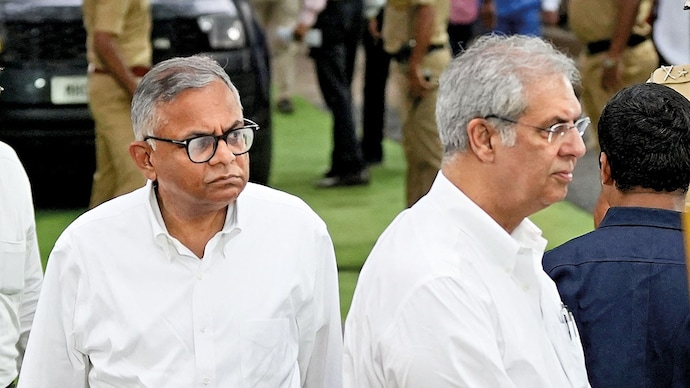
POWER CENTRES: N. Chandrasekaran and Noel Tata. (Photo: Reuters)

ISSUE DATE: Sep 28, 2026 | UPDATED: Sep 21, 2026 19:41 IST
For almost three decades, some of the biggest listed companies in the Tata Group have held shares in a company that could not itself be traded on the stock market. That is finally coming to an end. Tata Sons, the unlisted holding company of the Rs 16.2 lakh crore Tata Group, is set to become a publicly listed company after its board cleared the proposal on September 17. The decision came after the Reserve Bank of India (RBI), on September 11, rejected Tata Sons’ application to surrender its status as a non-banking financial company (NBFC).
But while the listing now appears settled, the question of who will lead Tata Sons through it remains unresolved. This comes even as the board approved a third five-year term for chairman N. Chandrasekaran despite opposition from Tata Trusts chairman Noel Tata, setting the stage for a fresh tussle over the leadership at a particularly sensitive juncture.
Chandrasekaran had announced on August 12 that he would not seek a third term and would step down when his present tenure ends in February 2027. He had also said that a Tata Sons board member, widely believed to be Noel, had opposed his continuation. In a statement following the board meeting, Tata Sons said, “Chandra acceded to the board’s request to reconsider his decision.”
Tata Trusts, however, has disputed the validity of the board’s decision. In a statement, it said the resolution approving Chandrasekaran’s reappointment was a “legal nullity” because Noel and one of the trusts’ nominee directors on the board had voted against it. Tata Trusts maintained that Chandrasekaran’s decision not to offer himself for reappointment had already been accepted and had “attained finality”. In a separate statement, Noel pointed to the possibility of a “serious legal challenge by any shareholder” to Chandrasekaran’s reappointment, hinting at a potential legal battle ahead.
During the meeting, Noel was also reportedly outvoted in his attempt to block the Tata Sons listing. In another statement, he said the board should consider options such as restructuring to avoid a public listing, seek legal opinion and ask to be heard by the RBI. Besides Noel and Chandrasekaran, the board comprises industrialist Venu Srinivasan, former Hindustan Unilever chairman Harish Manwani, investment professional Anita M. George and Tata Group chief financial officer Saurabh Agrawal.
THE PUSH FOR LISTING
Tata Sons falls under the RBI’s NBFC framework as a Core Investment Company (CIC), reflecting its role as the principal holding and investment company for the group, allocating capital and holding shares in various Tata companies. Specifically, it qualifies as an upper-layer NBFC, which requires it to get listed. Under the current norms, the upper layer comprises NBFCs with assets of Rs 1 lakh crore or more, based on the latest audited balance sheet. Tata Sons had a standalone asset size of Rs 1.75 lakh crore in FY26.
H.P. Ranina, a senior Supreme Court advocate, says Tata Sons fits the upper-layer NBFC classification both because of its asset size and because its holdings in listed companies give it indirect access to public funds. “RBI guidelines are mandatory and apply uniformly to all companies,” he says. The RBI’s current upper-layer list has 17 NBFCs. In an attempt to bolster its case for declassification, Tata Sons repaid over Rs 20,300 crore of debt and became debt-free. But the RBI rejected its plea to surrender its CIC registration.
There are 17 unlisted companies in the Tata Group, prominent being Air India, Tata Industries, Tata AIA and Tata Projects besides Tata Sons. The 26 listed companies include Tata Consultancy Services (TCS), Tata Steel, Tata Motors, Tata Chemicals and Tata Power. Under listing norms, Tata Sons will initially have to dilute 2.5 per cent of its stake to the public, rising to 15 per cent within five years and 25 per cent within 10 years. Tata Trusts, which currently hold 66 per cent of Tata Sons, other group companies and the Tata family would therefore retain a 75 per cent stake. But listing would bring Tata Sons under quarterly investor scrutiny and it would require shareholder approval for key decisions, including the appointment, reappointment or removal of board members and their remuneration, appointment of statutory auditors, preferential issues, and corporate restructuring such as mergers and demergers.
Chandrasekaran reportedly favours going public, while Noel prefers to keep the holding company unlisted to protect the Tata Group’s century-old philanthropic legacy. Tata Sons is majority-owned by Tata Trusts, which have a controlling economic interest and veto rights over board appointments and certain strategic matters. The largest are the Sir Dorabji Tata Trust, with a 27.98 per cent stake, and the Sir Ratan Tata Trust, with 23.56 per cent. “Once Tata Sons becomes listed, these rights should be reviewed against minority shareholder protection, board independence, related-party safeguards and applicable listing requirements,” says Shriram Subramanian, founder and managing director of proxy advisory firm InGovern.
UNLOCKING VALUE
The Shapoorji Pallonji (SP) Group, yet another large shareholder, owns 18.4 per cent of Tata Sons, while nine Tata companies, including Tata Motors and Tata Steel, together hold 12.87 per cent. These nine companies have their own reason to favour the listing. Their investments in Tata Sons have remained locked up for almost three decades, making them what some analysts consider dead capital. Tata Steel, Tata Motors, Tata Chemicals, Tata Power, Indian Hotels Company Ltd, Tata Consumer Products and Tata Investment were among the companies that bought into Tata Sons through a 1995-96 rights issue. Questions were raised then about why listed companies should put capital into an unlisted, illiquid parent. Ratan Tata, then chairman, had argued that the investments would be rewarded once Tata Sons became a public company. That promised listing has been delayed ever since.
As of March 31, Tata Sons had 404,146 paid-up equity shares. The nine listed companies collectively owned 52,013 shares. Assuming a Tata Sons valuation of between Rs 9 lakh crore and Rs 14 lakh crore, as estimated by market observers, those holdings would be worth between Rs 1.2 lakh crore and Rs 1.8 lakh crore.
Subramanian sees capital access as an important benefit. “A public listing would give Tata Sons capital flexibility to raise debt and equity when it needs funds for its capital-intensive unlisted businesses,” he says. “It would also provide liquidity to the SP Group and the seven listed companies that hold shares in Tata Sons.” For Tata Sons, a listing would bring greater transparency and price discovery, he adds, while benefiting the 17.7 million shareholders of Tata Group companies that hold shares in Tata Sons.
THE GOVERNANCE TEST
The move would also subject the Tata Trusts’ special rights to greater scrutiny, says Subramanian, bringing them in line with the governance requirements applicable to listed companies, and potentially reduce reported differences among trustees and restrictions affecting the functioning of the trusts.
According to Ranina, the company would need to strengthen its board and appoint new independent directors, so that two-thirds of the audit committee comprises independent directors. Related-party transactions would also come under closer scrutiny. If Tata Sons were to extend a loan to Air India or closely held companies such as Tata Electronics or Tata Digital, for instance, the transaction would require audit committee approval.
Matters at Bombay House, the Tata Group’s headquarters, are on a collision course. With Chandrasekaran having agreed to continue as chairman and the Tata Sons board favouring a public listing, the Noel-led Tata Trusts is likely to seek legal recourse. That could be acrimonious, and perhaps even more bitter than the legal battle that followed Cyrus Mistry’s ouster as Tata Sons chairman in 2016. Such a battle would cast a long shadow over a group that prides itself on good governance and accountability, and could even affect investor confidence in the long run.
- Ends