
No green screens, real ships, 91 days: How Nolan spent $250 million on The Odyssey
The documentary The Odyssey: The Making of an Epic tracks Christopher Nolan's $250 million production across five countries without relying on green screens. It highlights a practical filmmaking approach shaped by real locations, physical training and historically rooted sound design.
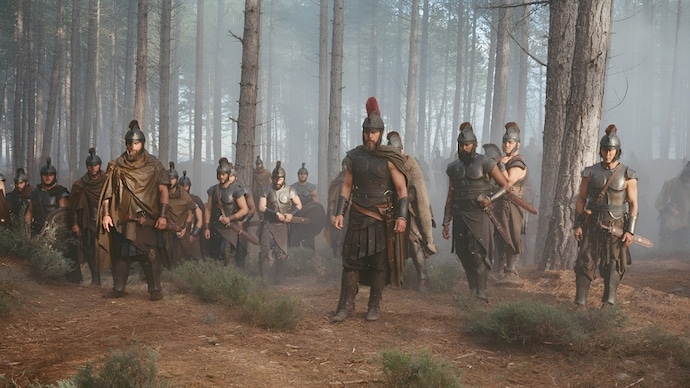

Christopher Nolan has never been a filmmaker who takes the easy route. But with The Odyssey, the Oscar-winning director may have taken on his most ambitious challenge yet.
Made on a reported budget of $250 million (over Rs 2,000 crore), The Odyssey wasn't just another Hollywood blockbuster. Instead of relying on green screens and computer-generated worlds, Nolan chose to build an ancient civilisation using real landscapes, practical effects and old-school filmmaking.
The recently released documentary The Odyssey: The Making of an Epic, now streaming on JioHotstar, offers a fascinating look at what went into creating one of the most anticipated films of the year.
A 91-day shoot across five countries
The film was shot over 91 days across Morocco, Scotland, Greece, Iceland and Italy. Nolan reportedly followed one simple rule throughout production: if a real location existed, they would shoot there instead of creating it digitally.
That decision meant travelling thousands of kilometres in search of locations that could naturally resemble the world described in Homer's ancient Greek poem.
Morocco's deserts became the harsh landscapes of Odysseus' journey. Scotland's rugged coastline recreated dangerous seas. Greece's historic forts and caves doubled as ancient kingdoms, while Iceland's volcanic terrain represented the mysterious world of the gods. The production finally wrapped in Italy, where coastal forts completed the visual journey.
No shortcuts for the cast
The commitment to realism didn't stop with the locations. According to the documentary, actors often had to trek for nearly 45 minutes over rocky terrain wearing leather sandals just to reach the set.
Matt Damon, who plays Odysseus, also underwent extensive physical training and reportedly spent almost a year growing his beard because Nolan didn't want artificial facial hair. Tom Holland, Anne Hathaway and the rest of the cast also filmed in harsh outdoor conditions instead of controlled studio environments.
Even the ships were real
Rather than relying on CGI, the production built large wooden ships inspired by ancient Greek vessels. The actors didn't simply stand on them while visual effects artists added movement later. Instead, they spent weeks learning how to row the ships together, recreating the physical effort ancient sailors would have experienced.
When storms appear on-screen, much of what viewers see is the cast dealing with real wind, rain and freezing sea spray rather than digital effects.
Music inspired by Ancient Greece
The authenticity extended beyond the visuals. Composer Ludwig Goransson avoided giving the film a conventional Hollywood orchestral sound.
Instead, he researched instruments that existed during ancient Greece. The soundtrack features instruments such as the aulos, an ancient double-reeded pipe, alongside the lyre, bronze percussion and raw vocal recordings to create a soundscape that feels rooted in mythology rather than modern cinema.
The team even recorded sounds created by striking stone walls and metal surfaces to make the world feel more tactile.
Why did it cost $250 million?
The massive budget wasn't spent on visual effects alone. Much of the money went into:
- Shooting across five countries
- Building practical sets and ships
- Transporting IMAX cameras to remote locations
- Creating large-scale action sequences without depending heavily on CGI
- Training actors instead of replacing them with digital doubles
- Spending months preparing costumes, props and historical details
The result is one of Nolan's biggest and most logistically complex productions.
A return to practical filmmaking
In an era where many blockbusters are filmed almost entirely inside studios using virtual backgrounds, The Odyssey takes the opposite approach. The documentary shows Nolan insisting on real locations, real weather, real ships and real physical performances whenever possible.
That philosophy has become one of the defining features of his filmmaking, from The Dark Knight and Dunkirk to Oppenheimer, and The Odyssey pushes it even further.
The Odyssey: The Making of an Epic is currently streaming on JioHotstar in India. For fans waiting to watch Nolan's latest film, the documentary offers a detailed look at the scale, challenges and craftsmanship behind one of the biggest productions of his career.