
Yash's Toxic: Women, Tabaahi and a marketing strategy built on provocation?
Toxic's Tabaahi song and other proms have triggered an online debate over how its women are presented. The reaction has renewed questions about whether controversy now functions as visibility in film marketing.

Yash's Toxic: A Fairytale for Grown-Ups will hit theatres on August 26, 2026.

New Delhi,UPDATED: Jul 13, 2026 07:30 IST
When Toxic: A Fairytale for Grown-Ups dropped its Ladies & Ladies promo on July 1, the conversation it generated had little to do with the film itself. Within minutes, social media was flooded with criticism over the way its female characters had been presented. And because this isn't the first time Toxic has found itself at the centre of an online storm, it raises a larger question: has backlash itself become a form of publicity?
Every big film wants people talking. The catch? In today's social media ecosystem, it increasingly doesn't matter whether audiences are talking for a film or against it. Visibility is visibility, outrage drives engagement, and controversy often keeps a film in the news far longer than conventional promotions ever could.
Which is precisely why Toxic's increasing provocation and attention-grabbing campaign deserves a closer look.
After much buzz and intrigue, Yash (who has been hogging all the attention to himself) and the makers finally decided to unveil some details about the women of the film.
Released as an introduction to the ladies of Toxic, the Ladies & Ladies promo featured Nayanthara, Kiara Advani, Huma Qureshi, Tara Sutaria and Rukmini Vasanth. But if you finished watching it knowing anything meaningful about these women beyond how they looked, you were probably in the minority.
The internet certainly wasn't impressed.
Instead of meeting women who would supposedly drive the story, viewers were served a montage of glossy close-ups, lingering camera movements and titillating, sexually charged visuals that many felt belonged more to the male gaze than to meaningful storytelling.
The loudest criticism was reserved for Kiara Advani's portrayal, with several users arguing that the camera seemed far more interested in her body than her character. Others questioned whether the promo had mistaken objectification for empowerment, while some accused relying on imagery and sensational aesthetics instead of introducing characters audiences could actually invest in.
This debate does sound familiar. It's actually been following Toxic almost from the day its campaign began.
Months ago, the film's first teaser too sparked polarising reactions. The footage showed Yash's gangster character, Raya, engaged in an intimate encounter inside a car while violence unfolded outside.
While supporters and foreign movie buffs defended it as a stylistic choice suited to the film's morally grey world, critics questioned its use of a deliberately provocative and male-gaze-driven intent, arguing that it inclined towards familiar misogynistic tropes.
Let's discuss posters now. Dark. Smoky. Violent. Seductive. Blah Blah.
Every visual leaned further into the same hyper-stylised aesthetic. Screamed masculinity and rage, all the while having the five strongest female actors backing the protagonist, reduced to being dolls.
Well, the conversation didn't stop there.
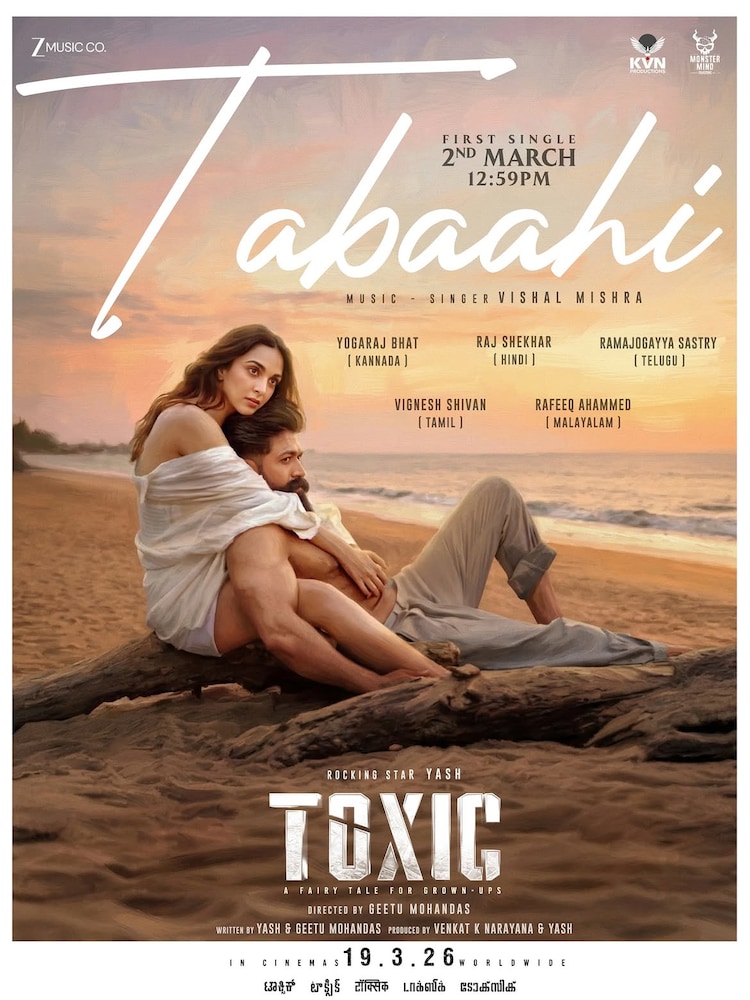
When the makers released the film's first song, Tabaahi, they doubled down on Toxic's sultry aesthetic. Positioned as a romantic track, the song's poster featured Yash and Kiara Advani lying together on a beach in an intimate pose. Even the song failed to leave much of an impression. Many listeners felt the lyrics lacked the emotion, substance and warmth one would expect from a love track. Once again, people were talking more about the poster than the music itself.
When the official video dropped last week, social media was quick to dismiss it as "trash" and "painfully uninspired". One X user wrote, "Felt like Yash tried to channel his inner Emraan Hashmi and the director tried to recreate a 'Haal-e-Dil' vibe, but they missed the mark completely. An average song, to be honest (sic)."
Composed and sung by Vishal Mishra, Tabaahi features lyrics by Raj Shekhar in Hindi. The song has also been released in Kannada, Telugu, Tamil and Malayalam, with lyrics adapted by Yogaraj Bhat, Ramajogayya Sastry, Vignesh Shivan and Rafeeq Ahammed, respectively.
Whether that is intentional or simply a by-product of the film's creative choices is impossible to say with certainty. But it is difficult to ignore how consistently Toxic's promotional material has leaned towards edgy gimmicks that keep audiences debating the marketing rather than the movie.
Perhaps that's also the reality of promoting a film in 2026.
Cinema is no longer competing only with other films. It's competing with Reels, Shorts, memes, podcasts, fan edits, influencers and algorithms that reward engagement over nuance. Simply releasing a trailer isn't enough anymore. Every teaser, poster and song has to stop the scroll. Better still if it sparks outrage.
Because outrage travels.
Every reaction video, quote post, meme and hot take pushes a film back into people's feeds. Social media doesn't distinguish between admiration and criticism; both generate reach for sure. And in an industry where attention has become the most valuable currency, even backlash can become visibility.
The pattern isn't unique to Toxic.
Sandeep Reddy Vanga's Animal generated weeks of heated debate around its portrayal of masculinity and misogyny. The controversy became almost inseparable from the film's marketing cycle, yet curiosity only grew stronger as release day approached.
Shah Rukh Khan's Pathaan found itself at the centre of a political storm after the release of the popular Deepika Padukone song Besharam Rang, with boycott campaigns dominating headlines. Despite the noise, the film went on to register record-breaking box-office numbers.
The Kerala Story, too, became inseparable from the debates surrounding it, with protests and political arguments keeping it in the headlines for weeks.
Of course, these films succeeded for different reasons far beyond their controversies. Outrage alone doesn't guarantee ticket sales. But they do illustrate a reality the industry knows well: polarising campaigns often keep a film in the headlines longer than conventional promotions ever could.
Which brings the conversation back to Toxic.
There is no evidence to suggest the makers deliberately set out to attract criticism. But if they did? Well...
The bigger risk, however, lies elsewhere.
If audiences begin to feel they're being provoked simply for the sake of staying in the news cycle, the strategy eventually begins to lose its edge. Today's viewers are more media-literate than ever. They can usually tell the difference between storytelling that naturally challenges them and marketing that appears designed to keep timelines busy.
That is what makes Toxic an intriguing case.
Months before its release, the film has already become one of the year's most discussed titles – not because viewers know its story, but because they are debating the way it's being sold.
Either way, Geetu Mohandas and Yash's Toxic has achieved something every campaign chases: it has become impossible to ignore. The only question left is whether audiences will eventually remember the story or just the strategy.
- Ends