
Diljit Dosanjh's Satluj disappeared from ZEE5; the questions it leaves behind won't
Honey Trehan's Satluj, inspired by Jaswant Singh Khalra, briefly reached ZEE5 before being taken down for Indian viewers. Its removal echoed the film's central theme of silencing uncomfortable truths and renewed debate around its troubled release.
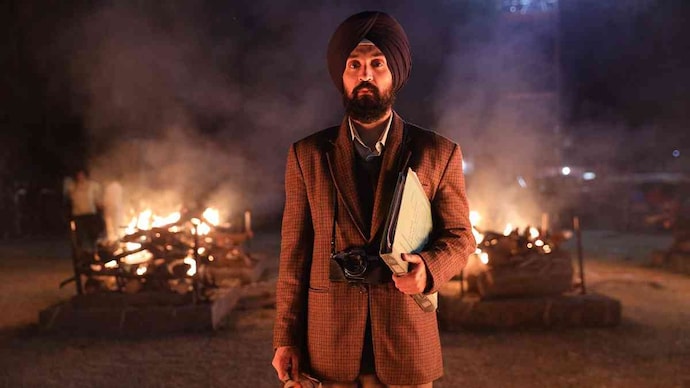
Diljit Dosanjh and Honey Trehan's Satluj was released directly on ZEE5 and was later taken down.

Mumbai,UPDATED: Jul 7, 2026 07:47 IST
On Sunday afternoon, curiosity got the better of me. After hearing about Satluj (earlier titled Panjab '95) for over three years, reading about the Central Board of Film Certification [CBFC] reportedly recommending 127 cuts, and watching director Honey Trehan fight one battle after another to release his film, I finally gave in and bought a ZEE5 subscription. I wanted to know what this film was trying to say that had made its journey so difficult.
And less than 48 hours after it arrived, Satluj had been removed from the platform for Indian audiences. There was a cruel irony to it: a film about erasure, silence and the cost of speaking uncomfortable truths had itself been silenced.
Barely a toddler in 1995, I was probably busy chasing candy floss at home when Punjab was living through one of its darkest chapters. We all know the history in broad strokes. We have read about militancy, insurgency and police action. But history often gives us numbers; Satluj gives those numbers faces. Inspired by the life of human rights activist Jaswant Singh Khalra, the film asks a question that stays with you long after the credits roll: when does a human being become just another statistic?
The biggest surprise about Satluj is that it is nowhere close to the explosive film many expected it to be. It is not inflammatory, nor does it ask viewers to choose a political side. It never glorifies violence or attempts to justify it. Instead, Honey Trehan quietly examines what happens when institutions stop seeing people as people. The film repeatedly reminds us that there are good and bad people everywhere. There are police officers who struggle with their conscience, and there are others who become so consumed by promotions, power and numbers that human lives lose all meaning. The tragedy, it suggests, is that when the bad become the majority, the good often lose their voice.
What unsettled me wasn't simply the violence but how ordinary it seemed to those carrying it out. Men pull the trigger almost mechanically. Bodies are dumped into rivers or cremated as laawaris, as if they never belonged to anyone. Those scenes don't rely on gore to shock you. They shake you because of the chilling normalcy with which death is treated. Somewhere along the way, success becomes measured in body counts, and humanity quietly disappears.
"Who is the terrorist?" It is perhaps the most powerful question the film asks because it quietly dismantles everything we think we know about power, violence and justice. At a time when cinema is increasingly celebrating alpha heroes, revenge arcs and violence designed to earn whistles, Satluj dares to swim against the tide. Its hero doesn't wield a gun or deliver punchlines. He fights an entire system with questions, conviction and an unshakeable faith that the truth is worth standing up for.
The film also handles history with admirable restraint. References to the 1984 anti-Sikh riots are present because they are impossible to separate from Punjab's story, but they never become a convenient justification for everything that follows. Instead, Satluj gradually becomes a film about accountability, about ordinary citizens discovering the language of human rights, and about one man refusing to accept that unnamed bodies could simply be written off as laawaris. "Unke waaris hain (They have families)," Khalra says, and in that one line lies the entire soul of the film.
Jaswant Singh Khalra almost feels unreal yet so real today. He is branded anti-national, accused of standing against his own state and painted as a terrorist sympathiser simply because he asks uncomfortable questions. He reportedly refused security and even turned down asylum in Canada because he believed leaving Punjab would mean abandoning the people he was fighting for. There is a quiet moment where his wife asks him what will happen to their own family while he is busy fighting for everyone else's. He doesn't answer her, but history did.
Talking about Satluj today, it is difficult not to notice how closely the film's own journey mirrors Khalra's. It spent years trying to reach audiences, changed titles along the way, and when it finally landed on streaming, it survived barely two days before being pulled down. The irony is impossible to ignore. A film about silencing the truth found itself silenced yet again.
Perhaps that's why one of Khalra's most powerful lines hits even harder today: "Darkness should never be feared. Challenge it." After the film was taken down, Diljit Dosanjh echoed that very sentiment on social media, writing, "I challenge darkness." It no longer felt like just a dialogue from the film. It had become the film's own reality.
What makes that even more unfortunate is that Satluj deserves to be discussed as cinema as much as it does as a controversy. Strip away the headlines, and what remains is a beautifully crafted film. Honey Trehan directs with remarkable restraint, allowing silence to speak louder than speeches. Punjab is portrayed without the postcard beauty Hindi cinema usually associates with it. Instead of mustard fields and celebratory songs, we see narrow brick lanes, dusty roads and homes carrying visible scars of conflict. It feels lived-in and authentic. There is perhaps a poetic irony that Abhishek Chaubey, whose Udta Punjab also battled censorship, is one of the producers of this film.
The performances only strengthen that honesty. Diljit Dosanjh disappears into Jaswant Singh Khalra with such quiet conviction that you stop seeing the star altogether. Geetika Vidya Ohlyan is deeply moving as Khalra's wife, who slowly inherits her husband's fight, while Arjun Rampal brings understated dignity to the CBI officer determined to uncover the truth. Combined with a measured screenplay and immersive cinematography, Satluj succeeds not just as an important film but as genuinely compelling cinema.
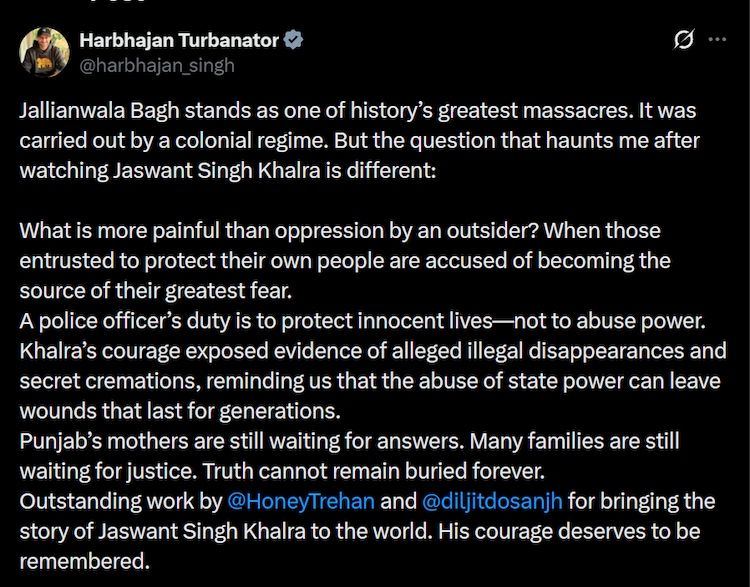
As the credits rolled, I kept thinking about what Harbhajan Singh wrote about Satluj on X: "Truth cannot remain buried forever."
It can be delayed, renamed, hidden behind legal battles or removed from a streaming platform, but it cannot be erased. Perhaps that is Satluj's biggest achievement. It reminds us that there have always been people willing to risk everything for the truth. We may celebrate them years later, build memorials in their names or make films about them, but that doesn't make their fight any less lonely. Honey Trehan has finally told Jaswant Singh Khalra's story. The heartbreaking part is that, even in 2026, telling it still seems to come at a cost.
- Ends