
How Diljit Dosanjh's Satluj exposed Punjab's political fault lines
Diljit Dosanjh-starrer Satluj came and went. The competing political readings remain, revealing far more about Punjab's layered discourse than the movie itself.
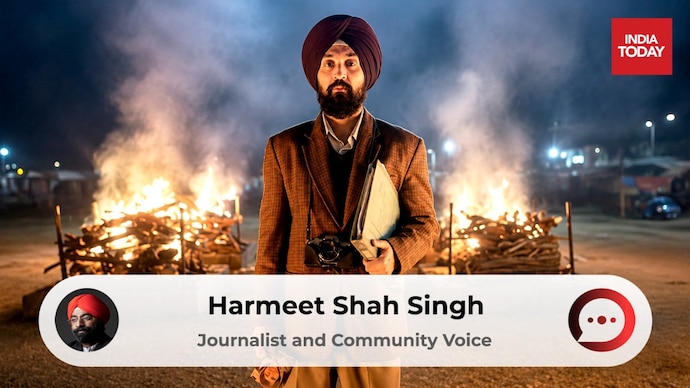

Diljit Dosanjh’s Satluj, centred on human rights violations during Punjab's years of unrest, appeared on Zee5 after months of anticipation and disappeared immediately.
Its brief availability exposed something more telling than the arguments over its release and blackout.
It demonstrated how differently the same film can be read by different constituencies. It also laid bare a misconception that the loudest online voices somehow represent Punjab.
ONE FILM. SEVERAL SIKH AUDIENCES
The anti-Diljit separatist lobby, particularly in North America, has broadly viewed the film as reducing Punjab's violent years to a Sikh police-versus-Sikh militant conflict, allowing the role of the state, or what it frequently calls the "deep state", to recede into the background.
A tiny but vocal circle of informal fellow travellers in Chandigarh, Jalandhar, Delhi and a few other cities faces a different predicament.
Its campaign centred on securing the film's release. Once Satluj became available, attention naturally moved to its portrayal of Punjab, its omissions and its political messaging. The film's withdrawal has restored the easier conversation on alleged censorship.
ANOTHER AUDIENCE. ANOTHER READING
During its streaming, there was never a single Sikh response to Satluj. There is rarely a single response by any community to any film that revisits a contentious chapter of its own history.
Many Sikhs supported Satluj's release simply because they believed every film deserves a fair opportunity to reach its audience. Their position should never be confused with that of the ideological ecosystem which invested the movie with far greater political significance.
The episode also exposed an inconsistency. The generosity extended to Satluj was not equally available to Kangana Ranaut's Emergency. Freedom of expression commands its greatest respect when it survives disagreement with the work itself.
That said, the Sikh audience is only one part of the story.
Many viewers outside the community, particularly among Hindus and those who supported the police's and the government's iron-fisted methods, were equally capable of reaching a different conclusion. Some regarded Satluj as a one-sided account that edges towards romanticising militant violence.
Human rights activist Jaswant Singh Khalra documented illegal cremations and enforced disappearances during those years. He was abducted outside his Amritsar residence in 1995 and later murdered. Several Punjab Police personnel were subsequently convicted in connection with his abduction and killing.
The film's brief appearance also opened another line of discussion.
In today's deeply polarised social media environment, some commentators question the methodology behind Khalra's estimates of those killed in staged police encounters. The film's removal may have interrupted that conversation almost as soon as it began.
THREE DECADES EARLIER
Although Satluj centred on Jaswant Singh Khalra, the broader cinematic examination of Punjab's years of militancy is hardly new.
Released in 1996, in a far more combustible political climate, Gulzar's Maachis questioned the official police narrative on a much larger canvas.
The Loudest Voices Are Still a Poor Barometer of Punjab
Since the 2020-21 farm agitation, a heady mix of comrades and neo-Panthak campaigners, supported by a small circle of dedicated reporters and digital amplifiers, has sought to frame Punjab's political conversation through its own vocabulary and ideology.
Their visibility often creates the impression that they speak for Punjab. They do not. Their online footprint may be substantial. But their electoral influence remains difficult to establish.
Long before this coalition acquired its present prominence, Paramjit Kaur Khalra, widow of Jaswant Singh Khalra, unsuccessfully contested the 1999 election.
In 2019, she lost the 2019 parliamentary election from none other than Khadoor Sahib, a constituency widely regarded as a Panthak stronghold.
Those electoral outcomes diminish neither Jaswant Singh Khalra's stature nor Paramjit Kaur Khalra's public life. They simply illustrate that admiration, ideological affinity and voting behaviour have never been the same thing in Punjab.
State politics springs from a remarkably diverse society. The Punjabi electorate includes Sikh or Hindu Scheduled Castes, OBCs; village and city dwellers; farmers, traders, industrial workers, professionals, government employees and countless others whose concerns seldom fit into a single framework.
It's too layered to be spoken for by any digital alliance of Left activists and neo-Panthak campaigners, or by any constituency in the Sikh diaspora, whether pro-India moderates or separatists.
Online influence and political influence aren't identical twins. Punjab has repeatedly shown that the two are related far less often than social media would have us believe.
Fine words butter no parsnips.
(The writer is a career journalist currently serving as Communications and Advocacy Director at UNITED SIKHS (UK), a charity registered in England and Wales)