
3,00,000 lightning strikes in 24 hours: What triggered Europe's biggest light show?
The unprecedented heatwave in Europe was interrupted in the Netherlands by a thunderstorm that brought relief and cooler winds, while also providing a night show for the residents.
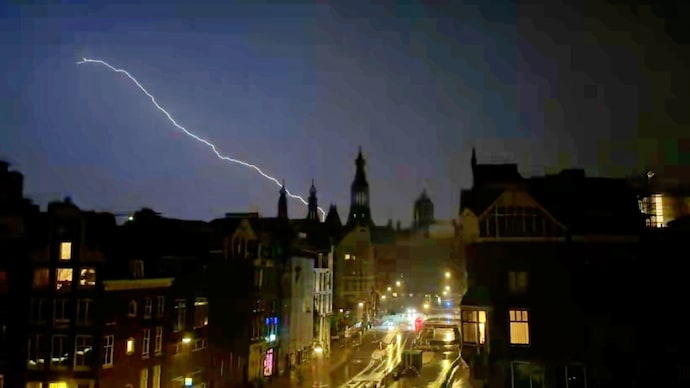

Amsterdam, in the Netherlands, witnessed a natural light show on June 28, 2026.
For nearly four hours, residents watched constant lightning flashes and heavy downpours.
KNMI, the Netherlands' meteorological department, said it registered more than 3,00,000 lightning discharges across the country in the span of 24 hours.
At the peak of the storm, around 30,000 lightning strikes hit across the Netherlands and northern Germany in just 30 minutes. That is about 17 strikes every second.
It goes without saying that this was no ordinary rain; it was a powerful thunderstorm that ended days of scorching heat.
WHAT WAS BEHIND THE INTENSE STORM IN AMSTERDAM?
Thunderstorms form when warm, moist air rises quickly into cooler air above, creating tall clouds that produce lightning, thunder, rain, and sometimes hail or strong winds.
In the Netherlands, such intense storms are less common than in hotter places like India’s monsoon regions, but they become more likely after extreme heat.
The country had just faced its first-ever Code Red heat warning as a consequence of the record-breaking heatwave sweeping across Europe.
In Amsterdam, temperatures soared above 30°C for over a week, with some spots nearing 40°C, part of the larger European heat wave that is making millions swelter.
After this heat-dominated period, when cooler air moved in, it clashed with the unstable hot, humid atmosphere, triggering explosive thunderstorms.
The Dutch meteorological institute issued a Code Orange warning for severe weather.
IMPACT OF THE STORM
The storms brought more than just aerial spectacles that were both beautiful and scary.
Lightning sparked fires from Groningen in the north to Utrecht and Amsterdam. One person was injured in a house fire in Landsmeer, and two calves died in a barn fire in Toornwerd.
Meanwhile, hailstones up to 5 cm, which is the same as that of a golf ball, fell in several places.
For locals, the onslaught felt extraordinary.
Many compared the constant lightning to a strobe light, lighting up the entire sky for hours. Others took the weather phenomena as a sign of a rapidly changing climate.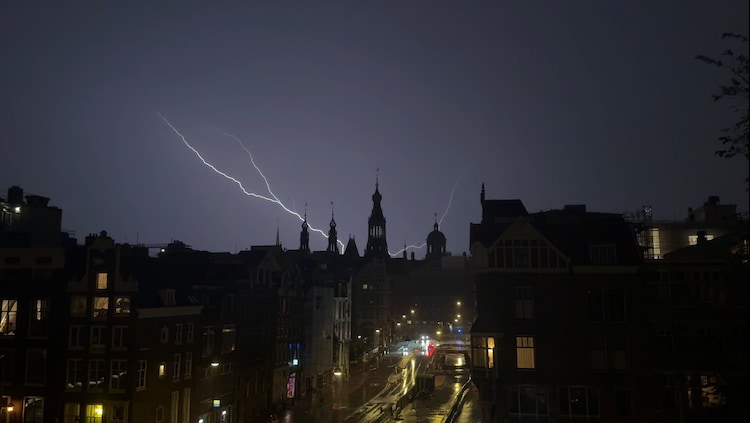
Scientists have noted that while individual storms are hard to link directly to climate change, hotter air holds more moisture and energy, which can fuel stronger thunderstorms and heavier rain.
Europe’s June 2026 heatwaves broke records and would have been “virtually impossible” without human-caused warming.
Events like this show how heatwaves don't often end simply, but instead ripple into other weather events, sometimes even record-breaking ones.
The series of lights seen streaking across the night sky in Amsterdam was, if anything, a reminder that extreme weather events are not just limited to temperatures but often result in more far-reaching consequences.