
Scientists connected three mini-brains. What happened next blew their minds

Scientists connected three lab-grown brain organoids and repeatedly stimulated them with signals. The network later became better at distinguishing inputs, suggesting specialised functions can emerge through experience.
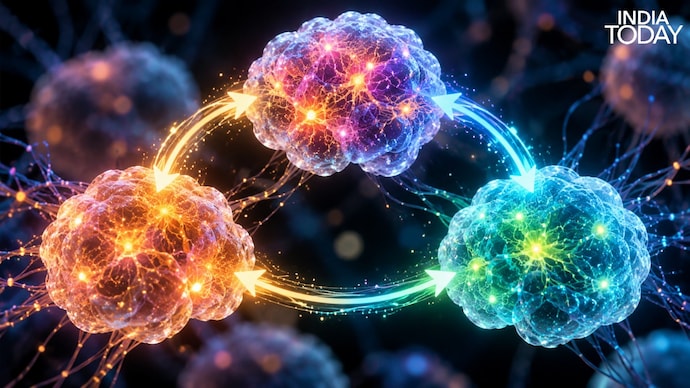
The organoids were repeatedly stimulated and their activity was monitored over time. (Photo: India Today)
New Delhi,Oct 1, 2026 11:54 IST Last UpdatedOct 1, 2026 11:54 IST
  Published by
Last UpdatedOct 1, 2026 11:54 IST Published bySibu Kumar Tripathi
Oct 1, 2026 11:54 ISTWhat happens when pieces of human brain tissue are connected together and repeatedly given the same information?
Scientists have found that the network can change the way it works and, after two weeks, become better at telling signals apart.
In a new study published in Communications Biology, researchers connected three human brain organoids, which are tiny, lab-grown clusters of brain cells, and found that the three-part network improved their performance on a simple signal-discrimination task after repeated stimulation.
The researchers were not actually connecting three complete human brains. Brain organoids are much simpler laboratory-grown models of brain tissue, created from stem cells.
They contain different types of brain cells and can form connections, but they do not have the full structure or complexity of a human brain.
The scientists wanted to test whether connecting these organoids into a larger, organised network would allow them to become better at processing information.
They compared networks containing one, two and three organoids. The organoids were repeatedly stimulated and their activity was monitored over time.
The striking result came from the three-organoid networks.
After around two weeks of repeated stimulation, the three-organoid system became significantly better at identifying where a signal was coming from. Single organoids and two-organoid networks did not show the same improvement.
The researchers also observed changes in how activity moved through the network. The three organoids began responding differently depending on the incoming signal, while electrical activity travelled through the connected tissue in more organised directions.
The response also became faster.
Perhaps most interestingly, the organoids had been produced under the same conditions. Yet repeated exposure to signals caused them to develop different functional roles within the network.
In simple terms, the experiment suggests that how brain cells are connected and what they repeatedly experience can shape what they eventually do.
This is an example of brain plasticity, the ability of neural networks to change their connections and behaviour in response to experience.
The findings do not mean scientists have created three miniature human brains that can think or become conscious. Instead, the study provides evidence that organised connections and repeated stimulation can help laboratory-grown brain tissue develop specialised functions.
The researchers, from the University of Tokyo and collaborators, describe the work as showing how initially similar organoids can be reorganised into functionally different modules through repeated input.
The bigger question now is how far this ability to reorganise can go, and whether increasingly complex networks of brain organoids could help scientists better understand how real brains learn and adapt.
- Ends