
Day and night to be equal on Sept 23: How equinox will make nights in India longer

Why does the September equinox happen? Here's the science behind the September 23 event, India's daylight hours and the changing seasons.
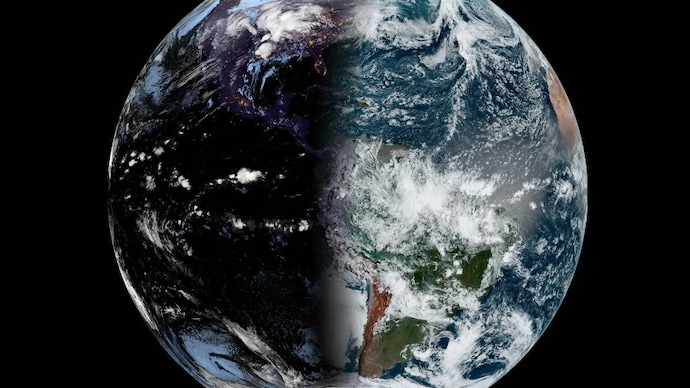

The seasons are about to change in the Northern Hemisphere, and India will experience the same astronomical event that marks this transition across the world.
The September equinox will occur on September 23 at 5:35 am IST, according to Nasa's 2026 astronomical calculations. But despite its name, the equinox does not mean that every place on Earth will get exactly 12 hours of daylight and 12 hours of darkness.
That begs the questions; what is it and what will it do?
WHAT IS AN EQUINOX?
An equinox happens twice a year, one in March and another in September. It occurs when the centre of the Sun crosses the plane of Earth's equator.
Earth's axis is tilted by about 23.5 degrees and as our planet travels around the Sun, this tilt changes how directly sunlight falls on the Northern and Southern Hemispheres.
During an equinox, neither hemisphere is tilted more towards the Sun than the other.
The Sun is directly above the equator at local noon, and both hemispheres receive roughly equal amounts of sunlight.
In September, the Sun crosses the equator while moving from north to south.
This is why the September equinox marks the astronomical beginning of autumn in the Northern Hemisphere and spring in the Southern Hemisphere.
In India, however, this does not mean an abrupt change to a traditional autumn season, since India's seasons are shaped by its monsoon and regional climate patterns as well.
WILL INDIA EXPERIENCE THE EQUINOX?
The equinox is a global astronomical event, so India experiences it too.
At 5:35 am IST on September 23, the Sun will cross Earth's equatorial plane.
And around this period, daylight and darkness become increasingly similar in length across India, although the exact duration varies from place to place.
For example, in New Delhi, September 23 has about 12 hours and 7 minutes of daylight, according to astronomical calculations. That is not exactly 12 hours because the Sun is a disc rather than a point of light, while Earth's atmosphere bends sunlight near the horizon.
These effects make sunrise appear earlier and sunset later than they would under a purely geometric calculation.
WHAT COMES AFTER THE EQUINOX?
The September equinox marks a turning point in the Sun's apparent journey across Earth's sky.
After that, the Sun's direct rays shift farther south of the equator as the planet moves towards the December solstice.
For the Northern Hemisphere, this means daylight gradually becomes shorter and nights longer.
So, while the equinox itself lasts only a moment, its effects unfold over the weeks that follow, changing how long the Sun stays above India's horizon each day.