
Is it done? A lot of people asked. PV Sindhu answered in Tokyo
After ending a 19-month title drought in Tokyo, PV Sindhu reflects on silencing doubters, trusting her attacking game, and rediscovering the self-belief that has reignited her World Championships hopes.
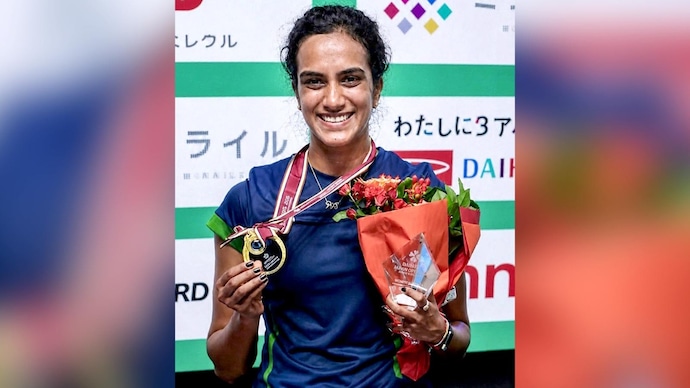

When PV Sindhu spread her arms to celebrate after the final point in Tokyo on Sunday, the tears had little to do with one badminton match.
They were the release of nearly two years without a title. Of months spent rebuilding after injuries. Of endless questions about whether one of India's greatest athletes had already played her best badminton.
"I had tears in my eyes because it was very, very important for me to win," Sindhu said after defeating Japan's Akane Yamaguchi 21-17, 21-17 to win the Japan Open Super 750 title on Sunday.
"I had been working really hard on myself, and I kept believing that I could do it. A lot of people were asking, 'What's happening? Is it done?' But I still believed in myself, my family, my coaches and my support staff."
In the end, belief proved stronger than the noise.
The triumph ended a 19-month wait for a title and gave Sindhu her biggest trophy since she won the World Championships in Basel in 2019. It also arrived at a time when many had begun wondering whether the two-time Olympic medallist could once again challenge the very best on the biggest stages.
This week in Tokyo, she left little room for doubt. Sindhu did not drop a single game en route to her maiden Super 750 title, becoming the first Indian to stand atop the podium at the Japan Open. She outclassed former Olympic champion Chen Yufei in the semi-finals before overpowering reigning world champion Akane Yamaguchi in the final.
It had been seven years since Sindhu last won a top-tier BWF title. She had claimed Commonwealth Games gold in 2022, but a stress fracture in her left ankle later that year interrupted her momentum and robbed her of valuable game time. In the seasons that followed, flashes of brilliance were often followed by frustrating exits. Too often, she looked like a player searching for the rhythm that had once carried her to Olympic finals and a world title.
Yet 2026 had hinted that something was changing.
With Los Angeles 2028 firmly in her sights, Sindhu quietly pieced together encouraging results. She reached the semi-finals of the Malaysia Open Super 1000, recovered from an early exit at the All England to make the quarter-finals of the Indonesia Masters, and then reached the last four of the Australian Open before taking a month-long break to reset.
Tokyo became the breakthrough she had been waiting for.
Against former world champion Yamaguchi, Sindhu produced one of her most complete performances in recent years.
She raced to a 3-0 lead, dictated rallies from the front court and repeatedly unleashed the steep smashes that once made her the most feared attacking player in women's badminton. Even when Yamaguchi clawed back to 16-16 in the opening game, Sindhu refused to panic, closing it out 21-17 before maintaining complete control in the second to wrap up the title in just 50 minutes.
A RETURN TO ATTACKING BEST
The performance reflected months of deliberate work.
Since Indonesian coach Irwansyah Adi Pratama joined her team in 2025, Sindhu has steadily returned to the aggressive style that defines her best badminton. The emphasis has not merely been on hitting harder but on moving better, attacking with conviction and cutting down the unforced errors that had crept into her game.
"My strength has always been my attack," Sindhu explained.
"Since I'm moving well and attacking well, it's important for me to cut down on the unforced errors. Not making too many unforced errors definitely changes the game because the rallies become much longer."
That clarity was visible throughout the week. Sindhu trusted her attack without rushing points, balanced aggression with patience, and looked physically equipped to sustain long exchanges against some of the tour's toughest opponents.
She also repeatedly spoke about staying calm, a theme that defined her campaign.
"Sometimes, when you're leading, you want to finish the rallies quickly, and you end up making simple mistakes," she said.
"My coach kept telling me, 'It's OK, just focus on the next point.' So I let go of what had happened and focused on the next point. I think that made the difference."
A PERFECT TRIBUTE
When the title was finally secured, Sindhu made sure the celebrations belonged to her team as much as herself, inviting Irwansyah onto the podium before thanking everyone who had stayed by her through the difficult months.
She spoke about the work she has been doing with Wayne Lombard, strength and conditioning coach, in terms of keeping her body ready for the big battles.
"I'd like to thank Wayne, Hera, Shai and my coach, Irwansyah. Both my families – my parents and my in-laws – have been there for me, and, most importantly, my husband. They stood by me through everything, even in my losses."
The victory could hardly have come at a better time. Next month's World Championships, in Delhi, now arrive with renewed optimism rather than lingering questions.
"Definitely. This will give me a lot of confidence," Sindhu said.
"I need to keep up the same tempo, maintain the same calmness, stay confident, and keep going. That's the aim. It's really good to win at this stage, and I want to maintain that."
Tokyo may not erase the difficult years that came before it. One title cannot rewrite an entire narrative.
But for the first time in a long time, PV Sindhu does not look like a former champion trying to relive old glory. She looks like a contender again. And perhaps that, more than the trophy itself, is what makes this victory feel significant.