
Nvidia civil war? Jensen Huang plots comeback, interim CEO building her army

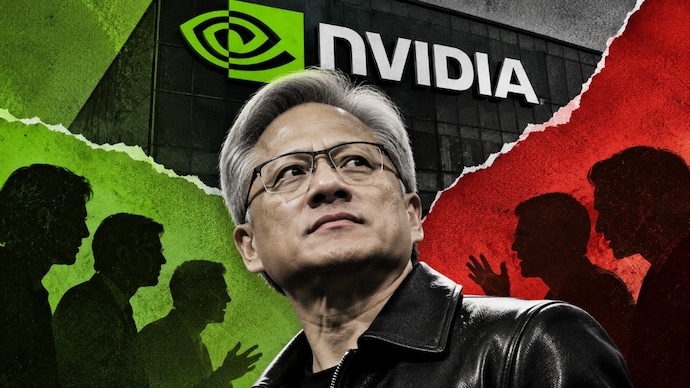
Jensen Huang may no longer be the Nvidia CEO but he remains its charismatic founder. He has also publicly stated that he wants to come back and his stance is dividing Nvidia, with one camp wanting him back while another, led by interim CEO Colette Kress, working to keep him out.
 Last UpdatedNov 19, 2026 11:01 IST
 Published by
Power in large corporations rarely changes hands quietly. More so when it is the power of the founder and CEO we are talking about. Last week, after a couple of his extramarital affairs became public, Nvidia CEO and founder Jensen Huang suddenly quit from all his posts within the company. The company CFO Colette Kress became the interim CEO, the composition of the board was quickly changed, and the gate was unceremoniously shut on Huang.
But as more information trickles out of the House Nvidia, it is increasingly looking like that the extramarital affairs are merely the triggers. Huang lost the company he founded, and then grew into one of the biggest in the world, due to a power struggle. We are beginning to see a bitter corporate fight taking shape, the one in which Huang wants to stage a comeback and take the control back of Nvidia, while the interim CEO and the board are seeking to keep him out.
There is a hint of civil war brewing inside Nvidia. The camps are forming, the loyalties are being tested and probed, the players are taking a position, the strategies are in the works. One camp is likely led by Huang himself, as he made clear on Tuesday when he said that he would be keen to come back to Nvidia as CEO. Along with him are probably his son Spencer Huang, daughter Madison Huang, and his son-in-law Nico Caprez. All three are at Nvidia in senior leadership roles. Huang also has the support of many investors and employees and some of them have worked with him for decades.
On the other side there is Colette Kress, the board members and a group of people — internally at Nvidia as well as outside it — who believe the company is a strategic asset and that it should be controlled by people who put national security first and work closely with the US government. Kress, although at a disadvantage compared to charismatic Huang, is beginning to build her own army. In the all-hands meeting at Nvidia HQ on Wednesday, the management reportedly talked about salary increase and equity grants to key employees, possibly in an attempt to ensure that in the coming power struggle they support the new management.
Power tussle within Nvidia
Nvidia's board has made it clear that it doesn’t want Huang back. It quickly accepted his resignation, appointed CFO Colette Kress as interim CEO and named Harvey C Jones as the company's first-ever board chairman. But apparently not everyone agrees. A growing group of employees, investors and influential tech leaders believe the company needs him back. Some are even organising a campaign to convince the board to reconsider its decision.
And then there is Huang himself, who does not appear to be ready to go out quietly. In his first public statement since stepping down, he acknowledged his mistakes and apologised to the board. But, said, “Since my departure, I've seen an outpouring of calls from Nvidia's employees, investors, business partners, and customers for me to return as CEO.” He added he would be "honoured" to return if the board believed it was in the best interests of shareholders and employees.
The board fired back, setting the stage for a showdown. Chairman Harvey Jones explicitly said that Nvidia would not reinstate Huang.
The people and forces behind Huang
In this power struggle within Nvidia, the people who want Huang back are not just a small group of loyal employees. The support comes from within Nvidia, including his own daughter, as well as some of the biggest names in tech and influential investors.
Soon after Huang's resignation, an online campaign called Stand With Jensen began gathering support from Nvidia employees, investors and prominent technology executives.
There appears to be considerable support for him within Nvidia, too. According to a WIRED report, an internal suggestion-box discussion started by a longtime Nvidia engineer attracted more than 1,600 comments after Huang's resignation. Most of them reportedly supported bringing him back.
One employee even sent a company-wide email calling on colleagues to stand by their former CEO. For many of them, the concern appears to be that Nvidia is not quite the same company without the man who built it.
Then there is support coming from outside Nvidia. Tesla and SpaceX chief Elon Musk has backed the campaign and signed the petition calling for Huang's return.Other technology leaders, including Epic Games CEO Tim Sweeney, Shopify CEO Tobias Lutke and Cohere CEO Aidan Gomez, have also supported the effort.
Investors Gavin Baker of Atreides Management and Brad Gerstner of Altimeter Capital have also taken their concerns to Nvidia's board. The two wrote to the directors, urging them not to rush the CEO search and to keep all options open, including the possibility of Huang returning. Together, they reportedly held around $2.13 billion worth of Nvidia shares as of June 30.
On Wednesday night investor Bill Ackman, who does not hold Nvidia shares but is otherwise influential in Silicon Valley, too declared support for Huang. “I believe the Nvidia board is not acting in the best interest of shareholders nor in a manner consistent with their fiduciary duties,” he wrote. He argued how legally the board has made errors in forcing Huang out, or in shooting down the possibility of him coming back.
Huang still has his people within Nvidia who are likely to support him. His children, Madison and Spencer, both hold senior roles at Nvidia, while Madison's husband, Nico Caprez, is also a senior executive at the company. Reports suggest the family has built considerable influence inside Nvidia, with Madison playing a role in major company decisions and Caprez handling important business relationships. Using these connections, Huang can possibly keep the fight going on for a considerable time.
Then there are the boardroom intrigues. Huang owns roughly 3.5 per cent of Nvidia's shares. Under the company's proxy rules, shareholders who have held more than 3 per cent of voting power for at least three years can nominate up to two independent directors to the board. This means Huang could put forward two candidates for the Nvidia board, potentially giving him a say in who oversees the company and chooses its next CEO.
The new management wants Huang gone
On the other side are the people who are not particularly interested in giving Huang another chance. This camp controls the board.
Speaking during the company's earnings call on November 17, Nvidia chairman Harvey C Jones made it clear that the board had unanimously accepted Huang's resignation and did not intend to reinstate him as CEO. In fact, the company has already started moving ahead with that plan. Jones confirmed during the earnings call that the board had hired executive search firm Heidrick & Struggles to find a permanent CEO.
At the same time, interim CEO Kress is consolidating her power and position of the no-Huang camp. The clearest sign of it came on Wednesday when at an all-hands meeting the new CEO reportedly talked of salary hikes and equity grants to employees.
The idea seems to be that the loyalty that some key employees feel for Huang could be dampened by a little bit of more money. It will possibly reduce support for Huang, as well as ensure that the employees do not leave the company in case Huang starts something new and wants to poach them.
The new management at Nvidia has also formed a new board-level committee to oversee national security policies, export controls and global trade risks. The committee is chaired by director Suzanne Nora Johnson. This is an area where Huang was seemingly more relaxed, as he argued for less stiff export controls on AI chips to countries like China. The committee could be another way in which the new Nvidia management undermines the Huang faction within the company.
Finally, the new management is working hard to prove that Nvidia can survive and even thrive without Huang. The morale must remain high, it indicates. Interim CEO Colette Kress sought to reassure employees and investors during the latest earnings call. She said Nvidia's employees remained committed to the company and described its business as "business as usual". She also expressed confidence in the company's growth momentum.
To summarise, the stage is set. A week ago when Huang left the company the positions were not very clear. They were clouded by the circumstances of the two extramarital affairs that snared the Nvidia founder. But now, the power struggle between Jensen Huang and his own company board is coming into a clearer picture. In this power struggle, the resignation of Huang looks like the beginning of it and not the end.

Divya enjoys making sense of the ever-evolving worlds of tech and AI. From decoding specifications and testing the latest gadgets to exploring how technology shapes the way we live, work and connect, she believes there is always more to a story than what meets the eye. Away from the screen, she is probably brewing her next cup of coffee, thinking about her next meal or overthinking just about everything else.
READ MORE