
Vietnamese crab exporter
Advertisement

Dr. Vishal Sikka: 'This Is Not The Time To Slow Down' On AI

In an exclusive interview, Hang Ten Systems founder and former Infosys CEO Dr. Vishal Sikka discussed the rapid evolution of artificial intelligence and its profound impact on software engineering and entrepreneurship. Addressing concerns over AI safety and disruption, Dr. Sikka stated, "This is not the time to slow down," arguing instead that nations like India must actively accelerate adoption, understanding, and scale. He highlighted that generative AI drastically compresses software construction time while remaining fundamentally human-guided. Dr. Sikka also backed Prime Minister Narendra Modi's warning against the weaponization of technology and critical resources, stressing that universal access to foundational models is essential to prevent geopolitical imbalances. Emphasizing the transformative potential of modern AI tools, he explained how individual creators and entrepreneurs can now achieve what previously required entire teams.

Read More

VIDEOS FROM OTHER SECTIONS

LATEST VIDEOS

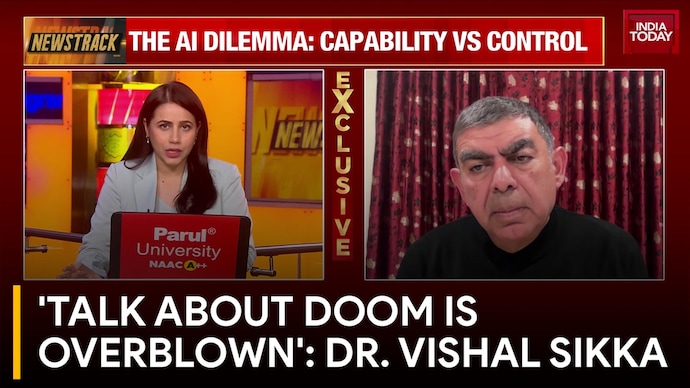
'AI Ending Humanity Is All Nonsense': Dr. Vishal Sikka to India Today

In an interview with India Today, Dr. Vishal Sikka, former CEO of Infosys and founder of Vianai Systems, addressed the global debate surrounding artificial intelligence, frontier models, and safety concerns. Dismissing doomsday predictions, Dr. Sikka stated, "this talk about AI ending humanity and all this, this is all nonsense." He noted that AI does not act on its own, emphasizing that outcomes depend entirely on the instructions and prompts given by human users. Addressing high-profile departures and warnings from researchers at frontier AI labs, he observed that fears often arise when humanity confronts new, complex technologies. He pointed to historical parallels in computing, such as processor errors and early manual calculation skepticism, to highlight how system trust and reliability build over time. Dr. Sikka also supported regulatory oversight, affirming that "AI has to be regulated" while explaining that technical advances in reasoning models, tool integration, and unit testing will steadily enhance software efficiency and precision across enterprises.


advertisement

Ashwini Vaishnaw: 'It's life-changing' as Students Tape Out Chips in 400 Universities

In an exclusive interview, Union Minister of Electronics and Information Technology Ashwini Vaishnaw detailed India's expanding semiconductor ecosystem and talent development initiatives. Vaishnaw highlighted that the Chips to Startup program now covers 400 universities across the country, giving students hands-on experience in chip design, tape-out, and testing. Speaking on the impact of the initiative on youth, Vaishnaw said, "It's life-changing because those students, when they go into the industry, like, there won't be many countries in the world where a student coming out of a university can say that I have taped out a chip." Responding to critics regarding India's focus on legacy nodes between 28 and 90 nanometers, he noted that this segment constitutes 70% of global semiconductor volume and powers essential electronics and automotive manufacturing. He outlined India's Semiconductor 2.0 blueprint, which includes upgrading B.Tech curricula to systems design and building five-year capabilities in advanced packaging, equipment manufacturing, and materials.