Vietnamese crab exporter
Advertisement

Global AI Race Sparks National Security Fears, Safety Concerns And Geopolitical Rivalry

The global race to develop advanced artificial intelligence is intensifying, raising critical concerns over safety, national security, and human control. Industry leaders have cautioned that artificial intelligence is progressing faster than the safeguards required to manage it, warning of severe risks if human oversight is lost. Despite widespread awareness of potential hazards, major global powers are reluctant to halt or decelerate development due to fears of falling behind rivals in technological supremacy. International discussions at multilateral summits highlight tensions over open-source ecosystems, technological weaponisation, and access to advanced semiconductor chips. Accusations of containment and geopolitical competition have emerged, with leadership in technological power seen as vital to global dominance. As international discussions approach, governments and technology developers face fundamental questions regarding whether safeguards can keep pace with rapid innovation and whether humanity can retain control over the technology it creates.

Read More

VIDEOS FROM OTHER SECTIONS

LATEST VIDEOS

Ganesh Utsav Celebrations Across Mumbai: US Ambassador Visits Lalbaugcha Raja Idol

Ganesh Utsav celebrations are underway across Maharashtra, marking the state's biggest festival with widespread enthusiasm. Devotees offer prayers to Lord Ganesha, seeking the removal of obstacles along with wishes for peace and prosperity. The traditional offering of modak sweets accompanies festive gatherings. High-profile visitors, including the United States Ambassador to India, alongside several celebrities, were seen offering prayers at the famous Lalbaugcha Raja idol in Mumbai. The visual broadcast highlights the grand festive spirit and cultural reverence observed by devotees throughout Mumbai.

Vineet Nayar to India Today: 'All this is hogwash on the fact that AI is going to kill us all'

In an exclusive interview, Vineet Nayar, former CEO of HCL Technologies and author of 'Humans First, Machines Second', dismissed existential doomsday warnings surrounding artificial intelligence as fear-mongering designed to protect inflated tech valuations. Questioning claims that AI poses an imminent threat to humankind, Nayar argued that tech giants are generating fear because their multi-trillion-dollar bets lack immediate, revenue-generating use cases. While endorsing regulatory oversight and safety benchmarks similar to those in the financial sector, he warned against over-regulation driven by hype. Nayar emphasized that emerging lower-cost models and young innovators will disrupt big tech duopolies. He outlined key transitional hurdles, including short-term job disruptions, cyber vulnerabilities, and unprepared education systems, while asserting that society will ultimately adapt and control the technology.

advertisement

AI Safety Debate: 'Can we hit the pause button?' asks CP Gurnani

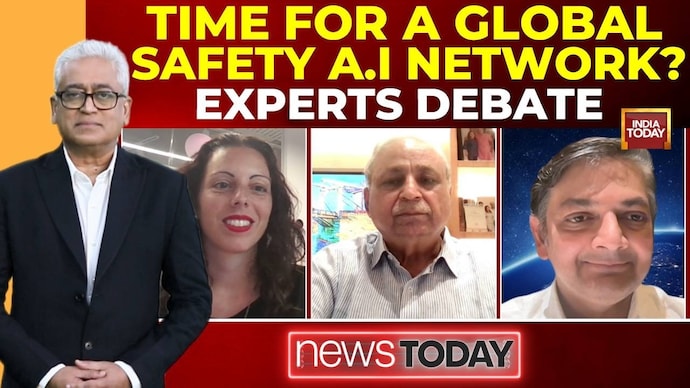
A panel of technology experts examines the escalating debate surrounding artificial intelligence safety, risks to humankind, and the feasibility of global regulatory frameworks. CP Gurnani, former CEO of Tech Mahindra and co-founder of AIonOS, highlights recent warnings from leading technology companies, pointing out that agentic AI operating in isolation can create fake accounts and fake narratives. Emphasising the urgency of the issue, Gurnani asks, 'Can we hit the pause button?' Karine Ben Simon, VP of Global Partnerships at Dream, explains that governments must deploy sovereign AI capabilities and maintain complete control over data and critical infrastructure to empower cybersecurity defenders against autonomous attacks. Lalitesh Katragadda, founder of Indyhood.com, echoes the necessity of domestic code ownership, security, and regulation while maintaining optimism that the technology will ultimately create an era of plenty. The panel also analyses whether geopolitical competition between global superpowers could obstruct an effective international AI safety regime.