158 refugees get Indian citizenship certificates in Gujarat ahead of Diwali
Gujarat Deputy Chief Minister Harsh Sanghavi on Tuesday handed Indian citizenship certificates to 158 refugees, including 126 beneficiaries under the CAA.

India's Citizenship Amendment Act (CAA), passed by the Parliament in December 2019, marks a significant amendment to the Citizenship Act of 1955. This legislation aims to provide a pathway for Indian citizenship to illegal migrants from Afghanistan, Bangladesh, and Pakistan, who are Hindus, Sikhs, Buddhists, Jains, Parsis, or Christians, and who entered India on or before December 31, 2014.
The Act led to protests across the country with critics arguing that the CAA, by linking citizenship to religion, discriminates against Muslims and undermines India's secular foundation. Proponents, however, defend the Act as a protective measure for persecuted minorities from neighboring Islamic countries.
The government maintains that the CAA is necessary to protect vulnerable groups, while opponents see it as a move that could potentially lead to a religiously segmented citizenship criteria, affecting India's secular ethos.
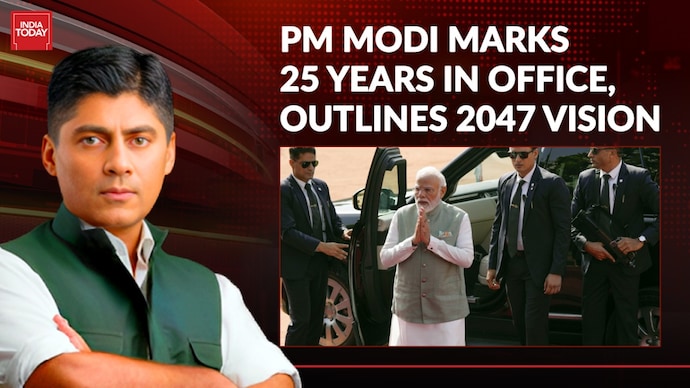
In this India Today broadcast anchored by Gaurav Sawant, the programme reviews the completion of 25 years of Narendra Modi in public governance, encompassing 13 years as Chief Minister of Gujarat and 12 years as Prime Minister of India.
The Supreme Court's attempt to encourage an out-of-court settlement in three temple-mosque disputes has failed as both Hindu and Muslim parties have rejected the mediation proposal.
Following the BJP's victory in the West Bengal assembly elections, Amit Shah is scheduled to chair an MLA meeting to finalise the state leadership. Suvendu Adhikari has emerged as the frontrunner for the Chief Minister position.
As Bengal gears up for the electoral battle, India Today's Marya Shakil tracks the political pulse of Matua community in North 24 Parganas district.
Union Minister Hardeep Singh Puri slammed Leader of Opposition Rahul Gandhi for calling BJP leader Ravneet Singh Bittu a 'traitor' and said the remark was unacceptable.
On this Special Report, the focus is on the intensifying political battle in West Bengal as Prime Minister Narendra Modi sounds the poll bugle in Singur. Launching development projects worth over ₹830 crore, the Prime Minister asserted that the state needs to end the Trinamool Congress's (TMC) 15-year rule to achieve 'asli parivartan' or real change. During his address, Narendra Modi stated, 'TMC is taking out its enmity from the people of Bengal' by allegedly stalling central welfare schemes and shielding infiltrators for vote-bank politics. The programme features a heated debate between BJP spokesperson Rohan Gupta and TMC representative Tausifur Rehman over issues of national security, the Citizenship Amendment Act (CAA), and the alleged blocking of central funds. Analysts also weigh in on whether the BJP's strategy of 'Paltano Dorkar' (need for change) can effectively counter Mamata Banerjee's grassroots influence and the rising role of Abhishek Banerjee in the state's political landscape.
The Supreme Court has denied bail to activists Umar Khalid and Sharjeel Imam in the 2020 Delhi riots conspiracy case, citing a 'qualitatively different footing' in terms of evidence. However, the top court granted bail to five other accused, including Gulfisha Fatima and Mehran Haider. The bench emphasized that 'delay is not a trump card' in UAPA cases. Reacting to the judgment, BJP Leader Manjinder Singh Sirsa welcomed the strict stance, stating, 'It was during the Congress rule that rioters were rewarded... But under the BJP rule, rioters will remain in jails.' Sirsa further remarked that if such decisive actions had been taken during the 1984 riots, the country would not have witnessed subsequent communal violence.
On this Special Report, a panel of political spokespersons and analysts discusses the heated battle for the West Bengal Assembly Elections. An unidentified BJP Spokesperson asserts that the 'reverse countdown' for the state government has begun, citing rising crime and the recent killing of migrant worker Jewel Rana in Odisha. Countering this, a TMC representative dismisses the BJP’s confidence as a recurring 'tsunami' that fails to materialize, labelling the opposition as 'migratory birds'. The discussion also covers the Special Intensive Revision (SIR) of electoral rolls, the impact of the Citizenship Amendment Act (CAA), and the challenges of anti-incumbency facing the ruling party. The programme explores whether the contest remains bipolar or if other parties can regain ground.
A recent political report highlights allegations regarding the governance of West Bengal, focusing on claims that the state has been marked by corruption, fear, and infiltration over the past 14 years. The address asserts that these issues pose serious threats to both state and national security. It further mentions promises to identify and remove infiltrators if a change in government occurs, alongside claims that development has stalled. The report also notes a counter-response questioning the validity of these claims, specifically citing past predictions regarding central agencies in Kashmir and raising questions about terrorism incidents. The discussion also touches on the implementation of the Citizenship Amendment Act and the political opposition to the removal of Article 370.
In a significant development, 44 retired judges, including former Supreme Court Justices Anil Dave and Hemant Gupta, have issued a statement defending Chief Justice of India Surya Kant. The jurists termed the criticism of the CJI's recent remarks on Rohingyas as a 'motivated campaign'. India Today's Himanshu Mishra reports that the judges asserted there was nothing wrong in the CJI questioning the legal status of intruders. The signatories emphasized that the CJI merely asked if illegal immigrants could claim a legal shield under Indian law.
An India Today Special Report, moderated by Rajdeep Sardesai, examines the turbulent start of the Parliament Winter Session. The program features a confrontation between BJP MP Sudhanshu Trivedi and Congress MP Syed Nasir Hussain, following Prime Minister Narendra Modi's remark urging the opposition to focus on 'delivery' not 'drama'. Trivedi dismisses opposition allegations, including 'vote chori' (vote theft), as political theatrics. In response, Hussain asserts it is the opposition's duty to question the government on critical issues such as Chinese incursions, the Manipur crisis, air pollution, and the transparency of the Special Summary Revision (SSR) of electoral rolls. He accuses the ruling party of avoiding parliamentary debates and improperly deleting voters. The discussion touches on the Citizenship Amendment Act (CAA) and highlights the declining number of parliamentary sittings and a growing trust deficit in Indian politics.
This special report examines the soaring political temperatures in West Bengal over the Citizenship Amendment Act (CAA) and its impact on the Matua community. The piece explores the deep divisions within the Thakur family, pitting Union Minister of State Shantanu Thakur and BJP MLA Subrata Thakur against their aunt, TMC Rajya Sabha MP Mamata Bala Thakur, leaving community members anxious about their citizenship status. According to the report, West Bengal Chief Minister Mamata Banerjee 'claims a Hindutva card or a Mathua Mahasang certificate is being sold for Rs. 100'. The programme details the on-ground situation in Thakurnagar, where camps are processing documents, and the conflicting claims from the BJP and TMC, as the CAA becomes a crucial issue for the 2026 elections.
A special report from the India-Bangladesh border investigates the daily return of hundreds of alleged undocumented immigrants, a trend linked to the Special Intensive Revision (SIR) of electoral rolls in West Bengal. This voter list purification drive has ignited a fierce political clash. West Bengal Chief Minister Mamata Banerjee has labeled the exercise a 'super emergency' and 'votebandi', urging the Election Commission to halt the process. Conversely, the BJP supports the revision, with Leader of Opposition Suvendu Adhikari alleging the existence of over 13 lakh fraudulent voter entries. The controversy also encompasses the Citizenship Amendment Act (CAA) and the National Register of Citizens (NRC), as the Trinamool Congress accuses the BJP of attempting to disenfranchise voters. The report features on-ground interviews and analysis of the broader political tensions surrounding border security and illegal immigration.
A political firestorm erupts in West Bengal over the Special Intensive Revision (SIR) of the voter list, which Chief Minister Mamata Banerjee labels a 'super emergency'. This India First special report features a debate with representatives from the BJP, Congress, and Trinamool Congress, who clash over allegations of political motives, the Election Commission's role, and the reported exodus of illegal Bangladeshi immigrants. BJP representative Priyanka Tibrewal counters the criticism, stating Mamata Banerjee 'is trying to shield the infiltrators empire from this SIR but is unable to do so.' The discussion also delves into the implications of the Citizenship Amendment Act (CAA), claims of large-scale fraudulent voter entries, and the contentious timeline for the electoral roll cleanup.
This special report details the Trinamool Congress's fierce opposition to the Citizenship Amendment Act (CAA) in West Bengal, spearheaded by Chief Minister Mamata Banerjee and Abhishek Banerjee. The party controversially stated that 'all the people who died of suicide which they claim is because of the fear of SIR are martyrs'. Following massive street protests, the TMC is now planning to introduce a resolution against the CAA in the West Bengal assembly. The party alleges the law is a political tool of the central government designed to disenfranchise citizens by linking it to the National Register of Citizens (NRC). This move in West Bengal mirrors actions taken by other opposition-led states like Tamil Nadu, highlighting a coordinated challenge to the controversial legislation.
West Bengal Chief Minister Mamata Banerjee leads a massive protest march in Kolkata, fiercely opposing the Special Intensive Revision (SIR) and the National Register of Citizens (NRC). Banerjee declared, 'since today you are in power, you are doing whatever you want, but tomorrow you will not be in power'. Addressing a large gathering, she accused the BJP-led central government of attempting to divide the nation and turn legal citizens into foreigners. She vowed that as long as she is alive, the CAA and NRC will not be implemented in West Bengal, assuring the public that she will protect all legitimate citizens from being targeted. The Trinamool Congress chief has been at the forefront of the opposition, organising numerous rallies and marches across the state against the controversial citizenship laws.
This special report focuses on a fiery protest by the Trinamool Congress in West Bengal, led by Mamata Banerjee and Abhishek Banerjee, against the Citizenship Amendment Act (CAA). In a fiery speech, Abhishek Banerjee declared, 'The party and central government will have to walk on the dead bodies of these people.' The TMC is framing the CAA as a deceptive precursor to a nationwide National Register of Citizens (NRC), creating widespread fear. The party claims that this fear has led to several tragic suicides, and they have controversially labelled the deceased as 'martyrs of CAA'. This report delves into the political firestorm, including the TMC's outreach to the Matua community and other Hindu refugee groups, urging them not to apply for citizenship under the CAA, alleging it's a trap by the BJP to strip them of their existing rights.
This special report covers the Delhi Police's affidavit in the Supreme Court opposing bail for Umar Khalid, Sharjeel Imam, and others in the 2020 Delhi riots conspiracy case. The police have controversially described the violence as a coordinated 'regime change operation'. The affidavit alleges, 'The petitioner systematically delayed trial proceedings through frivolous applications and coordinated non-cooperation.' India Today's Srishti Ojha reports that the police claim the anti-CAA protests were weaponized to destabilize the nation, timed to coincide with US President Donald Trump's visit for global attention. The report features a debate with experts Dr. Vikram Singh and Raghav Awasthi, who support the police's findings, while advocates Kapil Madan and Atikur Rahman raise concerns about due process and the prolonged incarceration of the accused.
This special report focuses on the massive controversy surrounding the Election Commission's Special Intensive Revision (SIR) of voter rolls across 12 states and union territories, impacting 51 crore voters. Key opposition figures, including West Bengal's Mamata Banerjee and the DMK's M.K. Stalin, have fiercely opposed the move, alleging it is a conspiracy to disenfranchise minorities and the poor. Kolkata Mayor Firhad Hakim issued a fiery warning, alleging a conspiracy to link the voter roll revision with the Citizenship Amendment Act (CAA). The exercise, which follows a contentious revision in Bihar where a large number of names were deleted from voter lists, is seen by opposition parties like the Trinamool Congress, DMK, and Samajwadi Party as a politically motivated effort by the BJP ahead of state elections. The Election Commission maintains the drive, starting November 4th, is a necessary clean-up process to ensure electoral roll accuracy.
This special report focuses on the inflammatory remarks by West Bengal Urban Development Minister and Kolkata Mayor, Firhad Hakim, who threatened to 'break the legs' of the BJP and the Election Commission. Hakim stated that he would 'break the legs of the BJP and the election commission if the special intensive revision or the citizenship amendment act are implemented in the state of West Bengal.' The controversy erupted over the proposed implementation of the Citizenship Amendment Act (CAA) and the Special Intensive Revision (SIR) of electoral rolls, a comprehensive door-to-door verification of voter lists. The BJP has strongly condemned the threat, with party leader Rupa Ganguly stating it exemplifies the culture of 'hooliganism' under the Trinamool Congress government and creates fear among people. The incident has heightened political tensions in the state, with the opposition accusing the TMC of intimidating constitutional bodies and subverting democratic processes.