
There is more BRICS in your lives than you think: Here's how.

From the infrastructure India uses every day to the trade imbalances it still struggles with, BRICS has a growing footprint at home
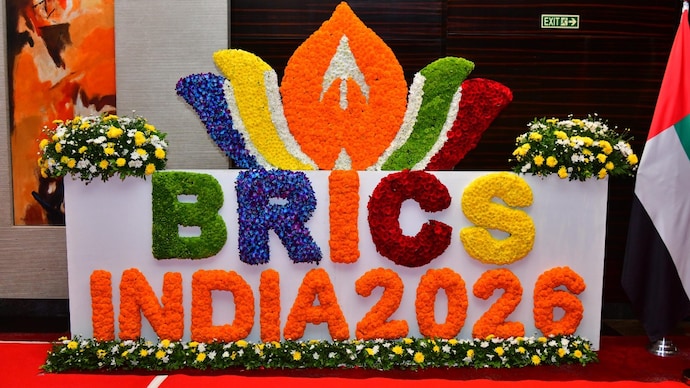


Over a year ago, US President Donald Trump declared: “BRICS is dead”. He had threatened 100% tariffs on countries that sought to challenge the US dollar.
Yet, as India hosts the 18th BRICS Leaders’ Summit in New Delhi on September 12–13, an analysis by India Today’s OSINT team finds the grouping’s little-noticed imprint closer home, in our everyday journeys, in the way India moves.
From the Delhi–Meerut rail corridor to road and rail projects in Madhya Pradesh and a bridge project in Assam, financing from the grouping’s New Development Bank has helped build and expand infrastructure across India. The bank has approved at least 35 projects in the country, with transport accounting for the largest share of its India portfolio. It is here, beyond summit declarations and diplomatic tensions, that BRICS takes on a more tangible meaning.
So, no, BRICS is not dead. But neither is it a cohesive economic bloc moving towards replacing the Western-led order. It is bigger, increasingly consequential and more complicated.
What began with Brazil, Russia, India, China and South Africa now encompasses 11 countries: Egypt, Ethiopia, Iran, the United Arab Emirates, Indonesia and Saudi Arabia have joined the original five. Expansion has given BRICS greater economic weight. It has also brought more competing interests under the same roof.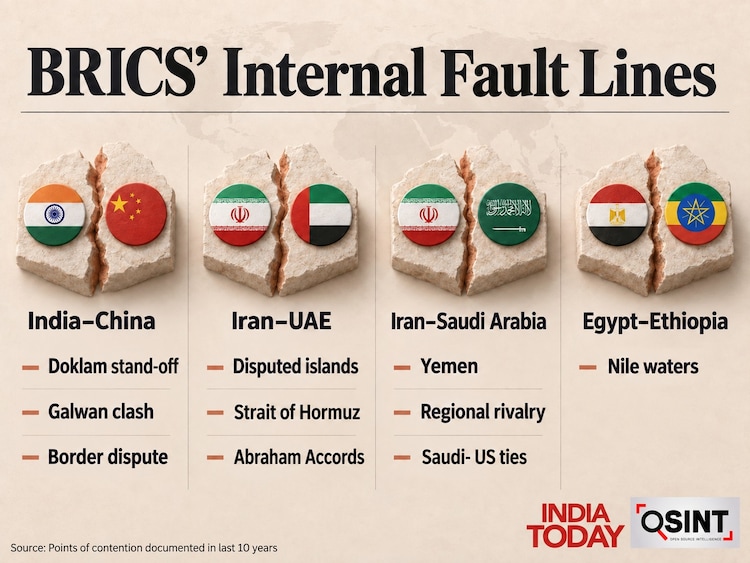
But size is not the same as usefulness.
India’s own trade numbers illustrate the contradiction. In 2024–25, India ran trade deficits with seven of the other 10 BRICS members — China, Russia, the UAE, Saudi Arabia, Indonesia and South Africa. The imbalance with China was by far the largest.
Nor has expansion produced anything resembling a common BRICS currency capable of displacing the dollar. India itself has framed its latest push around linking digital payment systems and central-bank digital currencies to make cross-border transactions easier, rather than replacing the dollar as the world’s reserve currency. The United States, meanwhile, remains India’s single largest merchandise export market.
THE BRICS BENEFIT INDIA CAN ACTUALLY TOUCH
For all the talk of BRICS as a geopolitical counterweight to the West, its most visible legacy in India may be far more concrete: metro lines, highways, bridges and water networks.
The New Development Bank, set up by the five original BRICS members in 2015, has approved 35 projects in India worth nearly $10.5 billion, according to its latest official figures. Around $6 billion has already been disbursed. India is now the bank’s second-largest recipient of financing, accounting for roughly 24 per cent of its loan portfolio.
A large share of that money has gone into moving people and goods.
By the end of 2023, India had 26 active NDB projects worth about $8.6 billion. Fourteen were transport projects - spanning roads, bridges, connectivity and urban rail. Together, they accounted for $4.7 billion, or 55 per cent of the bank’s approved financing in India at the time. Seven projects were devoted to water and sanitation; the remaining five covered renewable energy, emergency assistance and multi-sector programmes.
The footprint is already visible across some of India’s biggest cities. NDB money has helped finance the 82.15-km Delhi–Ghaziabad–Meerut RRTS, 26.8 km of Chennai Metro’s Corridor 4, roughly 31 km of the Indore Metro, and around 58 km of Mumbai Metro Lines 2A, 2B and 7. New projects listed this year include the Lucknow Metro expansion, affordable-housing finance and energy infrastructure.
THE $226-BILION PROBLEM
India’s merchandise trade with the BRICS partners analysed was heavily tilted towards imports in FY2025-26.
India exported $95.7 billion and imported $321.8 billion, leaving a $226.1 billion trade deficit.
China alone accounted for a $112.1 billion deficit, followed by Russia at $50.9 billion, the UAE at $26.5 billion, Saudi Arabia at $20.5 billion, and Indonesia at $15.8 billion.
So the first reality check is simple: a bigger BRICS does not automatically mean balanced trade for India.
CHINA IS THE HARD LIMIT

BRICS may add suppliers. But India has not yet diversified its BRICS imports enough to reduce its China dependence.
China supplied $46.4 billion of electrical machinery, against just $1.43 billion from the rest of BRICS. For machinery, it was $29.4 billion versus $1.2 billion; for vehicles and parts, $2.87 billion versus $0.14 billion.
The gap is smaller in organic chemicals and plastics, where the rest of BRICS supplied $2.21 billion and $2.56 billion, respectively.
But the larger picture is clear: BRICS can diversify some supply chains. It cannot yet reproduce China’s manufacturing scale.
BRICS CAN OPEN DOORS - NOT REPLACE AMERICA
India has consistently framed BRICS as a “non-Western, but not anti-Western” platform. Yet the grouping is often seen as a counterweight to the US - particularly over the dollar and the Western-led financial order - a perception reinforced by repeated statements from Donald Trump.
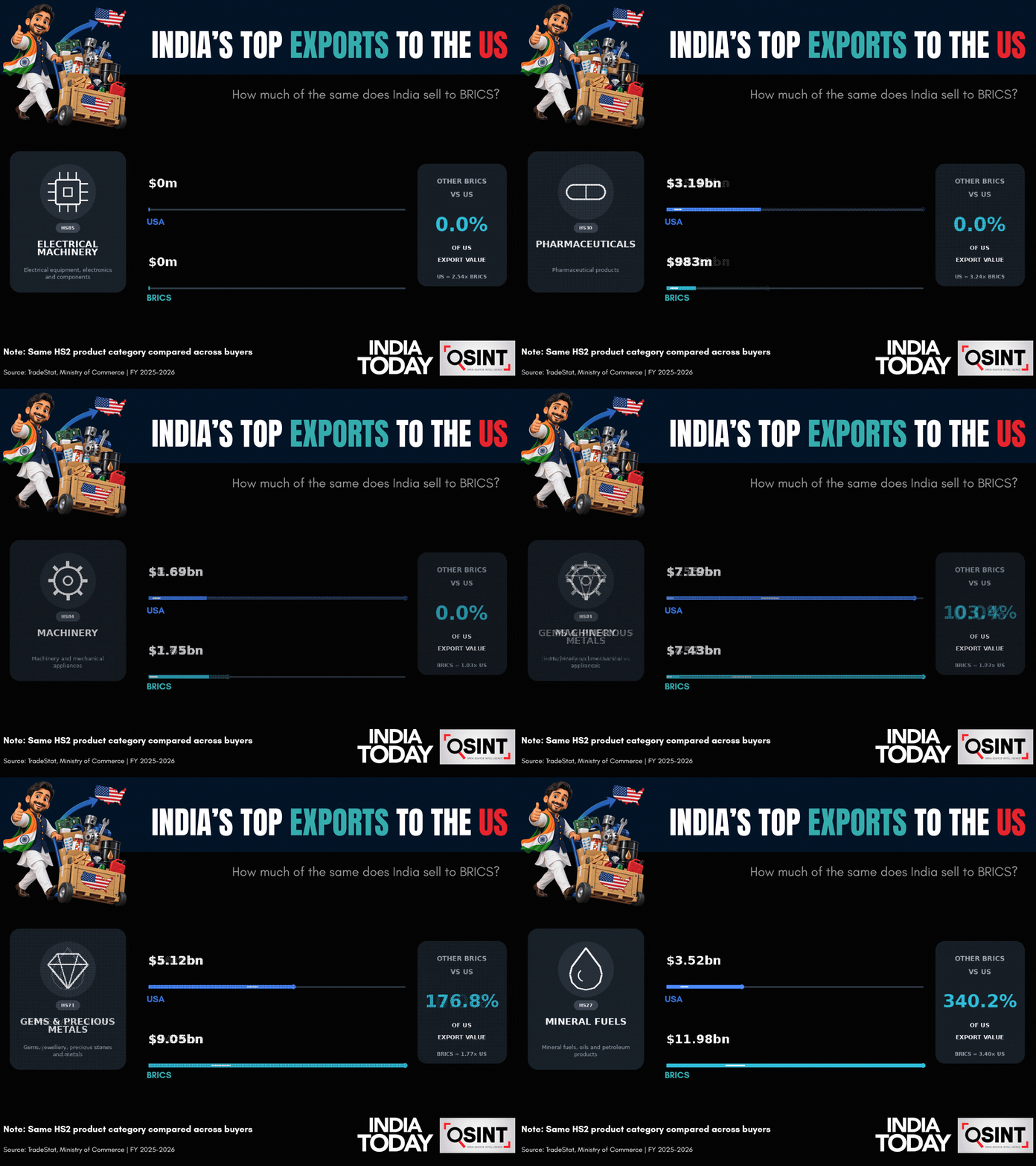
India’s trade with both sides, however, tells a more nuanced story. The US remains the larger market for several key Indian exports: $25.7 billion of electrical machinery went to the US, compared with $9.6 billion to other BRICS markets. In pharmaceuticals, the gap was $8.7 billion versus $2.5 billion.
But BRICS markets are important buyers in some other categories. India exported $8.8 billion of gems and jewellery to other BRICS markets, compared with $5.1 billion to the US. For mineral fuels, it was $11.8 billion versus $3.5 billion.
The takeaway is not that BRICS can replace America. It is that BRICS can give India more markets to fall back on when tariffs or other trade barriers make access to one market harder. And there is already a substantial - if still underused - trading base to build on. UNCTAD’s latest study found “intra-BRICS merchandise exports reached $1.17 trillion in 2024, more than 13 times their 2003 level. Yet intra-BRICS trade still accounts for only about 20% of South-South trade,” despite BRICS members accounting for more than two-thirds of Global South GDP. UNCTAD says the bloc’s trade potential “is yet to be fully tapped.”
DE-DOLLARISATION IS A BRICS FAULT LINE?
The debate inside BRICS is moving beyond the idea of a common currency to a more practical question: can members make cross-border payments easier without deepening strategic dependence on one another?
At an August BRICS finance meeting, RBI Governor Sanjay Malhotra said: “Cross-border payments are an area of interest for all of us, including the BRICS, because we feel there is a lot of scope for reducing cost but it is still at discussion stage.”
But even here, there are limits to how far India wants to go. Reuters reported that “India has also been reluctant to deepen financial connectivity with China”, citing national-security concerns. An earlier Chinese proposal to link Alipay+ with India’s instant payments system had also stalled over “national security concerns due to its Chinese links.”
The larger disagreement is over the dollar itself. EAM S Jaishankar has said: “India has never been for de-dollarisation. Right now, there is no proposal to have a BRICS currency.” He has also said: “The United States is our largest trade partner and we have no interest in weakening the dollar at all.”
Russia, meanwhile, is pursuing de-dollarisation far more aggressively. Speaking at the 2026 BRICS forum, Russian Economic Development Minister Maxim Reshetnikov said: “Three years ago, the dollar and euro totalled 85 per cent of settlements for Russian exports. The figure now stands at about 11 per cent.” He presented the shift as part of Russia’s push to build an alternative international financial system.
THE BIGGER BRICS GETS, THE MORE IT PULLS APART
Expansion has brought economic opportunities - but also a much longer list of geopolitical contradictions.
Iran and the UAE now sit inside the same grouping despite their sharply divergent positions. Iran and Saudi Arabia have restored diplomatic relations, but remain regional rivals. Saudi Arabia, meanwhile, retains a deep strategic and defence relationship with Washington, while the UAE has formalised relations with Israel under the Abraham Accords.
Egypt and Ethiopia remain at odds over the Grand Ethiopian Renaissance Dam (GERD) and the Nile waters. India and China remain strategic competitors even as they are major trading partners.
And within the original BRICS, India and Brazil have generally favoured a more economically focused grouping, while China and Russia have pushed a more geopolitical interpretation.
The fault lines are not theoretical.
At the BRICS Foreign Ministers’ Meeting in May, members failed to produce a joint statement, and India issued a Chair’s statement instead. Carnegie said members had “differing views” over West Asia, Gaza and navigation through the Red Sea and Bab Al-Mandab Strait.
Chatham House’s September assessment captures India’s balancing act: New Delhi wants BRICS to be “non-Western but not explicitly anti-Western”, even as the expanded membership includes countries with much more openly anti-Western positions.
That is perhaps the central contradiction of India’s BRICS presidency.
SO, WHAT DOES INDIA ACTUALLY GET?
Dr Shashi Tharoor, Lok Sabha MP and Chairperson of the Parliamentary Standing Committee on External Affairs, called India’s hosting of the summit a matter of “great prestige” and said it demonstrated the country’s “diplomatic convening power” on the global stage.
There has been some chatter that it was India’s compulsion that brought Xi Jinping to Delhi for the BRICS summit. But the equation works both ways. China is set to host the BRICS summit next year. Xi’s presence in Delhi was therefore not simply a favour to India; it also reflects the value Beijing attaches to the grouping - and to keeping it relevant. For India too, that relevance is ultimately about what the grouping can deliver beyond the optics of a summit.
BRICS can give India more development finance, alternative suppliers, energy and commodity access, additional export markets and greater diplomatic leverage.
But the data also shows what it cannot currently provide: balanced trade, a substitute for China’s manufacturing supply chains, one integrated export market, a replacement for the US and European consumer base, a common BRICS currency or a unified geopolitical position.
The most useful way to understand BRICS for India is therefore not substitution, but diversification.
Trump said BRICS was dead. The data suggests something more complicated. BRICS is bigger. It gives India more options. The real question is whether those options are strong enough to reduce the dependencies India actually wants to escape.