
Why Bhutan has declined E20 ethanol petrol offer from India
Bhutan has declined offers from Indian oil companies to supply E20 petrol. The development comes at a time when India's E20 petrol mandate has sparked widespread debate over its impact on vehicle performance and mileage.
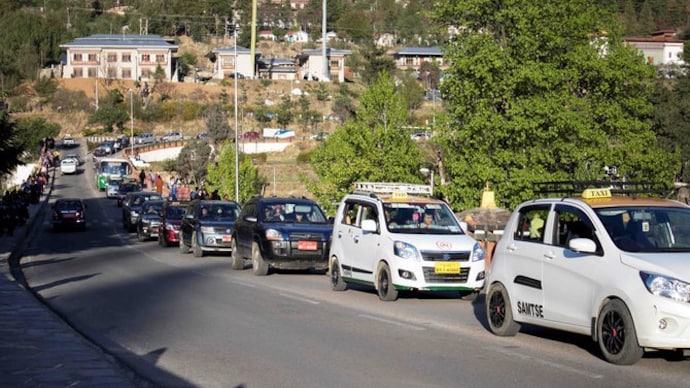

At a time when the government's E20 petrol mandate has sparked widespread debate and protests over its impact on vehicle performance, Bhutan has quietly declined an offer from Indian Oil Marketing Companies (OMCs) on the supply of E20 fuel. According to a report in The Bhutanese, Bhutan has asked India to continue supplying normal petrol as long as such fuel remains available in the Indian market. But why has the Himalayan nation said no to ethanol-blended petrol?
The answer lies in Bhutan's inadequate and ageing fuel storage infrastructure, which is not equipped to handle ethanol-blended petrol. Its steep, hilly terrain is also a challenge as vehicles require maximum power. Authorities fear E20 may not deliver the consistent performance required on Bhutan's mountainous roads.
THE E20 PETROL CONTROVERSY
In India, the introduction of E20 petrol - a 20% ethanol and 80% petrol blend - has sparked a massive backlash, particularly from owners of petrol vehicles manufactured before 2023. They have reported worsening fuel efficiency, rising maintenance issues, and increased wear and tear. While the government has admitted that E20 causes mileage to drop a little, the trade-off is outweighed by improved acceleration and better engine performance.
Now, India's push for E20 petrol has direct implications for Bhutan, which sources all of its fuel directly from India. Presently, Bhutan purchases the higher-export quality petrol and diesel from India. These are more costly than the fuel sold at Indian petrol pumps.
However, Bhutan's Department of Trade has said a firm no to Indian OMCs - IOCL, BPCL, HPCL - offering to supply E20 petrol.
WHY BHUTAN HAS SAID NO TO E20 PETROL OFFER?
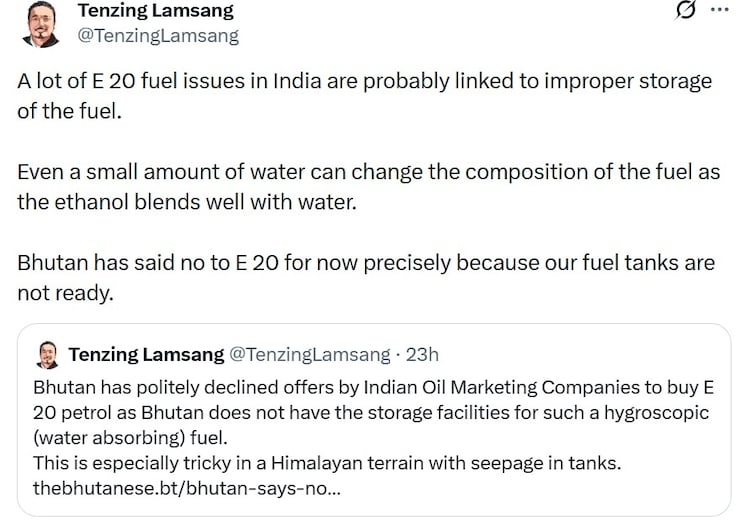
The major reason behind it is Bhutan's ageing fuel tanks, which are stored underground. Due to this, there remains a high chance of seepage of water into the fuel tanks, a Bhutanese official said, as per the report.
Now, let's understand a bit of chemistry. Unlike normal petrol, E20 or ethanol-blended petrol contains a hydroxyl group. This makes it highly hygroscopic. Meaning, it readily absorbs moisture from the surroundings. On the other hand, pure petrol does not readily absorb water.
Thus, if E20 fuel is stored in fuel tanks susceptible to water contamination, there remains a high chance of the fuel getting diluted. Now, the water and the fuel cannot be separated easily. This water inside fuel tanks also accelerates corrosion in steel tanks and pipelines.
In the long term, this may lead to major engine issues and affect vehicle performance, the official said.
"Considering the existing condition and quality of several of the underground storage tanks, the import and handling of ethanol-blended fuel may pose challenges in ensuring fuel quality," the Bhutan government told The Bhutanese.
Moreover, most of Bhutan's fuel depots are situated in mountainous regions with high humidity. Thus, in such conditions, preventing moisture from entering storage tanks or stopping condensation becomes very challenging.
Due to this, Bhutan has requested Indian OMCs to give advance notice if the government decides to pursue higher levels of ethanol blending or adopt fully ethanol-blended petrol. It has also requested Indian OMCs to provide leak-proof tanks.
Earlier this week, the government told the Supreme Court during a hearing that the E20 policy was an "experiment" and its results would only come out next year. As the remark sparked a massive outrage, the government denied the remark was ever made. However, a video of the Attorney General making the remark has since gone viral.
India has already begun testing E25 petrol on vehicles (a blend containing 25% ethanol), according to a report in The Economic Times.
But what if India mistakenly sends E20 fuel to Bhutan? The official said it would be detected easily as the fuel would turn milky even if a small amount of water seeps in.
The Bhutan example shows that fuel transitions cannot follow a one-size-fits-all model. Regions with challenging terrain may require pure petrol rather than ethanol blends.