
Hormuz will reopen only after...: Iran President Pezeshkian lays down terms for US

In an exclusive interview with India Today, Masoud Pezeshkian linked the reopening of the Strait of Hormuz to an end to US pressure on Iran, including the naval blockade and sanctions.
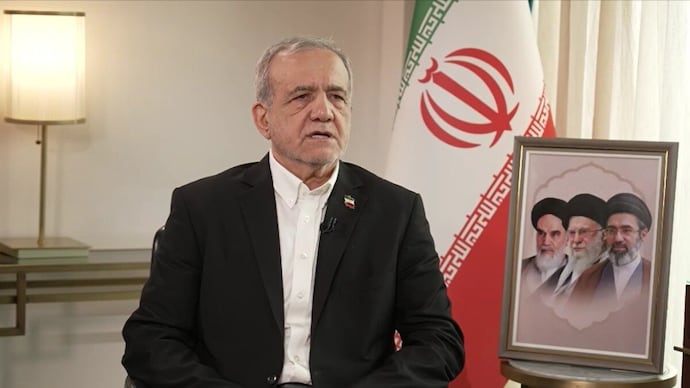

The war in the Middle East has turned the Strait of Hormuz into a high-stakes pressure point, after Iran shut the strategic waterway following US-Israeli strikes and Washington imposed its own blockade. Iran has now hinged on the possibility of reopening the waterway based on Washington's action. Iranian President Masoud Pezeshkian said Tehran is willing to work towards an internationally recognised maritime framework if the US ends its blockade and other activities against Iran.
Speaking in an exclusive interview with India Today, Pezeshkian said Iran was negotiating with Oman over a specific maritime framework for the strategic waterway. Asked about the status of the waterway, Pezeshkian defended Iran's actions, saying Tehran was responding to attacks and pressure from the United States and its allies.
"You see, neither Hezbollah, nor us, I don't think initiated that. All of these groups are defending themselves," Pezeshkian said, arguing that Iran had been forced to respond to attacks against it. He questioned why the US was blocking regional routes while simultaneously bringing weapons into the region. "On what basis are the Americans attacking our region, and blocking our routes, and we should do nothing?" he asked.
"If we are alive, we have to respond. We will not respond when we are dead. So we are alive, and we will respond," Pezeshkian told India Today's Foreign Affairs Editor Geeta Mohan.
THE CONDITION FOR REOPENING HORMUZ
Pezeshkian made clear that the reopening of the Strait of Hormuz would be linked to an end to US pressure on Iran, including the American blockade and sanctions.
Blaming the sanctions for worsening conditions for ordinary Iranians, the Iranian President said, "If Americans stop this blockade and sanctions, you know, sanctions mean killing the patients, it means making people unemployed, it means poverty, discontent, and thousands of problems."
Washington, he argued, was putting pressure on civilians through economic measures after failing to achieve its objectives through military action.
"And now that they have not been able to reach their objectives through war, they are doing it through economic activities. They will fail," Pezeshkian said.
India and other countries remain concerned about disruptions around the Strait of Hormuz, one of the world's most important energy corridors. The waterway is particularly significant for India because a major share of its energy imports passes through the Gulf region.
At the centre of the dispute is Iran's demand for recognition of its control over the strategic waterway, including the ability to collect fees from vessels using the route, which has been rejected by Washington. Oman, which controls the opposite bank of the strait, has said it is negotiating with the agreement of other regional states.
Turning to the diplomatic efforts under way, Pezeshkian said Tehran was engaged in talks with Oman to establish a framework for the waterway.
"In this regard, we are dealing and having negotiations with Oman regarding a specific maritime framework," he said. The push is also expected to involve Arab countries, with their foreign ministers due to meet in Oman to discuss an arrangement concerning the Strait of Hormuz.
"On Monday, the foreign ministers of the Arab countries — who wanted us to quarrel with each other — will have a meeting with Oman in order to have a kind of agreement about the Hormuz Strait, and the IMO will announce this status," Pezeshkian said.
Under the proposed arrangement, the waterway could be opened within internationally established principles, but Tehran has attached a clear condition to any such move.
"So, within the internationally established principles, the waterway would be opened up on the condition that the US will terminate its blockade and its coward activities," he said.
IRAN VOWS NOT TO BOW TO US PRESSURE
Even with maritime routes under pressure, Tehran does not intend to concede to sanctions and blockades, according to Pezeshkian.
"Of course, the maritime routes are easier, but it is not the main route. If they block them, we will not surrender," he said.
Reiterating his position that economic pressure would not force Iran to capitulate, he added: "It has been a long time that they have been thinking, in their mind, that if they put sanctions on us, if they block it, they can make us surrender. They will fail."
Pezeshkian is on a visit to New Delhi for the BRICS summit. He also held a bilateral meeting with Prime Minister Narendra Modi, with the two sides discussing ways to expand economic cooperation, including India's investment and partnership at Chabahar port.
For now, however, the message to US on Hormuz remains clear: Iran says it is prepared to work towards an internationally recognised maritime arrangement, but any reopening of the strategic waterway would depend on the Washington ending its blockade and pressure campaign against Tehran.