
Abbas Araghchi pays tribute to Soleimani in Baghdad amid US-Iran tensions
Qassem Soleimani, the longtime commander of Islamic Revolutionary Guard Corps' Quds Force, was killed alongside Iraqi militia leader Abu Mahdi al-Muhandis in a US drone strike near Baghdad International Airport in January 2020.
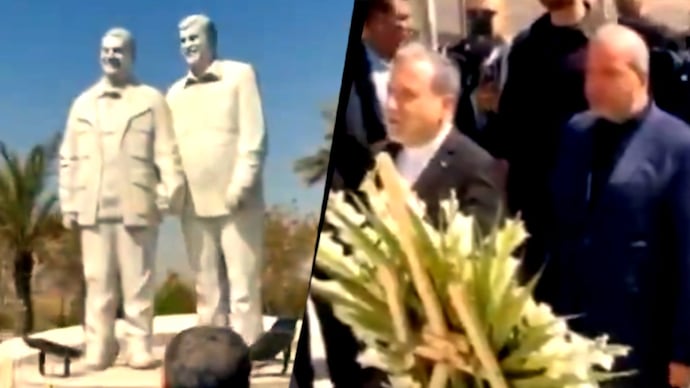

Iranian Foreign Minister Abbas Araghchi began his visit to Iraq on Sunday with a symbolic stop at the site where top Iranian commander Lieutenant General Qassem Soleimani and Iraqi militia leader Abu Mahdi al-Muhandis were killed in a US drone strike in 2020.
His visit comes at a sensitive time for the region. The US and Iran are trying to implement a recently signed memorandum of understanding (MoU) aimed at ending months of conflict, but fresh military exchanges involving US forces and Iran have raised concerns about the durability of the agreement.
Araghchi laid tribute at the memorial of Soleimani and al-Muhandis before holding official talks with Iraqi Foreign Minister Fuad Hussein in Baghdad.
The key focus on the agenda is planning funeral ceremonies for the late Iranian Supreme Leader Ayatollah Ali Khamenei in several Iraqi cities. Iran has announced that nationwide funeral ceremonies will begin in early July after they were postponed because of the war.
LEBANON, HORMUZ AMONG KEY ISSUES
Araghchi's visit comes just hours after he accused Israel of violating the US-Iran memorandum of understanding by continuing military operations in Lebanon.
He said the agreement required fighting to stop across all fronts, including Lebanon, and argued that Washington was responsible for ensuring Israel complied with the terms of the deal.
"It is the responsibility of the United States, in accordance with the commitments it accepted under the memorandum of understanding, to ensure that these attacks by the Israeli regime are brought to an end and to allow the cessation of the war to be fully implemented there as well, including the withdrawal from the occupied territories," Araghchi said.
The Iranian minister also warned against any attempt to challenge Tehran's control over the Strait of Hormuz, saying such moves would increase tensions and delay the full reopening of the strategic shipping route.
WHY WAS QASSEM SOLEIMANI KILLED
Soleimani, the longtime commander of the Islamic Revolutionary Guard Corps' Quds Force, was killed alongside al-Muhandis in a US drone strike near Baghdad International Airport in January 2020. The operation, ordered by US President Donald Trump, sharply escalated tensions between Washington and Tehran.
The Trump administration had said Soleimani had orchestrated attacks by Iran-backed militias against US forces in Iraq and was planning further "imminent" attacks on US diplomats and military personnel. The strike came days after a rocket attack on the K-1 airbase in Iraq killed an American contractor and after protesters linked to Iran-backed militias stormed the US embassy compound in Baghdad. Washington said the operation was intended to deter future attacks, while Iran condemned it as an act of "state terrorism", setting off one of the most serious escalations in US-Iran tensions in decades.
Earlier this month, Trump argued that the strike ultimately paved the way for the current diplomatic breakthrough with Iran.
"If I didn't kill General Soleimani, we probably wouldn't be talking right now about this deal," Trump said during a press conference at the G7 Summit.
"He was a mad genius. They were never able to replace him," he added.
Trump also defended the emerging agreement, saying it was the result of years of pressure rather than short-term negotiations. He argued that without the deal, military operations would likely have continued and the Strait of Hormuz would have remained closed.