Pakistan deploys troops to Saudi Arabia under Mecca pact to defend against Houthis

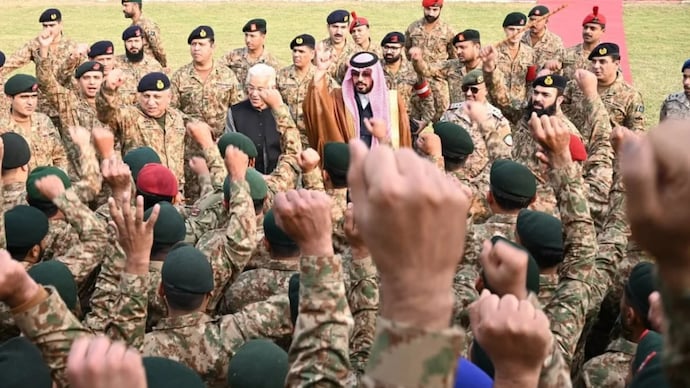
A send-off ceremony was held for Pakistani troops heading to Saudi Arabia, attended by Defence Minister Khawaja Muhammad Asif and Saudi Ambassador to Pakistan Rajeh Tami Albugamy. In its statement, Pakistan's military said the deployment was intended to strengthen the kingdom's ability to respond to emerging security threats.
 Last UpdatedNov 29, 2026 21:30 IST
 Published byWritten BySatyam Singh
Saudi Arabia's new mutual defence arrangement is beginning to take shape on the ground. Islamabad has announced the deployment of troops to the kingdom as Yemen's Houthi rebels step up attacks on strategic Saudi targets, putting the recently signed Mecca Joint Defence Agreement to an early test, which commits Pakistan, Saudi Arabia and Turkey to treating an armed attack against any one of them as an attack against all.
The deployment comes amid a renewed Houthi offensive against Saudi Arabia, with the rebels stepping up attacks on strategic infrastructure across the kingdom. Between Saturday and Sunday, the Saudi-led coalition reported intercepting multiple incoming missiles, while the Houthis claimed to have carried out five strikes on key Saudi installations, bringing the kingdom's energy, military and transport infrastructure into the crosshairs.
PAKISTAN SENDS TROOPS UNDER MECCA DEFENCE PACT
A send-off ceremony was held for Pakistani troops heading to Saudi Arabia, attended by Defence Minister Khawaja Muhammad Asif and Saudi Ambassador to Pakistan Rajeh Tami Albugamy. In its statement, Pakistan's military said the deployment was intended to strengthen the kingdom's ability to respond to emerging security threats.
"The military deployment reflects Pakistan's unwavering commitment to the security, sovereignty and territorial integrity of the Kingdom of Saudi Arabia," it said. The military also reaffirmed that "Pakistan remains steadfast in its commitment to safeguarding the Kingdom's security and the sanctity of Haramain Sharifain."
Islamabad has not officially disclosed the number of personnel being deployed or how long they will remain in Saudi Arabia. However, Al Jazeera's reported that the contingent comprised around 100 soldiers of various ranks from the Pakistan Army's Lahore Corps. Importantly, Pakistan has maintained that its forces will operate within Saudi territory, indicating that the deployment is focused on protecting the kingdom rather than launching ground operations against the Houthis in Yemen.
The Mecca Joint Defence Agreement, signed on August 7, provides the broader framework for this cooperation. Under the arrangement, an armed attack against one member is considered an attack against all three participating countries.
HOUTHIS CLAIM ATTACKS ON SAUDI AIRPORT, OIL FACILITIES
The troop deployment comes as the Houthis step up their attacks on Saudi Arabia, targeting infrastructure that is critical to the kingdom's economy and security. The rebels claimed they had carried out five attacks on Saudi installations, including King Khalid International Airport in Riyadh, radar facilities in Abha and Khamis Mushait, and energy infrastructure operated by Saudi Aramco.
The targets also included the Jazan refinery, the Hawiyah gas plant and the Al-Shuqaiq and Jazan power stations in southern Saudi Arabia.
Saudi authorities, meanwhile, reported intercepting several incoming missiles, including projectiles directed towards Riyadh and the Al-Shuqaiq power station. Emergency alerts were sent to residents in affected areas, advising them to take shelter. The Saudi-led coalition said debris from intercepted missiles had caused no civilian injuries.
The situation has also raised concerns over the safety of Saudi Arabia's energy infrastructure. On Thursday, a strike on the Jazan refinery killed a Nepalese worker and injured several others, temporarily disrupting some operations. The refinery has a processing capacity of 400,000 barrels per day.
The Saudi-led coalition announced what it described as "a military response operation" to destroy "vital" assets used by the Houthis to carry out attacks and threaten maritime navigation in the Red Sea and Bab el-Mandeb Strait. Its spokesperson said the coalition "will respond immediately to any further attacks, in accordance with international humanitarian law."
The escalation extended beyond Saudi territory on Sunday, when the coalition asked civilians to evacuate Ras Isa port in Yemen's Houthi-controlled Hodeidah province. The warning was followed by Houthi threats to target Saudi Red Sea ports, including Jeddah, in retaliation for what the rebels described as an attack on the fuel terminal. The coalition announced a military response but did not specifically confirm a strike on the port.
HOUTHIS WARN PAKISTAN, TURKEY AGAINST JOINING ALLIANCE
Pakistan's decision to strengthen Saudi Arabia's defences has also drawn a sharp reaction from the Houthis, who criticised Islamabad and Ankara for aligning themselves with Riyadh. Mohamed Ali al-Houthi, a member of the group's Supreme Political Council, accused Pakistan and Turkey of overlooking Saudi Arabia's role in the conflict in Yemen.
He said the two countries had ignored "the (Saudi) aggression, the blockade, the killings, and the ongoing crimes" in Yemen.
"Just as the previous coalition against our country ended in failure, any future coalition will likewise fail," he said, as quoted by Euro News.
WHY SAUDI ARABIA IS TURNING TO REGIONAL ALLIES
Saudi Arabia has been fighting the Houthis for more than a decade as part of Yemen's civil war. Riyadh backs the internationally recognised Yemeni government, while the rebels control Sanaa and several of the country's most populous areas.
The conflict began escalating again this summer, with the Houthis making territorial gains along Yemen's Red Sea coastline and intensifying attacks on Saudi targets. Their military activities have also increasingly affected maritime security around the Bab el-Mandeb Strait, which is a strategically important passage connecting the Red Sea to the Gulf of Aden.
The US-Iran war, which erupted in February, has increased pressure on Riyadh. Saudi Arabia has consequently sought greater military cooperation with regional partners, including Pakistan, Turkey, Egypt and Syria.
Egypt had announced military support for Saudi Arabia more than a month ago, with a regional official indicating that Cairo would provide air defence systems and aircraft to help counter incoming missiles and drones. The proposed assistance was not expected to include ground troops in Yemen.